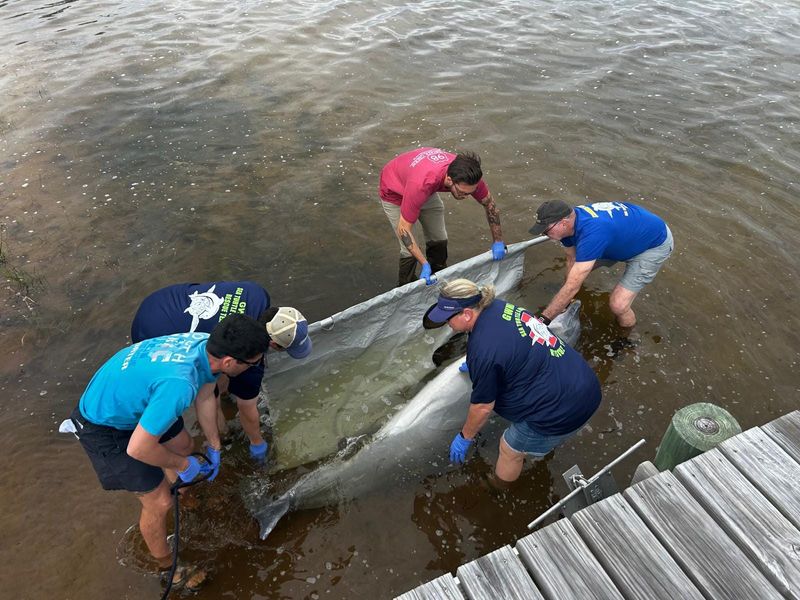
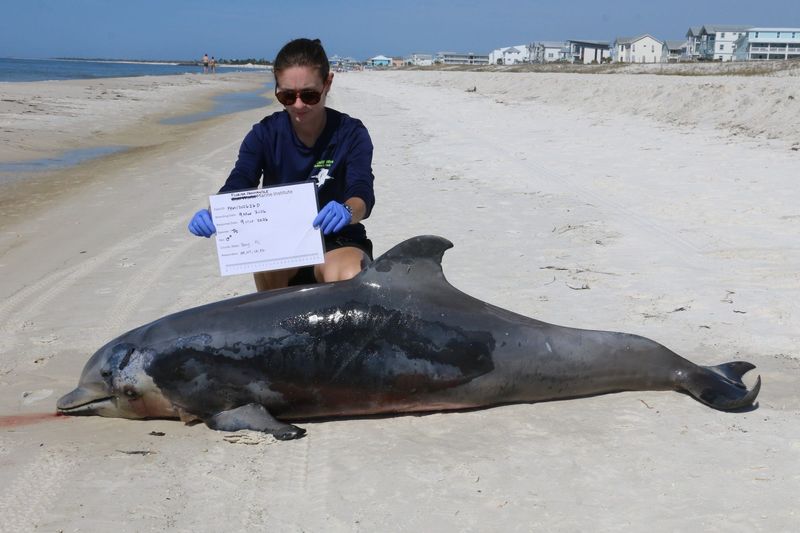
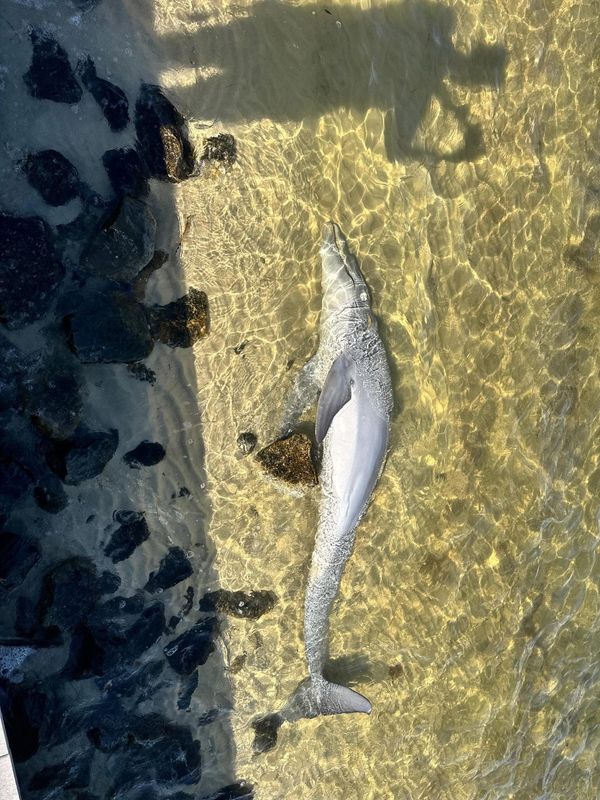
PANAMA CITY — New evidence for the cause of deaths in an unusual dolphin die-off in Gulf and Bay counties appears to point toward red tide.
A news release from the Florida Panhandle Marine Institute says that 25 bottlenose dolphins died in March, the majority of those in Bay and Gulf counties. Previous reporting by the News Herald found this number to be unusually high, citing statistics from the National Marine Fisheries Service.

At the time of last reporting on April 10, FPMI told the News Herald that the total death toll for dolphins in the panhandle since March had reached 47.
FPMI said that while it attempts to recover and investigate whenever a dead marine mammal is discovered, decomposition can cause key indicators in the potential cause of death to disappear. It said that 88% of the bottlenose dolphins recovered had already reached this point of decomposition.
Dauphin Island Sea Lab worked with FPMI to necropsy and sample tissues from some of the recovered dolphins.
“Many of those tissues have been sent off for analyses,” the release said. “Analyses are conducted by various external laboratories throughout the country, and results must be combined into a bigger picture for full understanding of mortality events.”
FPMI said that the efforts are being managed by NMFS.
They were able to analyze samples from seven animals for evidence of biotoxin exposure, six of which indicated very high levels of brevetoxin exposure. Brevetoxins are neurotoxins commonly produced by Karenia brevis, an algae commonly responsible for red tide.
“We are still awaiting the results from histopathology (tissues sectioned and examined by an expert under a microscope), to conclude our investigation into this mortality event,” the release said. “However, at this time our leading hypothesis is that it was caused by brevetoxin, or red tide.”
A stubborn red tide gripped St Joseph Bay in 2025, in what a Florida Fish and Wildlife Conservation Commission researcher described to WJHG as an anomaly.
A similar mortality event unfolded in 2004 with St Joseph Bay as the geographic epicenter. One hundred three dolphins reportedly died, and their primary cause of death was found to be brevetoxins. Dolphins are apex predators and can aggregate brevetoxins through the food web, causing delayed mortalities even after a red tide event ends.
To rule out other causes in the 2026 mortality event, FPMI also tested for common viral infections that affect dolphins in the Gulf. Tests for brucella, cetacean morbillivirus and highly pathogenic avian influenza all came back negative.
Pam George, president of FPMI, previously told the News Herald that the stranded dolphins are typically adults and have no visible signs of injury. Most of the strandings occurred on March 7.
Testing is ongoing, and FPMI said it will release more information as it becomes available. In the meantime, it’s asking the public to report stranded, sick or injured marine mammals or sea turtles.
Readers who find themselves in such a scenario can contact FWC at 888-404-3922 or the NOAA Fisheries Southeast Region at 877-942-5343.
A 1999 U.S. Geological Survey study found that the tidal range in St Joseph Bay was roughly 1 foot and 1.3 feet during sampling in 1997 and 1998. A separate 2022 study published in the Journal of the Coastal and Estuarine Research Federation describes St Joseph Bay as having restricted water circulation.
A fact sheet on the St. Joseph Bay Aquatic Preserve describes the bay as a coastal lagoon with minimal freshwater influence. These factors appear to point to the bay having relatively limited water exchange. In similar coastal systems, this condition can allow algal blooms, such as red tides, to persist for longer periods.
This article originally appeared on The News Herald: Bay, Gulf dolphin deaths appear to be tied to a remnant of red tide
Reporting by Dylan Gentile, Panama City News Herald / The News Herald
USA TODAY Network via Reuters Connect