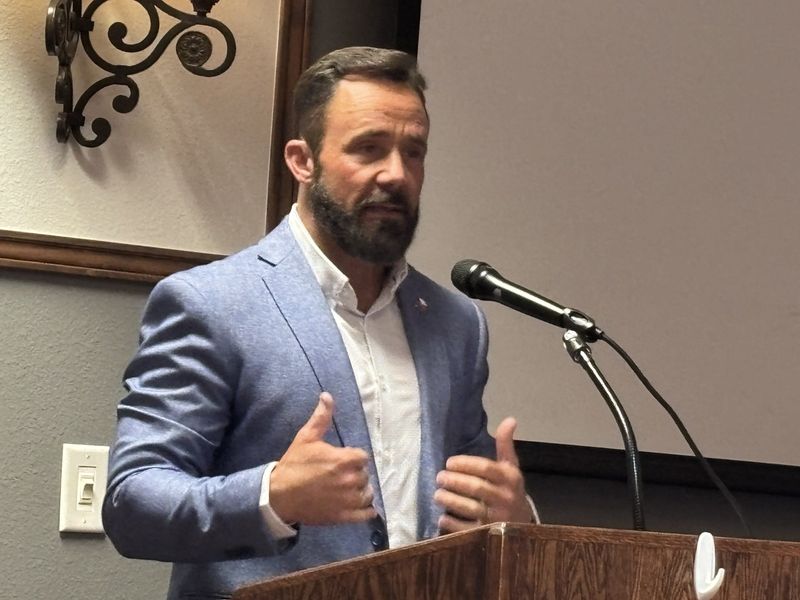
A dinner by the High Plains Republican Women was held at Abuelo’s Tuesday evening, May 5, at which Amarillo Mayor Cole Stanley spoke about the turnaround in the City of Amarillo and his views on the running of a city.
Several candidates for office also attended the event, along with others who wanted to listen and ask questions. The meeting was led by Holly Jeffreys, the group’s president and a state representative candidate, who introduced Mayor Stanley. He started with, “What I’d like to do with you here this evening — I could get up here and give you my political hoorah speech … or expound on my top three things in some esoteric way, and not really give you much meat.”

Stanley explained why he ran for office. “I was a complainer, and I went down to city hall building safety and finally decided if I’m going to spend 10 hours of every week down in building safety arguing, I’d instead try to fix it. Let’s find a way to get building projects through the city and get plans permitted easier.”
He said after he was elected, “We became a council of change and didn’t mind being agents of change. I would have loved to have been buddies with Ginger (Nelson, former mayor) and just come alongside and contribute several things that had to do with building safety as well as public safety and see Amarillo go on a smooth road, but as many of you guys know, being in the world of politics, that’s not always the way it works.”
Using the Amarillo Zoo & Sanctuary as an example
“I believe it’s more important to try and fix things and make them better than to be liked,” he said.
In one example, Stanley mentioned former councilmember Josh Craft, who made a connection with Stephanie Brady, executive director of Wild West Wildlife Rehabilitation Center, who told him that the zoo needed some help. “We didn’t deny it or try to push it back. We told her we agreed, and (asked) what can we do,” Stanley said. Craft launched a year-long operation of trying to structure it to bring in a non-profit.
“You now have Wild West Wildlife Center and the Zoo Sanctuary pulling together,” Stanley said. “We have so many people out there at the zoo that are cleaning and volunteering and doing such a great job.” He admitted that if he would have asked people to come out and do the job volunteers are doing, it wouldn’t have worked the way it’s working now.
He explained that when the city is faced with questions such as, is public safety more important than a bear sanctuary, then it becomes a battle. “We really have to deal with paying our police officers and retaining and putting money into fleeting vehicles,” he continued.
“So, you’re forced to make choices,” he said. “Then you face the Facebook frenzy of ‘How did you let it get so bad?’”
Stanley listens to concerns about Fermi, and water
Stanley said that Mike Ford, a vocal critic of Fermi America, was coming into town to give an update on Fermi, the proposed new massive A.I. data center project under construction near the city. Stanley said while he didn’t have anything to do with Fermi coming, “The thing I like about Fermi, if they ever make it, is that they make power.”
Stanley told the group that he was concerned with the water situation, long term. “I don’t think we should be using water to grow corn and turn it into ethanol if we can just make gasoline. If we’re talking about water conservation, let’s talk about water conservation,” he said. “Me telling you not to let your sprinkler spray the sidewalk is not going to offset a trillion gallons of pumpage here in the upper 26 counties. You realize a trillion gallons is pumped out of that aquifer in the upper 26 counties where 95% is in farm-ranching agriculture.”
He said on the council’s vote to sell water to Fermi, “I have no affiliation other than I am a welcome sergeant. I want to welcome everybody to the City of Amarillo, so yes, when you’re bringing businesses in, I’m trying to welcome them, but it’s important for you all to hear.”
Updating financial policy for the greatest change
Stanley said they have studied and asked what they could do to update the city’s financial policy, which would bring about the greatest change they could see for Amarillo.
“You realize one of the most important things that we do is manage a $550 million budget. That is a lot of money to either do great things with or squander and have poor services,” he said, “and not really get to what you need — and all that comes down to your budget. I have drug council through budget workshops that were seven days long because if we didn’t have the right data to make the best decisions, we couldn’t tell what our actual budget was because everything was grouped together.”
Stanley talked about the general fund, water and sewer and all the different departments they fund. He said they netted about a $20 million increase in water and sewer enterprise, which is a good thing mainly because they can now get to the mainline extensions and repairs of things they’re doing.
The mayor said that they have an internal auditor doing great work and a new incoming CFO, and they were are going to amend the budget so that they will have their actuals recognized, which could lead to having more money to use for capital projects. He said that before, the staff would just move money back and forth throughout departments to balance out those under budget and those over budget.
“We put in the financial policy that only within the direct department can those directors, at the city manager’s authority, move monies around,” he said. He explained that they’re not getting it down to every screw and bolt, but within the departments, they can move their money while being held accountable.
Stanley said that total revenues over their total expenditures netted roughly a $14 million savings for the city in FY 2024. “So, that means we pull that full $14 million into our next budget cycle. Plus, we are tracking now at a 10% increase from what our expectations and our budget were for our sales tax revenues. So, that could be another $8 million right there,” Stanley said. “It’s my job to communicate that so the public knows we’ve got money to pay for these core services.”
Stanley said that he was not trying to run for office again. “My intentions are to finish well. I want to say, ‘Coach, I left it all on the field — I didn’t even take a pace — I just kept plowing through it and now it’s time … as a public servant to get out of the way and go do that next thing the Lord has for me to do.”
Finding unity in family, cowboy culture
“You cannot find unity in politics and performances,” Stanley said. “You can only find unity in families, and if we come together for our cowboy culture and we believe in values represented here, we can find unity.”
He stated that for him to be a good leader, he had to care more about the public’s needs than his own. “I may be tired, but you need help with that water issue, right? So, let me work for you.”
Addressing the gun violence and recent shooting
Stanley urged people to stop being so quiet and polite and letting it work through the social media so much. He also said to take the theory and instill it into youth.
“We had a mass shooting and we have two innocent youths who were killed,” Stanley said, noting that a pastor in town then said, “we have to do something. I don’t know what, but we have got to do something.”
“I said, ‘No, we don’t have to do something, but we’ve got to do the right thing,’ but what do we look at?” Stanley brought up the fact that teen curfews are now not a choice since the State Legislature passed a law that made them illegal.
The pastor mentioned the gun buyback program, but Stanley said that he didn’t think that idea would work with this community. “The real problem is that we’re fighting an uphill battle because we’re losing the families,” he said. “If you have a single mom with kids, you’ve got to have a village of people around a single mom that can love her and support her and help her raise her kids.”
“We are the most connected society we’ve ever been, but we don’t know each other’s names and we never walk outside,” he concluded. “We go in our garage, close the door and don’t engage or mentor.”
Stanley said that the public needed to fight for the servanthood mentality to help the lady on the side of the road with a flat tire. “We’ve got to be the first person to shake a homeless person’s hand, but not just give them cash, but look them in the eye, not past them, and say, ‘What can I really do to help you? I’m not giving you cash, but I’ll buy food or give you my work gloves.’”
“There are so many opportunities, and you guys are the answer,” he said.
Stanley mentioned volunteers’ efforts, along with the work that Teresa Kennedy was doing in the Barrio. “She’s a worker over there and getting that little park going along with other projects.”
The mayor said that he loved the fact that he had been downtown for five years and he’s learned one thing — that he alone is not the answer.
When Stanley was taking questions from the group, one of the participants said that he had left him a message about the street sweepers and had not heard back. Stanley apologized and said he had sent the message to the city manager and said that he would check on it.
This article originally appeared on Amarillo Globe-News: Mayor Stanley talks city finances, water concerns, community unity
Reporting by Nell Williams, Amarillo Globe-News / Amarillo Globe-News
USA TODAY Network via Reuters Connect