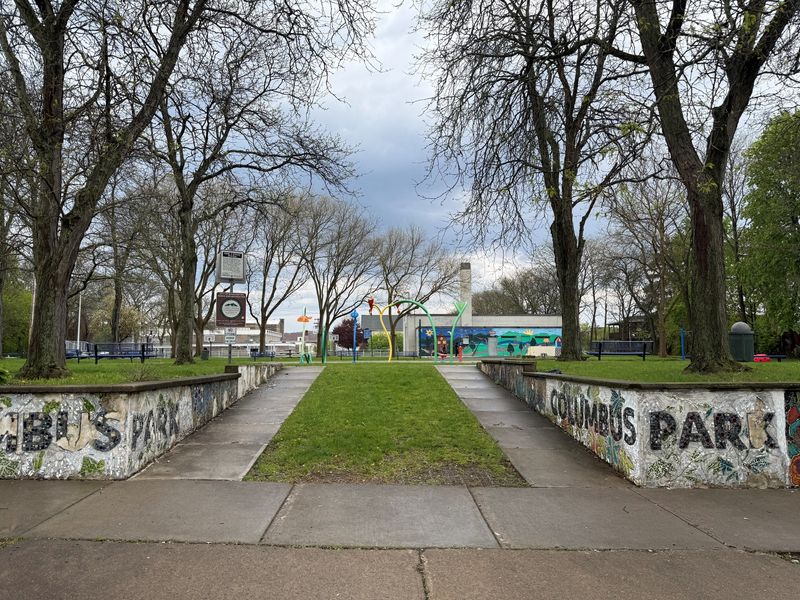
The recent Columbus Park name switch to Center City Park marks one step forward in a larger effort to invest in the downtown Binghamton neighborhood surrounding it. The “Reimagining Center City” campaign is a promise to let local residents drive those decisions, a theme also being explored by New York’s Community Commission on Reparations Remedies and outlined at a recent local hearing.
The goal of the “Reimagining Center City” campaign is to go into the community and speak directly with current residents about what they would like their neighborhood to look like.

Participants include the Astor D. Rice Foundation, VINES, Sons of Italy, the Binghamton School District, Broome County Public Library, Broome County Urban League, Broome County NAACP, and Trinity AME Zion Church.
Residents in Center City already received a knock on the door in early April from members of VINES and the Astor D. Rice Foundation to learn about local programming.
Organizers for the campaign are now focused on identifying funding opportunities, making community connections, and student involvement.
In a May 5 email statement, Binghamton City Councilwoman Rebecca Rathmell mentioned exploring heritage grants and other local approaches to “identify and advance historical markers and/or maps” in the park and around Center City.
The campaign will run until June, then the information collected over recent months will be compiled into a public presentation in July.
How NYS is discussing reparations, statewide and locally
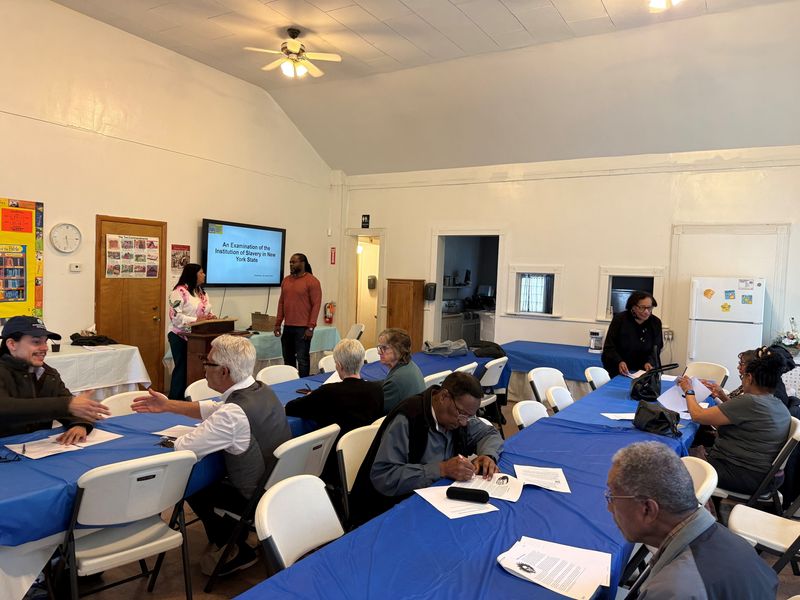
The New York State Community Commission on Reparations Remedies held a public hearing at Trinity AME Zion Church in Binghamton on April 28 as part of their upstate tour to discuss the history of slavery in New York and gather information about what residents would like reparations to look like.
The NYSCCRR is a commission that is made up of nine branches, which was established in 2023 by New York Gov. Kathy Hochul.
The presentation touched on redlining, the systematic structure of slavery which can be seen in the modern-day housing market, the New York City Draft Riot in 1863, and the assimilation programs that were in place for immigrants but denied to Africans.
Brenda Brown, 78, of Endwell, was one of the dozen people in attendance who came out of curiosity to try to encourage the younger generation to learn about Black history in the state. Brown previously worked as a social worker before starting a private practice and now volunteers at the Association for Vision Rehabilitation and Employment.
“Young people don’t have that understanding, and we have to work with them,” Brown said.
One of the topics covered was Seneca Valley, a booming Black community in the heart of New York City that through eminent domain was converted into what is now Central Park.
Rev. Damond Wilson, pastor at Trinity AME Zion Church, compared that to the history of Center City Park and the surrounding area.
“We are in the process of making sure something like that never happens again here in Binghamton, Broome County.” Wilson said at the end of the NYSCCRR meeting.
Five forms of reparations and the next steps for the Commission
According to the UN Basic Principles, there are five different forms of reparations which include restitution, rehabilitation, compensation, satisfaction, and guarantees of non-repetition.
When asked how important it is for residents to connect systemic racism to their everyday lived experience, Hayden Frederick-Clarke, public education coordinator for the NYSCCRR, said it is “imperative” for people to understand how society was “formulated and formed.”
So far in the first part of the commission’s tour, Clarke has found that residents who are of African descent “regardless of ethnicity and national origin” are concerned that the public hearings are just another conversation with no tangible solution.
Clarke’s colleague Mabel Acosta, who led the presentation, said, “This is a complex issue but the core idea is simple. When harm is created by systems, repair must also happen through systems.”
Binghamton was just one stop of many on the tour, which is expected to end in June — there is the possibility of an extension if needed.
At the tour’s conclusion, the suggestions and insights from each informational session will be collected into a report and submitted to the Commission. Participants took two surveys during the workshop, an entry and an exit survey.
The entry survey asked basic questions about identity for the commission to have an idea of who they are interacting with during the presentations while also getting a sense of thinking patterns.
The exit survey acted as a general review of the workshop and an opportunity for participants to share their thoughts on reparations in New York and how the commission can make it a better experience.
Wilson felt that the first Black church in Binghamton seemed like a fitting arrangement for the NYSCCRR to hold a discussion about reparation efforts. “Having an event talking about how do we reinvest in areas that have been deprived previously, it’s definitely something this community needs to hear.”
The history of Trinity AME Zion Church is all about “giving people freedom, returning their dignity and letting them know they are people of worth and value,” Wilson said.
To learn more about the NYSCCRR visit ny.gov. Presentation packages will also be made available to the public on the website.
Opportunities to learn about local history
“Before the Bulldozers: The Untold Story of Susquehanna Street”
VINES is partnering with local citizen historian Brenda Cave to host a two-part presentation about the history and impact of urbanization projects on the lives of Susquehanna Street residents.
The event is free and open to the public but a $5-$10 donation is suggested.
Visit vinesgardens.org under the “Events” section to register for the presentation.
Clio: Historical site map
Broome County Historian Roger Luther shared the website with City Council members that maps out areas of historical significance.
Kalyn Grant reports on public service issues for the Press & Sun-Bulletin, focusing on schools and community impact. Have a story to share? Follow her on Instagram @KalynCarmen and on Facebook under Kalyn Kearney. Get in touch at KCGrant@usatodayco.com
This article originally appeared on Binghamton Press & Sun-Bulletin: Center City investment ties into broader NY reparations plan
Reporting by Kalyn Grant, Binghamton Press & Sun Bulletin / Binghamton Press & Sun-Bulletin
USA TODAY Network via Reuters Connect