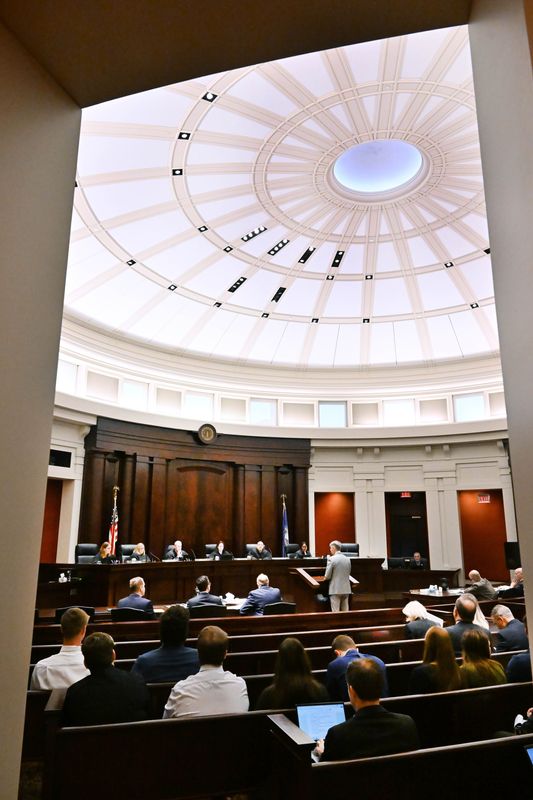
Lansing — The Michigan House and Senate have continued their battle over the fate of nine bills from 2024 that the House refuses to send to Gov. Gretchen Whitmer, bringing the historic legislative squabble to the Michigan Supreme Court lectern.
In arguments before the high court on Wednesday, an attorney for House Republicans argued the current Legislature had no duty to send the bills to the governor in January 2025 after the Democratic lawmakers who passed them in 2024 failed to send them to the governor.

An attorney for Senate Democrats argued the House’s failure to present those bills breached the chamber’s constitutional duties and threatened the checks and balances on which state government relies.
“If the House’s anti-majoritarian tactic is allowed to succeed, it will unilaterally and drastically change Michigan’s bicameral Legislature, its separation of powers, our checks and balances, and the majoritarian principle which underlies everything we do in state and local government,” said Mark Brewer, an attorney for the Senate.
Kyle Asher, an attorney representing the House, argued a ruling requiring the House to send the bills more than a year after they were passed would create a snarl of implementation problems and infringe on the separation of powers between the Legislature and judiciary.
“I don’t think we’re really asking for anything drastic here,” Asher said. “Requiring one Legislature to present its own bills, if that’s the line that this court ends up drawing, is a really simple line to be administered going forward. But issuing retroactive relief at this time to resurrect bills that, in our position, have lapsed, I think that is very drastic relief.”
The high court will rule in the coming months on whether the House’s refusal passes constitutional muster and, if not, whether the court has the authority to set a timeline for the bills to be sent to Whitmer’s desk.
The suit filed by the Senate marks the first time in roughly 200 years that a legislative chamber has asked the judicial branch to resolve a purely legislative dispute, House attorneys have maintained.
The case dates back to January 2025, when the Michigan House, after coming under Republican control in the 103rd Legislature, refused to send the legislation passed by the Democratic majority in 2024 under the 102nd Legislature to Whitmer for her signature.
The Senate sued over the House’s refusal, and so far, both the Court of Claims and the Court of Appeals have concluded the bills must be sent to the governor. The House has appealed those rulings.
The legislation at stake in the case would allow the Charles H. Wright Museum of African American History and Detroit Historical Museum to seek a property tax millage in Wayne, Oakland and Macomb counties; greatly increase government units’ contributions toward state employee health care costs; allow corrections officers to join the Michigan State Police’s hybrid pension plan; and alter rules related to debt collection.
Justices asked attorneys Wednesday about the usual process used when it comes to presentation of passed bills to the governor, as well as the prospect of a court issuing a timeline for presentation to the governor — an order the Court of Claims stopped short of issuing in light of the separation of powers between the branches of government.
Justice Kimberly Thomas noted it would not be unusual for a court to order the Michigan Department of Health and Human Services, which is under the executive branch, to remedy some constitutional ill if one existed.
“How is this different from that situation?” Thomas asked.
Asher noted that DHHS was under the executive branch, but not the executive branch itself. An order for the Legislature to present the bills, he argued, would encompass the entire branch and relegate it from a coequal branch to one inferior to the judiciary.
“We’re not coming here today to thumb our nose at the courts and that hasn’t been our position in this entire case,” Asher said. “We’re here with the genuine belief that we’re right on the merits and the 103rd House lacks a clear legal duty to present the 102nd Legislature’s leftover bills; and, had the 103rd done so, that act itself would have violated the constitution.”
Brewer dismissed the House’s concerns about the separation of powers, arguing that they were the first to violate the principle by refusing to send the executive branch bills that had been appropriately passed by majorities in both chambers.
“I think it, frankly, takes a lot of chutzpah for the House to come here today and say to the courts, ‘Don’t interfere in the legislative process,'” Brewer said. “That is exactly what the House has done. They are the guilty party here. We are asking the court for a remedy to restore the status quo and to restore the historical practice and to restore the historical understanding of what the Michigan Constitution said.”
eleblanc@detroitnews.com
This article originally appeared on The Detroit News: Court weighs Legislature’s battle over bills that never got to Whitmer
Reporting by Beth LeBlanc, The Detroit News / The Detroit News
USA TODAY Network via Reuters Connect