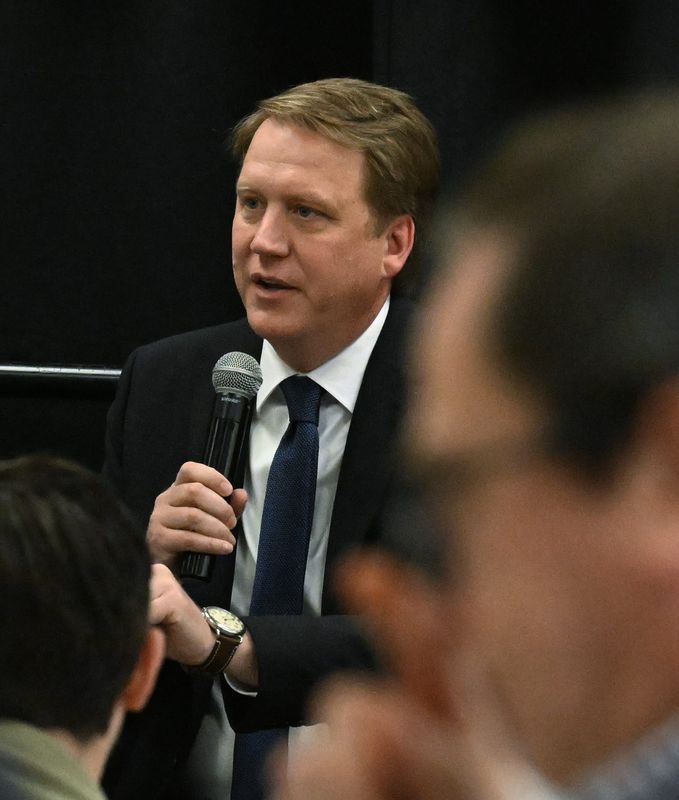
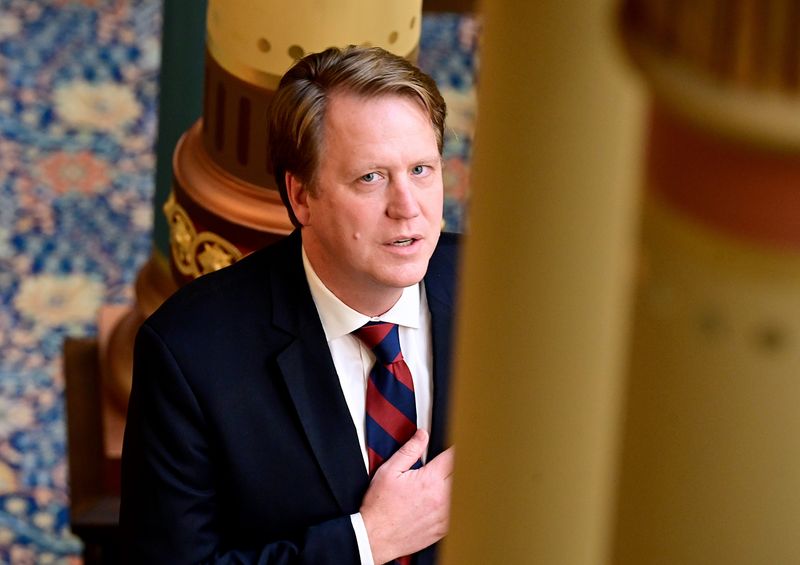
There was a time not so long ago when Sen. Aric Nesbitt was the future of the Michigan Republican Party.
The 46-year-old Senate minority leader had what should have been the ideal launchpad for a gubernatorial bid. To many, Nesbitt looked like the second coming of Former Michigan Gov. John Engler.

Engler, then the 42-year-old Senate majority leader, spent years before his successful 1990 gubernatorial run traversing Michigan, rebuilding county parties, cultivating local leaders and assembling the organizational muscle necessary to defeat Democratic Gov. James Blanchard’s attempt for a third term. At the time, the party was struggling for an identity in the aftermath of ideological and social conservatives supplanting the milquetoast establishment that had dominated the party for 20 years under Govs. George Romney and Bill Milliken.
Nesbitt had an opening to become the party’s standard-bearer. He failed to seize it.
His public profile as Michigan’s top-ranking Republican was eclipsed after Rep. Matt Hall, R-Richland Twp., became speaker of the House following the 2024 election. The gubernatorial campaign Nesbitt subsequently launched has since become a quixotic exercise, marked by stagnation and polling that has consistently kept him mired in the low single digits. At this stage, his path to the nomination is implausible.
Hall’s rise underscores what Nesbitt missed: leadership positions only matter if they are leveraged effectively.
Engler understood this. So did then-Senate Majority Leader Dick Posthumus, who, while running as Engler’s lieutenant governor in 1998, delegated day-to-day caucus duties.
Engler understood this. So did then-Senate Majority Leader Dick Posthumus, who, while running as Engler’s lieutenant governor in 1998, delegated day-to-day caucus duties.
Nesbitt has done no such thing.
The result is a caucus that looks rudderless.
Senate Republicans were once the nation’s premier state-level Republican political apparatus. Only the national party committees were better organized and better funded. They were disciplined, professional and deeply strategic, producing ranks of formidable political talent. Unfortunately, many of those seasoned operatives have either retired or been pushed outside the tent in the Trump era.
It certainly did not help the optics of Nesbitt’s candidacy when one of his top staffers was caught doing political work for a gubernatorial rival. That embarrassing episode only reinforced perceptions of dysfunction and a leader losing control of his own operation.
A special election loss on May 5, in the 35th Senate District, centered on Bay City, Midland and Saginaw, is more than a disappointing defeat. It’s a major political blow to Nesbitt, who spent months pressing for the election, only for Republicans to falter when they failed to recruit Rep. Bill Schuette, R-Midland, or another A-lister as their candidate.
Nesbitt now faces an unavoidable choice: either step down as leader and devote his full attention to his faltering gubernatorial bid or abandon the race and recommit himself to the Senate Republicans.
If he refuses, senators should take matters into their own hands by ousting Nesbitt and installing new leadership — either for the remainder of 2026 or by ending the distracting contest between Sens. Roger Hauck and Michael Webber over who will lead next term. At a moment when Republicans should be singularly focused on reclaiming the majority, an internal battle is an unnecessary and self-defeating distraction.
This cycle is not beyond saving. Republicans could still regain the majority. But doing so requires leadership.
The question is no longer whether Nesbitt can become the Republican gubernatorial nominee, let alone the next governor. It is whether he is willing to put his party’s future ahead of his own.
Dennis Lennox is a Republican political commentator and public affairs consultant. Follow @dennislennox on X.
Clarification: Nesbitt does not run day-to-day operations for the Senate Republican Campaign Committee.
This article originally appeared on The Detroit News: Aric Nesbitt’s dual roles are costing Michigan Republicans | Opinion
Reporting by Dennis Lennox / The Detroit News
USA TODAY Network via Reuters Connect