Researchers with the Voyageurs Wolf Project made a historic finding this spring on a different species of large carnivore – they captured the first modern-era evidence of cougar reproduction in Minnesota.

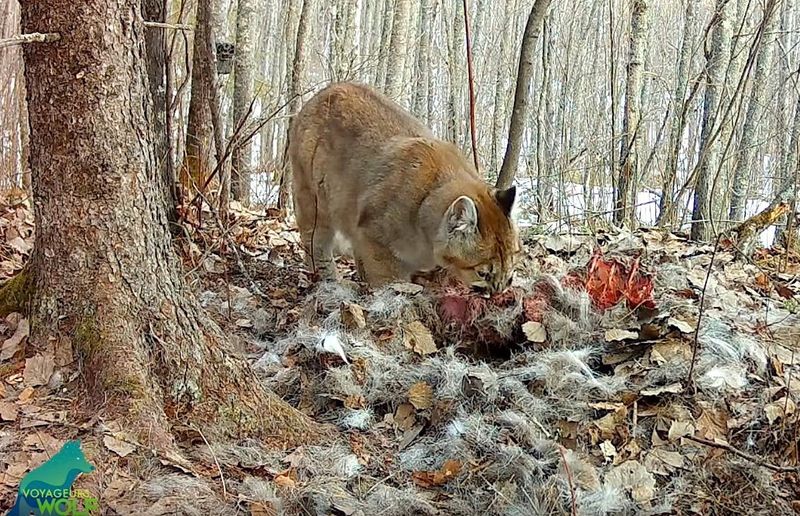
As part of its study on white-tailed deer survival and mortality in northern Minnesota, on March 25, 2026 VWP staff placed trail cameras near a deer that had recently been killed and covered with leaves.
The “caching” behavior is common among large wildcats, which come back to feed at the site. The researchers were able to find the deer carcass via signals from a GPS collar they placed on the animal in January.
The researchers suspected the kill was made by a bobcat, the most common large feline in the region, but also knew there was a chance it was from a cougar, said Thomas Gable, VWP leader.
To find out VWP staff placed two trail cameras at the site.
It was soon evident what species had made the kill. And the researchers made a huge finding in the process.
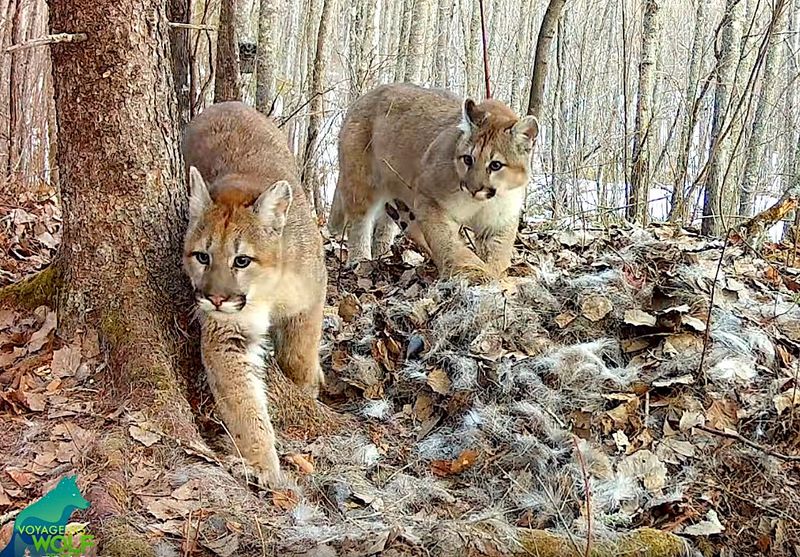
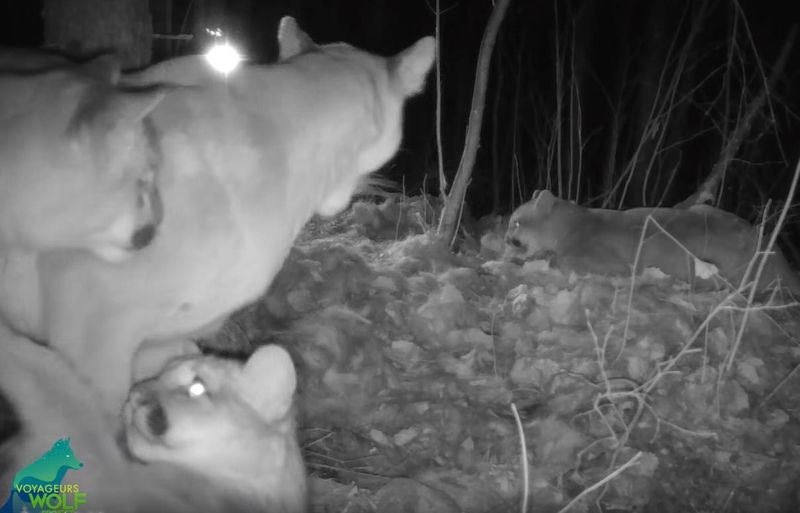
Within hours after setting up the cameras, four cougars – an adult female and three kittens – were captured on video at the kill site.
“The entire family showed up that evening and spent hours in front of our cameras,” Gable said. “Without a doubt, our best trail camera capture yet.”
Cougars were native to Minnesota but were extirpated, or wiped out, of the state in the 1800s, according to the Minnesota Department of Natural Resources.
The species’ fate began to improve in the mid- to late 1900s as bounties ended and more protective regulations were enacted in western states that still had cougars. In time cougars began to increase in number and expand in range.
From the late 1900s through this year individual cougars were observed, often through trail cam images, in Minnesota. The Minnesota DNR reported about 180 detections of suspected wild cougars in the state since 2004.
However, all previous evidence showed lone cougars or animals dispersing into Minnesota from a large source population in Nebraska, South Dakota and North Dakota. And nothing proved the species was reproducing in the Gopher State.
Until now.
“Looking at the footage was and still is surreal,” Gable said in a Minnesota DNR press release. “We never anticipated seeing four cougars together in northern Minnesota.”
The Minnesota DNR estimated the three kittens are between 7 and 9 months old.
It’s the second confirmation of cougar reproduction in the Upper Midwest in as many years. In March 2025 the Michigan DNR verified reports of wild cougar kittens in the Upper Peninsula.
Cougar reproduction in Wisconsin could be next
The findings leave Wisconsin as the next likely state in the species gradual recolonization of its former range.
Cougars were native to Wisconsin but extirpated from the state by the early 1900s, mostly through unregulated hunting.
In recent years cougar sightings, mostly via trail cameras, have become fairly common in Wisconsin. The Wisconsin DNR tallied about 120 confirmed or probable cougar sightings from January 2017 through January 2024.
On Feb. 9, 2026 a cougar was found dead on railroad tracks in Adams County.
However, all evidence in Wisconsin, when found, has been only from male cougars and there’s been no sign of wild kittens. But Randy Johnson, large carnivore specialist for the Wisconsin DNR, said it’s likely a matter of when, not if, cougars begin reproducing in the Badger State.
“We’re keeping our eyes peeled just like everybody else,” Johnson said in an April 30 phone interview. “And I have a feeling the finding will pop up suddenly just like it did in Michigan and Minnesota.”
Cougars are a protected species in Michigan, Minnesota and Wisconsin.
Wolf Project cameras have captured plenty of firsts
Voyageurs Wolf Project was founded in 2015 with the goal of researching wolves in summer, but it encompasses much more, including wolf predation behavior, number of pups born, where they make their dens and impacts on prey species.
As part of its work VWP staff has deployed hundreds of trail cameras in the Greater Voyager Ecosystem of northern Minnesota. The research has documented several firsts, including wolves fishing for suckers and eating blueberries.
Since 2023 its cameras had detected eight lone cougars and dozens of bobcats, not to mention other species.
But the images captured March 25 of the cougars were extraordinary in all regards. The VWP cameras collected 7.3 hours of footage of the cougars, Gable said.
The video includes fascinating scenes of cougar behavior, including the mother grooming her kittens, the kittens growling and hissing at each other, a kitten feeding on the deer carcass and the adult vocalizing.
“We feel incredibly fortunate we were able to capture such a wild moment in such detail,” Gable said.
The VWP released a couple minutes of video highlights April 30. Gable said more footage will be shared soon on the VWP Facebook page.
The cougar with kittens represents the first resident, reproducing female recorded in Minnesota in modern times but a “single family group does not by itself establish a self-sustaining breeding population,” the Minnesota DNR said in a statement.
The agency said it will continue to monitor cougar occurrences statewide and potentially track this specific family group with the Voyageurs Wolf Project.
This article originally appeared on Milwaukee Journal Sentinel: Finding of wild cougar kittens is first in Minnesota in modern era
Reporting by Paul A. Smith, Milwaukee Journal Sentinel / Milwaukee Journal Sentinel
USA TODAY Network via Reuters Connect