On Easter morning in 1920 or 1921, my grandmother Wilma fell into the privy vault of her family’s outhouse.

Grandma lived with her parents and brother on South Jefferson Street in Congerville, the gas boom-era suburb built on Muncie’s south side in the 1890s.
Like most late 19th- and early 20th-century neighborhoods, Congerville had no sewers. Many homes instead relied on cesspools or outhouses, small yard closets built over a hole in the ground called a privy vault.
Just before the fateful incident, my great-grandmother Dillie dressed little Wilma, then 4 or 5, in a white frock and matching patent leather shoes.
On the way to the car for church, Wilma stopped to use the outhouse.
Once inside, she spotted a bird’s nest up in the corner. A curious child, she stood on the seat to inspect, but she lost her footing and fell into the filthy vault, ruining her Sunday best. Grandma said it was the only time she ever saw her mother angry.
Even if you kept your footing, outhouses were still foul places, especially in summer. In cold weather or at night, people used a chamber pot. Come morning, it was dumped either into a cesspool or an outhouse privy vault. If all that sounds gross, that’s because it was.
Like most municipalities, sanitation was generally bad in Muncie between the 1870s and 1930s. Surface drainage was also neglected and poorly understood. Open storm sewers routinely clogged and caused flooding during heavy rains. Outhouses just added to the nastiness. If we could travel back in time to, say, 1900 Muncie, we’d be overwhelmed by the smell.
The problem was recognized from the beginning. Local boosters, city council and a few prominent businessmen began pushing for sewers in the late 1870s. Muncie’s post-Civil War growth in homes and commercial buildings brought on a sanitation crisis.
In 1879, the city council, in partnership with Delaware County’s commissioners, moved forward with Muncie’s first underground sewer, officially named the High Street Sewer. Its construction was controversial. Naysayers dubbed it: “Cloaca Magna” and the “Great Municipal Pizrectum.”
Construction began in April 1879. The sewer ran south along High Street from the White River to Jackson Street. It was essentially a massive pipe set in an enclosed tunnel made of brick and mortar.
At Washington Street, the sewer turned radically east and looped under the courthouse square. The plan was to drain large privy vaults beneath public outhouses, which often overflowed during crowded trials. One observer called them a “stench factory in the courthouse yard.”
In 1967, when the current County Building was under construction, workers unearthed the sewer line and old vaults while digging out the foundation. Munsonians had long forgotten that the sewer ran beneath the square. Construction was delayed until it was rerouted and the vaults filled.
The original High Street Sewer was completed in October 1879. Over the next few years, the city added combined sanitary and storm sewers under Gilbert and Jackson streets. Property owners connected at their own expense.
Public debates continued during construction, mostly over taxes. The anti-sewer folks kept asking why city money should go to drain private outhouses and cesspools. Other Munsonians pointed to the town square stench factory and insisted sanitation was a public duty.
Muncie’s early 1880s newspapers often printed editorials for and against sewers. In 1882, the debate played out in a battle of essays between James Boyce, a Scottish-American industrialist and Dr. Henry Winans of the city’s board of health.
Before you jump to any conclusions, Dr. Winans, the city’s chief health officer, opposed the sewers, while pro-infrastructure Boyce pushed for a vast network.
In May, Boyce wrote in the Morning News: “A systematic perforation of the city with adequate tiling would do much for the health and comfort of our people” and help “eradicate the grim monster from beneath our dwellings, bedrooms and business houses.”
Winans responded a few days later, arguing: “The city is no more bound in law or equity to remove the water and filth from a private cellar than to remove the excrement from a private vault.”
Boyce and his allies carried the day, and the city began building a sewer system in the mid-1880s. In one final 1884 prophetic retort, Dr. Winans penned an op-ed warning that combining stormwater and waste drainage would prove disastrous in the future, a “unique sanitary monstrosity.”
The High Street Sewer drained into the old mill race, not the river. The race was a water channel cut around 1830, designed to power mills on what was then Muncie’s north side. It ran along present-day Race and Wysor streets and turned the wheel at Wysor and Hibbits flour mill, where Star Bank is today.
The mill converted to steam sometime after the Civil War, and by the 1890s, the old race had become an open sewer. When water was high, it carried the filth from the Gilbert and High Street sewers into the river near the High Street Bridge. In dry summer months, sewage sat stagnant in the race.
After repeated complaints, the city bricked over the mill race at High Street into its own sewer in 1899. The rest was filled with dirt taken from a city-wide street grading project.
Muncie expanded its sewers into the suburbs during the early 20th century. They all dumped directly into Buck Creek or the White River. After the High Street Dam was built in 1910, raw sewage pooled behind until enough rain fell to push the filthy water downstream into Yorktown.
Storm ditches like Democratic Run were enclosed in underground sewer pipes. The Democratic Run was a natural creek that evolved into an open storm sewer. It flowed from what is now Commonway Church on Mulberry Street south to the Big Four (CSX) tracks, then west to Beech Grove Cemetery before emptying into the river.
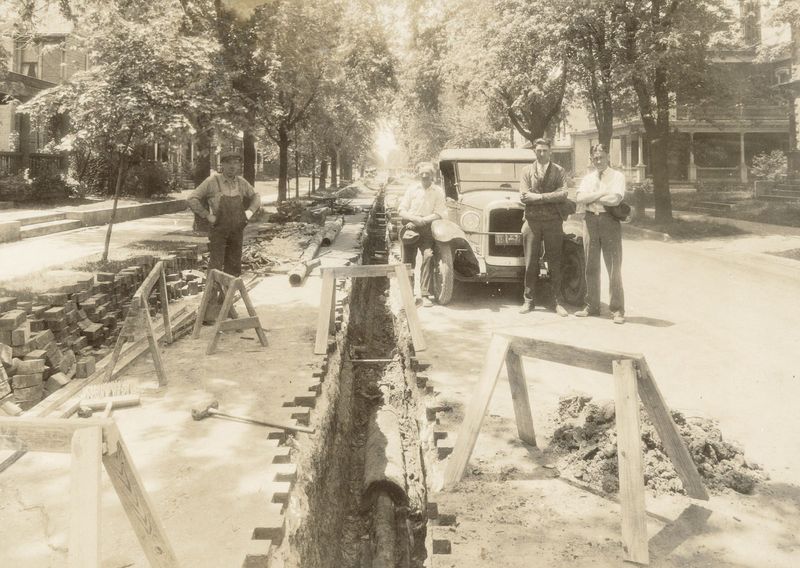
In Congerville, residents petitioned for a sewer not long after Grandma fell in her outhouse. Construction on the new line began in 1924. Congerville Sewer was completed a year later and drained into Buck Creek at Shedtown.
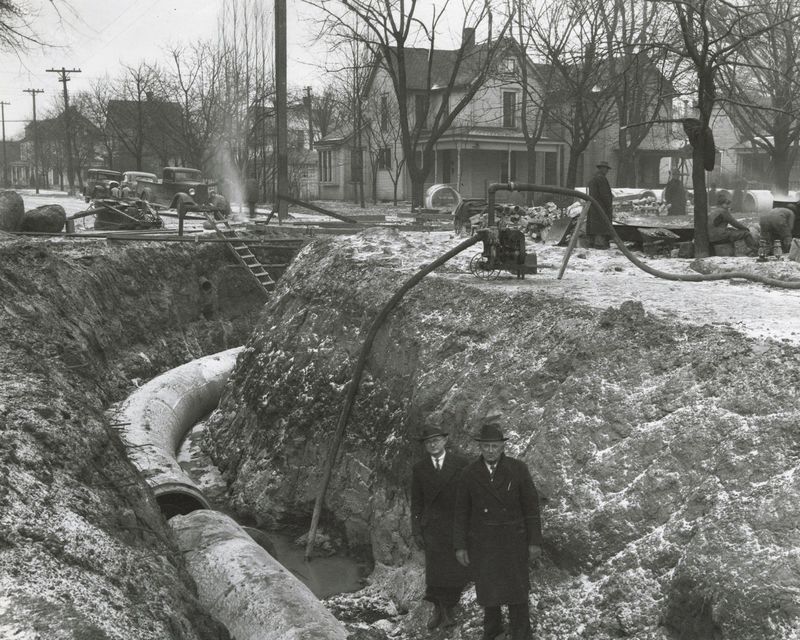
In the 1930s, Works Progress Administration workers built an interceptor sewer linking the main lines. It was connected in 1941 to the new Water Pollution Control Facility west of town. Then in 1968, the city established the Muncie Sanitary District, a separate government tasked with managing Greater Muncie’s sanitation.
In recent years, the MSD has modified the system into separate stormwater and sanitary sewers. The project should be completed within the next decade, finally eliminating the “sanitary monstrosity” that Dr. Henry Winans warned us about so long ago.
Chris Flook is a Delaware County Historical Society historian and senior lecturer of media at Ball State University.
This article originally appeared on Lafayette Journal & Courier: ByGone Muncie: The ‘Great Municipal Pizrectum’ and other sanitary tales
Reporting by Chris Flook, Muncie Star Press / Lafayette Journal & Courier
USA TODAY Network via Reuters Connect