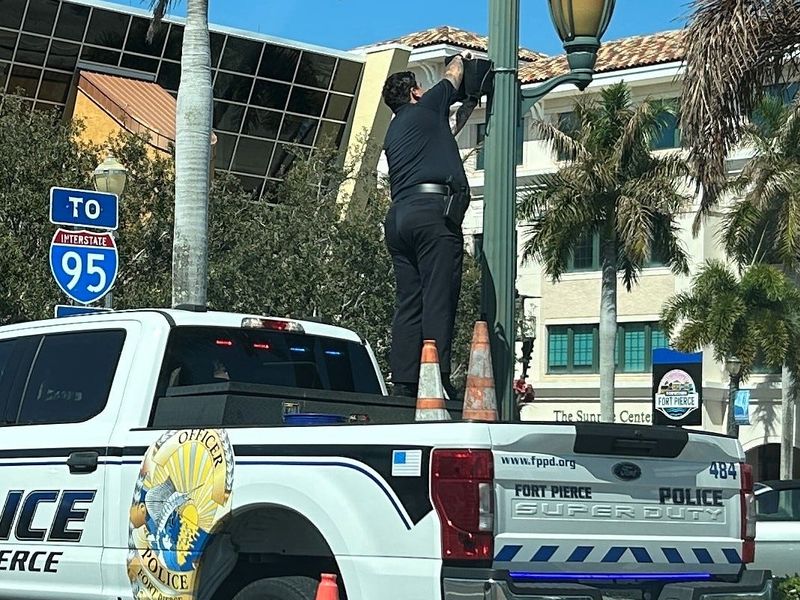
Florida law enforcement agencies have used AI-powered license plate readers to track drivers tied to political protests and rallies throughout the state, police records show.
Dozens of police departments, sheriff’s offices and campus police have searched thousands of surveillance networks around the country using automated license plate reader cameras made by the private company Flock Safety. The cameras record everything from tag numbers to bumper stickers to car colors.

Police do not need a warrant to track drivers, and the data can be stored for weeks.
Flock says its cameras help small police departments find missing people or stolen cars. But a TCPalm investigation found agencies have used the mass surveillance technology for other means, such as tracking protesters. TCPalm is a member of the USA TODAY NETWORK-Florida.
Florida agencies searched drivers tied to demonstrations 19 times in 2025, some around the No Kings protests against the Trump administration in June and October, TCPalm’s analysis found. No Treasure Coast agencies reported that in their Flock data, but it that is not conclusive because Flock relies on a self-reporting honor system.
Flock spokesperson Holly Beilin told TCPalm that agencies are in charge of policing themselves.
“It is not on Flock when agencies use the technology for things not within their policy,” Beilin said.
The most protest-related searches came from the Seminole County Sheriff’s Office, which searched over 8,000 Flock networks 10 times between April and May 2025. The searches correspond to an anti-Trump May Day rally “for human dignity and human rights” in the “war on working people,” according to a Seminole County Democratic Party.
While crimes can happen at protests, many searches did not correlate with an arrest, and the descriptions that law enforcement provided often do not show if they were looking for vehicles engaged in potentially criminal behavior.
“There is unfortunately a long history of law enforcement in the U.S. surveilling people, not because they’re suspected of wrongdoing, but because of their protest and political activities,” said Jay Stanley, a senior policy analyst at the American Civil Liberties Union.
Police around country use Flock ALPRs for protests
Flock-connected agencies nationwide searched for drivers tied to protests over 160 times in 2025.
Most descriptions were vague, but others mentioned specific protests. The Morristown Police Department in Tennessee cited “Suspicious Protester Vehicle ‘No Kings’ ” as the reason for searching Flock cameras on May 17.
Police use Flock cameras for left- and right-leaning gatherings. For example, the Plover Police Department in Wisconsin searched seven times in September 2024 for “trump rally POI,” meaning person of interest.
The Electronic Frontier Foundation, a digital rights nonprofit, found police used Flock cameras to track known activist groups around the country. Not only did it find mentions of No Kings, but the 50501 protests in February, the Hands Off protests in April. Both protests were against the Trump administration’s “anti-democratic and illegal” policies.
Searches for protesters are likely much higher, as permissive laws do not require Flock users to say what they’re using the technology for. Plus, TCPalm’s analysis used data from only a fraction of Flock networks around the country.
When requesting Flock data on a particular target, the user is prompted to enter a reason. For much of Flock’s history, entries were vague, such as “investigation” or “misc,” or simply left blank. This ambiguity means the public cannot decipher if the dozens of searches for “demonstration” represent protests or merely a test of the Flock system.
One Hollywood police officer simply left a smiling emoji as their reason in October.
“These meaningless descriptions mean we don’t know what the technology is being used for or if it’s justified,” Stanley said.
Flock announced in December it had updated this system, now requiring officers provide a reason with a drop-down list of pre-written offenses, rather than a fill-in-the-blank field. Users still have the option to write their own response, and there is an “other” category.
How Florida police use Flock cameras
There are hundreds of Flock cameras around Florida, used by police departments including Pensacola. Records do not show any use of Flock cameras in Pensacola to track protestors.
Tracking protesters represents a small portion of how the technology is used, as Flock cameras collect data on every passing vehicle. But the sheer volume of searches makes it impossible for small police agencies to monitor how the data is used, said Dave Maass, investigations director of the Electronic Frontier Foundation.
“You might trust your local police department or city council, but as soon as you start sharing that data outside your city or state, you lose control of it,” Maass said.
The ACLU, Electronic Frontier Foundation and other civil liberties groups suggest Flock searches should require a warrant.
Tracking ex-partners and abortion-seekers
Flock’s dragnet surveillance network has come under fire from members of the public, media and Congress for its use tracking protesters, immigrants and drivers pulled over by mistake.
For example, an FHP trooper stopped a driver in Franklin County in March 2025, but the “Flock camera read tag incorrectly. Flock tag expired, vehicle tag is valid,” records show.
Flock cameras also spurred national backlash after they were used to track someone seeking an abortion in April 2025. The Johnson County Sheriff’s Office in Texas searched 83,000 Flock cameras to track a woman seeking an abortion in Illinois, according to 404 Media, an independent online news outlet.
Flock’s search log shows deputies cited the reason as: “had an abortion, search for female.”
Spokespeople for Flock said this case is a misunderstanding and that her abortion had nothing to do with the Flock search.
“This woman was never under investigation for abortion,” Beilin said. “She ended up going to the police for domestic violence.”
What is Flock Safety?
Flock Safety sells law enforcement agencies its surveillance technology and access to its nationwide license plate reader network. During its eight years in business, Flock has mounted cameras in over 5,000 communities across 49 states. The cameras can be fixed roadside or on moving vehicles.
Flock also partners with private businesses, homeowners associations and gated communities. While businesses can’t search the network, law enforcement agencies can access their data. Flock recently made headlines when it cancelled its proposed partnership with Ring’s home surveillance cameras after public backlash.
Flock told TCPalm the cancelation was a business decision, as it would not be a “revenue-generating partnership.”
Clients own their data and can get real-time alerts when a targeted vehicle is scanned by one of their cameras. Users also can search key words and vehicle descriptions using a unique AI feature called “Vehicle Fingerprint.”
The article continues below.
Flock users often request tag data from all Flock clients in a region or state at once. That means when a user wants license plate data in Florida, most Flock-connected agencies statewide receive the same request.
TCPalm’s analysis is based on statewide data stored in the Vero Beach Police Department’s Flock system.
Flock CEO Garrett Langley said the public should have less insight into how the data is being used. Journalists are “trying to turn a public records process into a weapon against you and against us,” he said in a Dec. 12 email to clients. Police Chief Michael Kochis of Charlottesville, Virginia, disagreed in his reply.
“People have a right to disagree and have issues with things,” and that “at the end of the day, communities get to have a say on how they want to be policed.”
Jack Lemnus is a TCPalm enterprise reporter. Contact him at jack.lemnus@tcpalm.com, 772-409-1345, or follow him on X @JackLemnus.
This article originally appeared on Pensacola News Journal: Florida police used Flock cameras to track No Kings protesters
Reporting by Jack Lemnus, Pensacola News Journal / Pensacola News Journal
USA TODAY Network via Reuters Connect