This story is part of the Iconic Brands series, a USA TODAY network project showcasing the companies and brands that helped shape the nation’s identity, economy and culture. The series celebrates American ingenuity with a deeply reported examination of how brands intersect with history, community and everyday life in celebration of the nation’s 250th anniversary. Find more at https://usatoday.com/usa250/iconic-brands
American Express has been around for more than two thirds of the United States’ existence.

Like the nation, AmEx has seen dramatic growth and cultural shifts.
With a business model that has adapted to changing needs and changing markets, American Express has, for most of its varied history, catered to growth and the perception of exclusivity.
AmEx now describes itself as “a global payments and premium lifestyle brand powered by technology.”
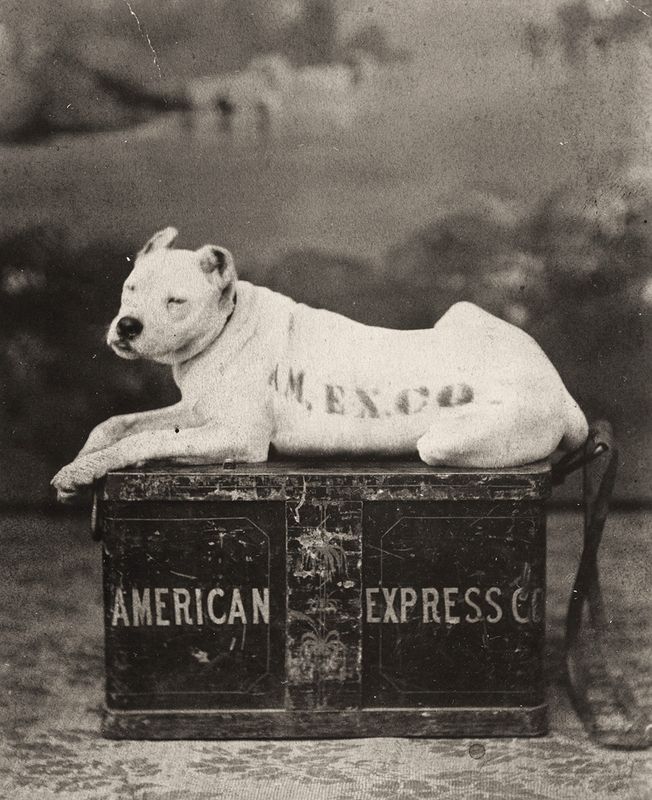
But its founding in 1850 centered on delivering precious goods and capitalizing on the country’s Westward Expansion.
By the end of that century, American Express products shifted as immigrants came to our shores and innovations in travel made the globe smaller.
The post-World War II economy brought the credit card era.
The financial services giant continues to feed and lead the USA’s and NYC’s economy. In early 2026, American Express announced it would build a new state-of-the-art global headquarters at 2 World Trade Center in Lower Manhattan, capping the WTC comeback.
While its roots as an express delivery service may seem far behind, AmEx pivots also showed consistency.
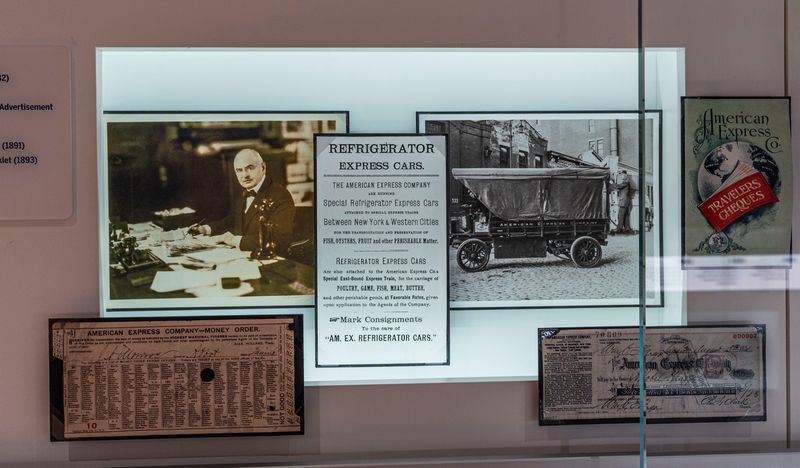
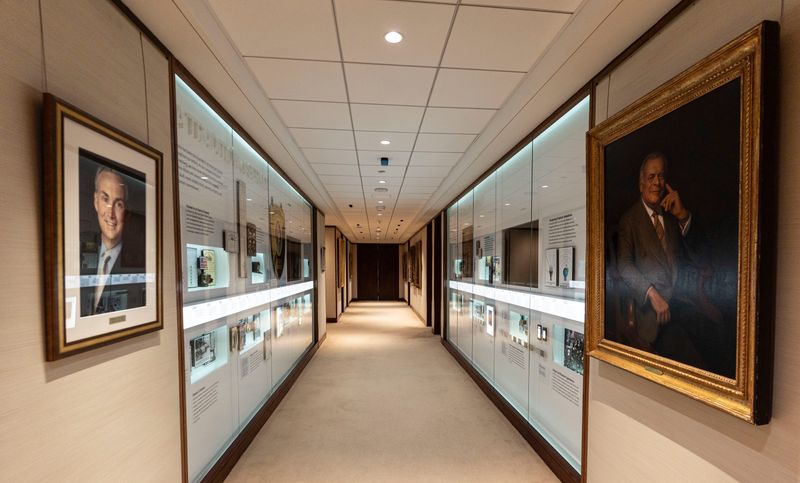
“Trust, security, service is a thread that goes through the entire business,” said Ira Galtman, American Express archivist, who spent an afternoon showing USA TODAY Network reporters AmEx collectibles, from a courier’s satchel circa the 1800s to one of the company’s first (paper) credit cards.
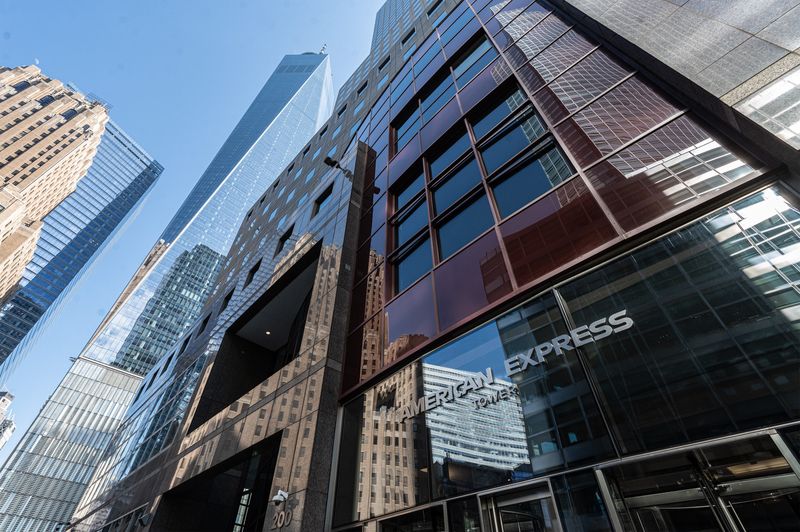
There’s plenty of pride of product in the American Express Tower, which overlooks the September 11 Memorial across West Street. AmEx, which employs around 75,000, was recently ranked No. 8 in Forbes and Statista’s list of “America’s Best Large Employers.”
How it started, how it’s going
In 1850, Henry Wells and William G. Fargo, along with John Butterfield, formed American Express. The company was based in Buffalo and Manhattan.
The company thrived with its connection to the Hudson River in Manhattan; to the Erie Canal and the country’s growing network of railways. Deliveries ranged from gold to oysters and just about anything in between.
Within a few years, two partners started another express delivery company — Wells Fargo — to push farther west as the Gold Rush sent California’s population soaring. The companies developed a symbiotic relationship shipping from East to West.
American Express kept supplies flowing to the Union Army’s frontlines during the Civil War. “Election ballots in 1864 were sent to the soldiers on the battlefield,” Galtman said.
Meanwhile, the company kept inventing products that fit a need in a changing nation.
In 1878, AmEx launched business-to-business shipping specialties.
But by 1882, the demand for goods went more liquid, with a need for quick cash. AmEx started the shift in its business model from goods to money.
American Express launched a more secure and user-friendly money order, in direct competition with the U.S. Postal Service. Money orders allowed new immigrants sending funds back to their countries of origin and provided families (few had checking accounts back then) to pay bills and buy items from catalogs.
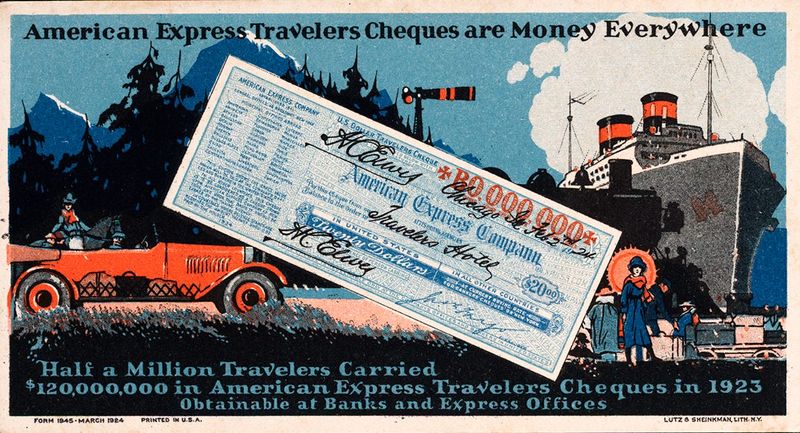
In 1891, AmEx came up with Travelers Cheques. Considered high-tech in its day, fraud-resistant travelers cheques provided a seamless way to convert currency and helped AmEx build its reputation for reliability and consumer protection.
The product came with a connection to a growing chain of offices at major cities in the world. Travelers would make those offices among their first stops, with services beyond money exchange, from sending mail to reading an American newspaper.
Travel assistance wasn’t as formal as now, but Galtman pointed to the company’s help for travelers when World War I started. He has a 1914 letter from a group of families who had been stuck in neutral Holland and were able to get ship passage to the U.S. with American Express’ assistance. The letter thanked American Express for its “unfailing courtesy, patience and resourcefulness,” and was signed by families from Providence, Rhode Island to Waco, Texas.
By 1915, the company was producing travel brochures; replicas of the artwork now decorate the walls of American Express Tower offices.
American Express already had a prominent role in currency exchange at home. From 1905 to 1908, the company was contracted with the U.S. government to provide currency exchange to new arrivals at Ellis Island. “We had a reputation for integrity,” Galtman said, providing a fair market rate for exchanges after other companies had not been as trustworthy with new immigrants.
In 1918, when the U.S. consolidated domestic express delivery, American Express’ pivot to the travel and finance industries was locked in.
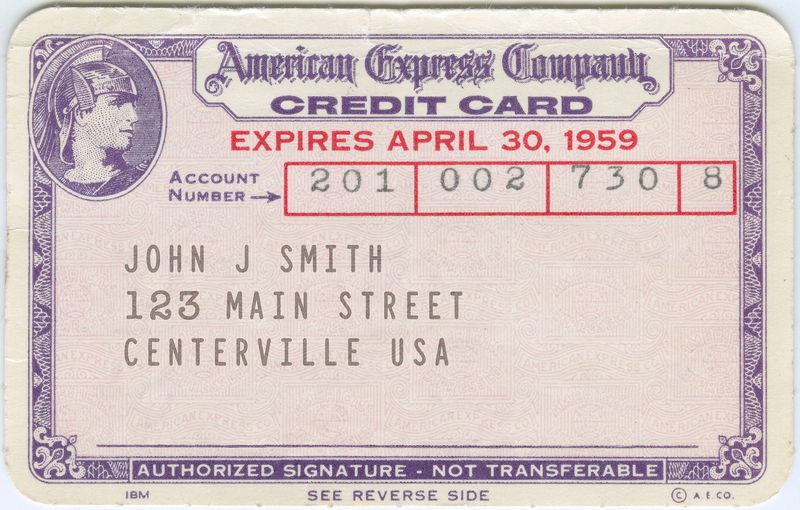
AmEx launched its first credit card in 1958. It’s annual fee: $6.
The paper card was purple to harken to the company’s popular and reliable Travelers Cheques that had a violet hue.
A pocket-sized merchant directory was produced to list all the places that honored the American Express card. American cities were listed, but so were major European hubs like Paris.
The card is now accepted in more than 170 million merchant locations, said Melanie Backs, the company’s vice president of corporate communications. “They wouldn’t fit it in a booklet anymore.”
AmEx adopted the plastic card in 1959. In 1969, the American Express card’s color was changed to green, just like money.
AmEx cards now come in all sorts of colors, from green to Platinum to the prestigious black Centurion, connoting prestige and packed with perks.
American Express made some bad investments too. In 1963, the company’s business loan sector fell prey to a Bronx swindler and his scheme that became known as “Salad Oil Scandal.” The ruse was so elaborate, it even included ships filled with water that only had a slick of oil on top to fool inspectors. The fallout nearly destroyed American Express after it was left to make good on loans when the perpetrator declared bankruptcy.
AmEx changes culture, culture changes AmEx
AmEx has long leaned into its status-symbol and clubby image.
In 1963, cards started carrying a “Member Since” statement that saluted customers’ loyalty and played up the idea of exclusivity.
Ad campaigns showcased the card as status symbol.
A famous series of ads in the 1970s focused on famous people like Jim Henson (and his Muppets) and others whose names were well known but visages maybe not immediately recognizable. The camera would focus on them and they would say, “Do you know me?” The card would show their name at the end with the tagline, “Don’t leave home without it.”
In a moment of cultural shift, U.S. Rep. Bella Abzug turned that particular ad pitch on its head, when she employed it to let women know of a new landmark law.
Abzug had led the charge in Congress to passed the Equal Credit Opportunity Act in 1974, which prohibited by law discrimination against credit applicants on the basis of sex or marital status; it was later later expanded to include race, color, religion, national origin, age, or public assistance status.
To get the word out about the new law, Abzug starred in her own mock AmEx commercial.
“Do you know me,” she asked with a wry smile as she sat in a cafe, wearing one of her signature hats. “Well, American Express did not know me.”
The New York Democrat then recounted for the camera how, as a sitting member of Congress, she had tried to get an American Express and was told, as was policy across the industry, that her husband needed to apply and she could have her card through him.
And so the battle for credit equality began.
Flashing her actual AmEx card, she said, “So now I have an American Express card so I can tell this story.”
Abzug in the ad boosted the company that started her crusade. “Carry an American Express card,” she said, “as a symbol of women’s right to credit!”
Phyllis Frank remembers the mock ad, and the discriminatory credit laws Abzug tackled. The focus was on American Express, she said, but the financial constraints for women were everywhere. Now 84, Frank recalls going to Bamberger’s in the Nanuet Mall around that time and the woman filling out the sales slip asked, “Miss or Missus?”
Frank wondered aloud, “If I decline to say, can I still buy a lipstick?”
Frank, for whom the Phyllis B. Frank Rockland County Pride Center was named, recalls that after the laws were changed, she did get a credit card in her own name.
Despite Abzug’s entreaty, Frank said she didn’t sign up for an American Express at first — “They were more expensive.” Frank, now a consultant with the Center for Safety & Change, a family shelter program, later did get an AmEx, but has since switched cards.
Boosting small business
On the heels of the Great Recession, American Express was looking for a way to help its small-business customers.
In 2010, American Express used its marketing influence to promote the idea of “Small Business Saturday” to follow the day-after-Thanksgiving Black Friday and land before Cyber Monday.
Small retailers “really had a hard time coming out of the financial crisis,” Galtman said.
The “Shop Small” concept caught on, with the support from the White House to state leadership. It’s now a holiday shopping tradition that boosts downtown storefronts across the U.S.
During COVID shutdowns, American Express offered grants for the hard-hit restaurant industry. The grants were mostly earmarked for things like building outdoor dining that met social distancing needs.
The grants evolved and continue supporting restaurants that are historically part of their communities.
Over five years, American Express’s Backing Historic Small Restaurants program has delivered more than $5 million in grants to 130 historic, small and independent restaurants across all 50 states, said Backs of AmEx’s corporate communications team.
The grants, part of a bigger Backing Small Business Initiative launched in 2020, have helped restaurant owners weather economic hardship, recover from disasters, preserve their spaces and expand to meet community needs.
AmEx changes the American lexicon
American Express invested a lot in its marketing and advertising — many campaigns became award-winning industry standouts — and many have become part of the American vernacular.
Think: “Don’t leave home without it” or “Membership has its privileges.”
The company also leaned into celebrity, with early Travelers Cheques ads carrying the distinct visage of Karl Malden, known as the veteran detective on the TV show “The Streets of San Francisco.”
In the 1980s, American Express leaned into its elite status and appeal with the ”Portraits” campaign. Famed photographer Annie Leibovitz captured celebrities (and cardholders) with a focus on subjects’ stunning personalities who happened to use the American Express card, rather than on the card itself.
Along with Leibovitz in the 2000s, AmEx launched the “My Life. My Card” campaign with iconic cardmembers highlighting what made AmEx an iconic brand. They were given questionnaires with specific questions to respond.
The campaign included some humorous, even outlandish, spots, including director Wes Anderson discussing his movie-making process and Martin Scorcese offering a harsh critique of photos capturing his nephew’s 5th birthday.
One 2004 spot featured Robert De Niro discussing love of and heartbreak in a post 9/11 NYC, which helped boost the Tribeca Film Festival that De Niro had co-founded in 2002.
A tower downtown, a symbol of USA strength
AmEx’ connections to Lower Manhattan and New York history run deeper than the Hudson its offices have long been near.
In the 1980s, American Express took a leading role in efforts to restore Ellis Island, where it has once supported new immigrants’ transition into the American economy, and the Statue of Liberty.
That included a 1983 marketing campaign that pledged to contribute a penny to the restoration of the Statue of Liberty every time one of its credit cards was used. (The Statue of Liberty’s exterior contains copper so she was the color of a penny before oxidation gave her a green patina.) The net: $1.7 million for Lady Liberty’s benefit and a near 30% increase in the card’s use by consumers.
In 2011, American Express provided a $100,000 grant to the National Trust for Historic Preservation to help rehabilitate and reopen a section of Ellis Island.
On Sept. 11, 2001, American Express lost 11 colleagues in its offices on the 94th floor of the World Trade Center North Tower. A memorial, Eleven Tears, honors those members.
AmEx in February 2026 sealed its commitment to return its headquarters to the World Trade Center complex. New York Gov. Kathy Hochul announced AmEx’s plans to build its new headquarters at 2 World Trade Center.
It will be the final commercial piece of the World Trade Complex, with building starting nearly a quarter century after the 9/11 terrorist attacks.
Port Authority of New York and New Jersey Executive Director Kathryn Garcia said the project “underscores the strength, vibrancy, and resurgence of the World Trade Center campus and New York.”
The building, which will stand 1,226 feet tall, will be nearly 2 million square feet and have 55 floors. It is due to be ready in 2031.
“This is an investment in our company’s future, our colleagues, and the Lower Manhattan community, reaffirming our deep commitment to the neighborhood we’ve called home for nearly two centuries,” AmEx chairman and CEO Stephen J. Squeri said in a statement. He described the building as “a home for innovation, interaction, and growth.”
The building, with room for up to 10,000 workers, will be energy efficient and incorporate more than an acre of outdoor space with several greenery-filled terraces and gardens and sweeping views of the Manhattan skyline.
How the list was chosen
The Iconic Brands 50 identifies American companies that most profoundly shaped the nation’s identity, economy and culture. Selection emphasized historical significance, industry-building innovation, measurable economic influence and lasting cultural impact. Brands were chosen for transforming daily life or becoming enduring symbols of American values. Long-term relevance and sustained national influence carried greater weight than short-term financial performance or recent popularity.
Note: This story has been updated to reflect accurate information regarding American Express’ timeline of products and services.
This article originally appeared on Rockland/Westchester Journal News: How 176-year-old American Express became an elite cultural symbol
Reporting by Nancy Cutler, Rockland/Westchester Journal News / Rockland/Westchester Journal News
USA TODAY Network via Reuters Connect