State officials said on Friday, April 17, that they were able to continue harvesting steelhead eggs on Michigan’s Manistee River after severe weather damaged a collection site earlier in the week, and have since added a second location in an effort to reach this season’s collection goal.
The Department of Natural Resources deployed a backup weir on the Platte River to aid in collecting about 3.5 million steelhead — or rainbow trout — eggs for distribution to fisheries in Michigan. Another million eggs are destined for other stocking programs.

Egg collection was scheduled to begin Tuesday, April 14, at the Little Manistee River Weir in Stronach, Michigan, but electrical damage from overnight storms caused a power failure at the facility, resulting in the loss of some of the fish being held for egg collection, the DNR said this week.
“Despite the damage to the facilities caused by heavy storms, steelhead egg collection continued this past week at Little Manistee River Weir, and over 1 million eggs were collected,” the DNR said.
Here’s a closer look at what’s taking place.
What are steelhead?
Steelhead, or rainbow trout, have two dorsal fins, including one adipose fin, mouth and gums are light, small spots along rays on entire tail, 10-12 rays in anal fin, the DNR said. Genetically rainbow trout and steelhead are the same species, but lead very different lives.
Rainbow trout stay inland while large specimens that inhabit the Great Lakes, but travel inland to spawn in streams have come to be called steelhead.
Native to the Pacific watershed, rainbow trout came to Michigan when eggs were imported from California in 1876. First stocked in the Au Sable River, then four years later in the Lake Michigan watershed, rainbows can now be found in all the Great Lakes.
Why is the DNR collecting steelhead eggs?
Steelhead provide sport fishing opportunities for both open-water fishing on the Great Lakes and tributary stream fishing, making the species a favorite of many anglers, the DNR said.
Since 1968, the Little Manistee River Weir has served as the sole source of winter-run steelhead eggs for fish hatcheries in Michigan and the main source for Ohio and Indiana.
This year, the Michigan Department of Natural Resources had planned to collect 4.6 million eggs. Thompson State Fish Hatchery (in Manistique) and Wolf Lake State Fish Hatchery (in Mattawan) were expected to receive 3.7 million of those eggs, Ohio would receive 500,000 eggs and Indiana would receive 400,000 eggs.
How does the DNR collect steelhead eggs?
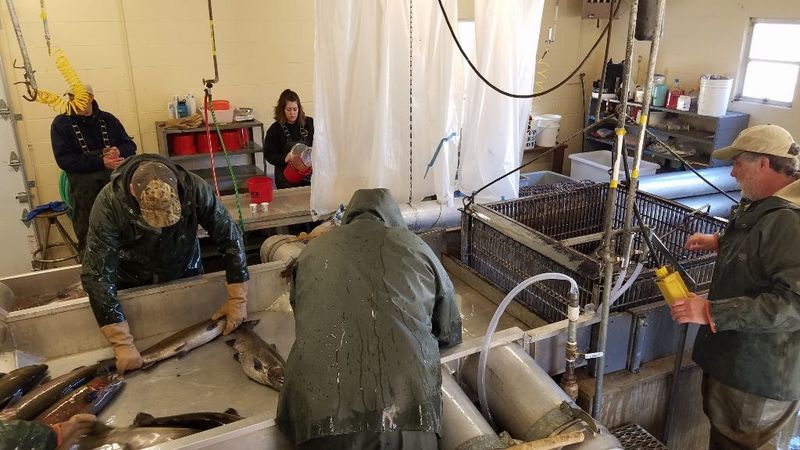
DNR “egg-take” operations begin with the installation of weir boards and jump screens by mid-March to stop the upstream steelhead migration in the Little Manistee River.
Once pumps are turned on at the facility, fish are diverted into holding ponds. Fish usually become ready to reproduce during the month of April and collection begins, continuing until the egg quota has been reached.
During egg collection, unripe or “green” steelhead (those that are not yet ready to reproduce) are held in maturation ponds or counted and passed upstream to sustain the Little Manistee River wild steelhead run.
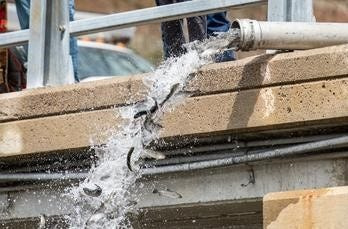
Steelhead that spawn during operations are also passed upstream and many eventually return to Lake Michigan, as this species is capable of spawning multiple times.
Once the quota of eggs is reached, the jump screens are removed and all remaining fish are allowed to migrate upstream. Boards will remain in place to block the upstream migration of invasive sea lamprey.
Planned spring steelhead egg-collection dates for 2026 were April 14, 15, 16, 21 and 22, but may change, based on the ripeness and number of fish present.
Eggs will be taken each day between 9 a.m. and 1 p.m., and the public is welcome to view the process.
What happened on the Manistee River?
Electrical damage occurred during overnight storms causing a power failure at the weir facility, resulting in the loss of some of the fish being held for egg collection.
This damage not only affected the main source of power, the DNR said, but also the backup power source and the notification system that alerts staff to power failures. Without power, the systems that sustained the fish were inoperable, resulting in the loss of many of the fish held in the facility at the time.
The weir’s main power source and three of the four pumps have been restored and are now functional; one pump is inoperable and will need repairs, the DNR said.
“No question, this loss of steelhead right before egg collection is a substantial setback,” said Randy Claramunt, chief of the Michigan Department of Natural Resources Fisheries Division. “This is disappointing to our staff, many of whom are anglers and care deeply about this fishery, but they are working quickly to collect eggs from the live fish at the weir to try to meet our needs for steelhead stocking next year.”
What is the DNR doing to continue the egg harvest?
Following recent storm damage at the Little Manistee River Weir (Manistee County), which resulted in a loss of fish, the Michigan Department of Natural Resources is evaluating other options to obtain the desired quantity of steelhead eggs for future stocking, including using the Lower Platte River Weir in Benzie County as a backup egg source.
To attempt to meet the season target, the Lower Platte River Weir was deployed to secure additional steelhead eggs. While the lower weir is in operation, anglers are reminded that the Platte River is closed to fishing within 300 feet of the structure.
Where are Michigan’s fish hatcheries?
There are six hatcheries in Michigan, including:
Can I tour a fish hatchery?
The DNR welcomes visitors to its state fish hatcheries and interpretive centers to see the fish rearing process and to learn about Michigan’s waters. For more information, visit Michigan.gov/Hatcheries.
The public also is allowed to watch the egg-taking activity between 9 a.m. and 1 p.m. each day. To check on the status of the egg-collection schedule, call the Little Manistee River Weir hotline at 231-775-9727, then press 8.
How do I know if the DNR stocked my lake, river
The DNR maintains an online fish stocking database. You can find out if any fish were stocked in your favorite fishing spots by visiting michigandnr.com/fishstock/.
This article originally appeared on Lansing State Journal: DNR steelhead stocking goal at risk after power outage kills fish
Reporting by Dan Basso, Lansing State Journal / Lansing State Journal
USA TODAY Network via Reuters Connect