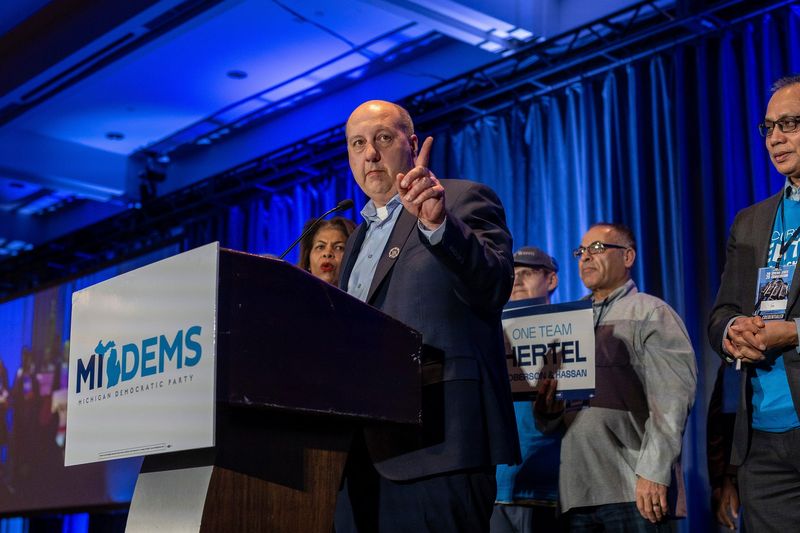
Michigan Democrats will gather in Detroit on Sunday, April 19, to choose endorsed candidates for a series of key offices up for grabs in this year’s November election.
The Michigan Democratic Party’s endorsement convention will take place at Huntington Place, where party delegates will back candidates for attorney general, secretary of state and a host of other races.

In Michigan, political parties select candidates for most statewide races, although voters will select nominees for governor and U.S. Senator in the August statewide primary. Republicans held their endorsement convention last month in Novi, opting for more establishment-aligned candidates than the grassroots contenders of years past. The major parties will officially nominate candidates at conventions later this year.
Democrats have historical trends on their side — typically, the party opposite the White House fares well in midterm elections. And President Donald Trump, a Republican, is struggling with lower approval ratings amid higher gas prices and the ongoing fallout from the U.S. and Israel’s war in Iran.
But the party does face challenges. Gov. Gretchen Whitmer is term-limited by state law and will not be on the ballot this fall. Whitmer, who is popular among Michigan voters according to approval ratings, has been a strong top-of-ticket candidate, handily winning both of her statewide campaigns for governor. And in the race to succeed Whitmer, former Detroit Mayor Mike Duggan running as an independent could provide a test for the eventual Democratic nominee’s ability to corral votes, as Duggan was a longtime Democrat before leaving the party in late 2024.
The midterms will also be Democrats’ first test since a bruising 2024 election that saw Trump carry the state. Secretary of State Jocelyn Benson, who is largely expected based on fundraising totals and name recognition to be the Democratic nominee in Michigan’s gubernatorial election this November, said April 10 the party’s voters are looking for leadership willing to take on tough challenges, namely a growing affordability crisis.
“I’ve found that message to be a unifying one for our party because as I talk to Democrats and even Republicans all across the state, it’s become actually abundantly clear that no matter what party we affiliate with, we all want our loved ones to be happy and healthy and safe and be able to choose Michigan as their home,” she said in an interview.
Here’s a rundown of candidates hoping to earn endorsements at the convention. Most of the races being decided April 19 are contested. Delegates, who are required to be Michigan Democratic Party members, will choose candidates through electronic ballots, or by a voice vote in uncontested races.
Attorney General
The race for the Democratic nomination for attorney general pits two big-county prosecutors — Oakland County Prosecutor Karen McDonald and Washtenaw County Prosecutor Eli Savit — against each other.
Also running for attorney general is Bill Noakes, a public defender and trial attorney with Neighborhood Defender Service of Detroit.
The current attorney general, Democrat Dana Nessel, can’t run again, because of term limits.
McDonald, first elected county prosecutor in 2020, announced her bid for attorney general June 24, pledging to protect kids and families and promote public safety.
McDonald has gained state recognition and even a national profile as a result of her prosecution of James and Jennifer Crumbley, the parents of the Oxford High School student who killed four students and injured six other students and a teacher during a shooting rampage at the school in November 2021. The Crumbleys, both convicted of involuntary manslaughter, were the first parents in America to be held criminally responsible for a mass school shooting committed by their child.
Her handling of the high-profile case has also brought criticism. The Michigan Attorney Grievance Commission is investigating allegations that McDonald crossed ethical lines while prosecuting the Crumbleys, the Detroit Free Press reported Jan. 16. Jeff Wattrick, a spokesman for the prosecutor’s office, dismissed the allegations at the time as “a political attack made with the same types of claims previously found not to have merit.”
Savit, who was also first elected county prosecutor in 2020, announced he was running for attorney general May 13. Savit pledged to fight corporate polluters, scams and rip-offs that harm Michigan consumers, and constitutional overreach and associated funding cuts by Trump.
In Washtenaw County, Savit campaigned to reduce racial and socio-economic inequities in the criminal justice system and increase support for mental health and addiction services. He established an economic justice unit focused on issues such as worker and consumer protection. He has also sought to eliminate, to the extent possible under current law, the use of cash bail in criminal cases, saying a defendant’s financial resources should not dictate whether he or she remains free pending trial.
Savit is also not without controversy. The Free Press reported Oct. 21 that Nimish Ganatra, senior assistant prosecuting attorney in Washtenaw County, alleges in a federal lawsuit that Savit retaliated against him for speaking out about alleged wrongdoing by a colleague Ganatra supervised. Savit declined comment Oct. 20 but said through a spokeswoman the lawsuit is without merit. The case is still pending.
Noakes, of Detroit, has run a low-key campaign since filing his candidacy with the Secretary of State’s Office in October.
While McDonald has reported raising more than $1.1 million and Savit more than $352,000, Noakes has not reported raising or spending any campaign money as of January, which was the most recent reporting deadline.
Noakes announced his campaign in a video shot in front of the Wayne County Criminal Justice Center, where he said he spends most of his days. If elected, he pledged to fight cuts to health benefits, veteran benefits, and food and nutrition support for families.
Secretary of State
The Democratic field for secretary of state received a sizeable shakeup in January when Lt. Gov. Garlin Gilchrist announced he would end his pursuit of becoming Michigan’s next governor and run for secretary of state instead. Joining Gilchrist in the field are Ingham County Clerk Barb Byrum, a longtime elections official and former state lawmaker, and Suzanna Shkreli, a former Michigan Lottery commissioner and Macomb County assistant prosecutor.
All three candidates have said they are best positioned to lead Michigan’s elections administration and stand up to Trump, who Democrats broadly describe as a threat to free and fair elections nationally.
Incumbent Secretary of State Benson cannot seek reelection because of Michigan’s term limit laws.
Gilchrist has been Whitmer’s lieutenant governor since she was first elected back in 2018. He likely has an advantage in name recognition among Michigan Democrats, having been Whitmer’s running mate in both of her campaigns. He previously sought an elections administration role when he ran for Detroit city clerk in 2017, losing to current Clerk Janice Winfrey.
Byrum has been clerk in Ingham County since 2012 and spent six years in the Michigan Legislature before that. She’s been a vocal critic of those scrutinizing election processes in Michigan, and like other candidates in the race, has vowed to defend the state’s election systems against any threat.
“When they’re attacking our elections, they’re attacking our democracy,” Byrum told the Free Press in May 2025, when she announced her campaign. Byrum is the daughter of former Michigan lawmaker and Michigan State University Trustee Dianne Byrum. Her family also owns a hardware store in Charlotte.
Shkreli resigned from her post as Michigan Lottery Commissioner in December, jumping into the secretary of state field. Before being lottery commissioner, Shkreli served as director of juvenile justice reform at the Michigan Department of Health and Human Services. Before that, Shkreli served as Michigan’s Children’s Ombudsman and worked as deputy legal counsel in the governor’s office.
When she launched her campaign, Shkreli also described democracy “as being at stake.”
Michigan Supreme Court
Although elections for Michigan Supreme Court justices technically are considered nonpartisan, major parties nominate candidates at their respective conventions. Two incumbent justices are seeking reelection to the state’s high court, both nominated or appointed by Democrats.
Chief Justice Megan Cavanagh was first elected to the court in 2018. She was unanimously tabbed by her fellow justices to take on the role of chief justice in March 2025. Before being elected to the court, Cavanagh was an attorney practicing private law and had over 15 years of experience practicing appellate law, according to her court bio. Cavanagh was also previously a shareholder at the Garan Lucow Miller law firm in Detroit.
Justice Noah Hood is running his first statewide campaign for the court, having been appointed by Whitmer in April 2025 to replace former Justice Elizabeth Clement. At the time of his appointment, Hood was a Michigan Court of Appeals judge. Hood previously worked as a federal prosecutor in the Eastern District of Michigan and in the Northern District of Ohio. He also previously practiced law as an attorney at the Miller Canfield law firm.
State Board of Education
Two positions on the Michigan State Board of Education are set to be decided this fall. Two incumbent members, Judith Pritchett and Tiffany Tilley, are seeking reelection to the board. J.E. Windle is also seeking nomination to run this fall.
U-M Board of Regents
Two of the board’s eight seats are up this fall, and two Democratic incumbents are seeking reelection. A third Democrat, however, is seeking an endorsement, as well.
Jordan Acker, a senior partner and attorney at the Goodman Acker law firm in Southfield, was first elected to the board in 2018. Also elected in 2018 was Paul Brown, a managing partner at eLab Ventures, a private equity firm.
Attempting to unseat one of the incumbents is Amir Makled, a civil rights attorney from Dearborn.
While races for university boards are often lower profile than other contests, the Michigan race has grown in attention for the role the university’s handling of protests against the war in Gaza could play in it.
Acker, who is Jewish, saw his Huntington Woods home vandalized in December 2024, when vandals spray painted “Free Palestine” on his wife’s car and smashed a window at the home with a jar that some media outlets said was filled with urine. The Goodman Acker law firm office in Southfield was also spray painted with anti-Israel graffiti in July 2024.
Makled represented a pro-Palestinian demonstrator who was arrested at the University of Michigan in 2024. Makled was detained at Detroit Metro Airport in April 2025 after returning from a family vacation, where federal agents held him for about 90 minutes and questioned him about his clients and the contents of his cell phone.
MSU Board of Trustees
Two seats on the Michigan State University Board of Trustees are up for election this fall.
Incumbent Trustees Brianna Scott and Kelly Tebay Zemke are seeking reelection. State Sen. Sylvia Santana, D-Detroit, is also seeking an endorsement. Santana cannot seek reelection to the state Senate due to Michigan’s term limit laws.
Wayne State Board of Governors
Two seats on the Wayne State University Board of Governors are also set to be decided in November.
There are four Democratic candidates seeking nominations: civil rights attorney Shereef Akeel; engineer Naz Hassan; labor attorney Richard Mack; and Detroit organizer Jeremiah Wheeler.
You can reach Arpan Lobo at alobo@freepress.com
This article originally appeared on Detroit Free Press: Michigan Dems to choose candidates for key races at Detroit convention
Reporting by Arpan Lobo and Paul Egan, Detroit Free Press / Detroit Free Press
USA TODAY Network via Reuters Connect