Sacred Heart Academy didn’t just educate its pupils on the basics.
It trained them in virtue and morality. It molded their consciences to fulfil civil, social and religious duties. It prepared them to become devout members of society.

And once in a while, it taught them how to play the zither.
For more than 40 years, the private school was a bastion of learning in downtown Akron. The academy was well known in the early 20th century, but has receded from memory over the decades.
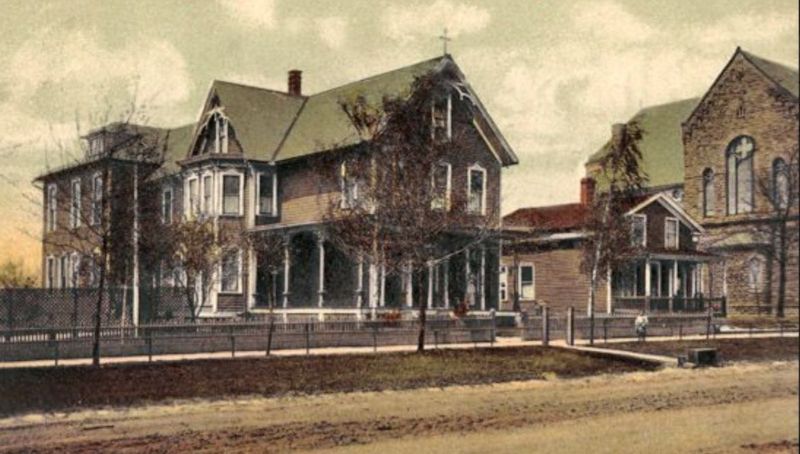
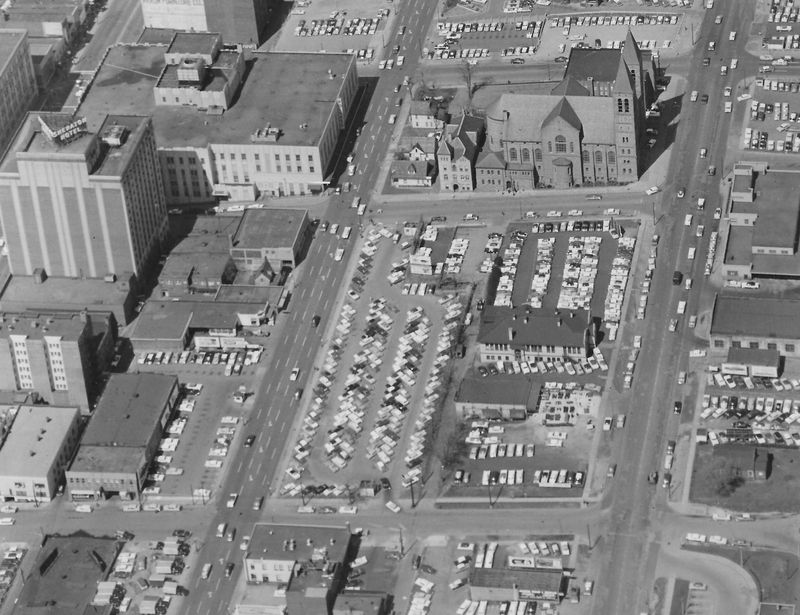
St. Bernard’s Catholic Church, the twin-spired landmark, was still a year from completion when the Sisters of St. Dominic opened the academy in September 1904 in their new convent at South Broadway and East State Street.
The Rev. John B. Broun, St. Bernard’s pastor, arranged the purchase of a 10-room house at 274 S. Broadway on behalf of the nuns. The 20-year-old residence of the Herman Walther family cost $5,000 (over $26,600 today).
“The building is a two-storied one, the ground floor being devoted to study and recitation rooms for the students, and the upper floor being the residence of the sisters, with the exception of one large room in which chapel exercises will be held,” the Akron Beacon Journal reported.
A secondary purchase for $1,000 included a vacant lot to the south.
Academy open to boys and girls
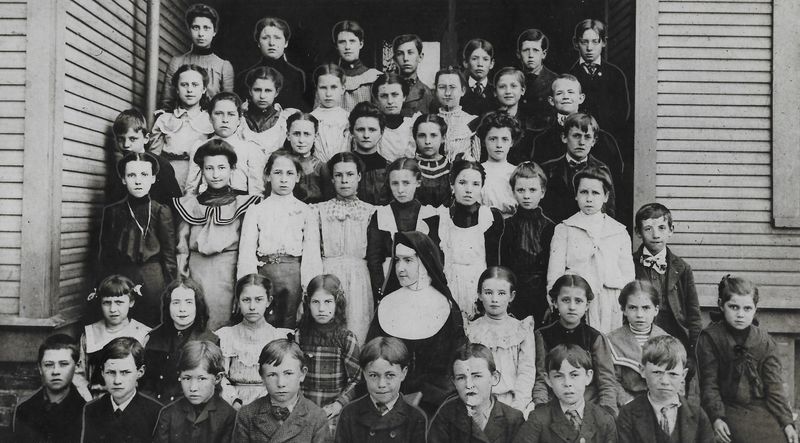
Sacred Heart Academy was open to boys and girls in kindergarten through 12th grade, making it Akron’s second Catholic high school behind St. Mary, which graduated its first class in 1901.
Under the direction of Mother Mechtilde, a dozen sisters taught general courses in English, religion, math, history, science, social studies and physical education. Secondary languages included Latin, German, French and Spanish.
More specialized courses were typewriting, stenography, bookkeeping and dressmaking.
In art classes, pupils learned to draw, paint and decorate china. In music classes, the nuns taught chorus, piano, organ, violin, guitar, mandolin and the ever-popular zither.
Sacred Heart’s first graduating class in 1906 consisted of six students: Earl Hamlin, Grace Williams, Emily Dangel, Elizabeth Buehrle, Cecilia Metzler and Florence Madden.
Enrollment soon topped 115, prompting the academy to build an addition behind the convent.
The school organized football, baseball and basketball teams that played St. Vincent, St. Bernard, St. Mary and other squads.
New academy rises in 1914
By 1914, Sacred Heart had 250 students from across Akron, graduating a dozen students a year.
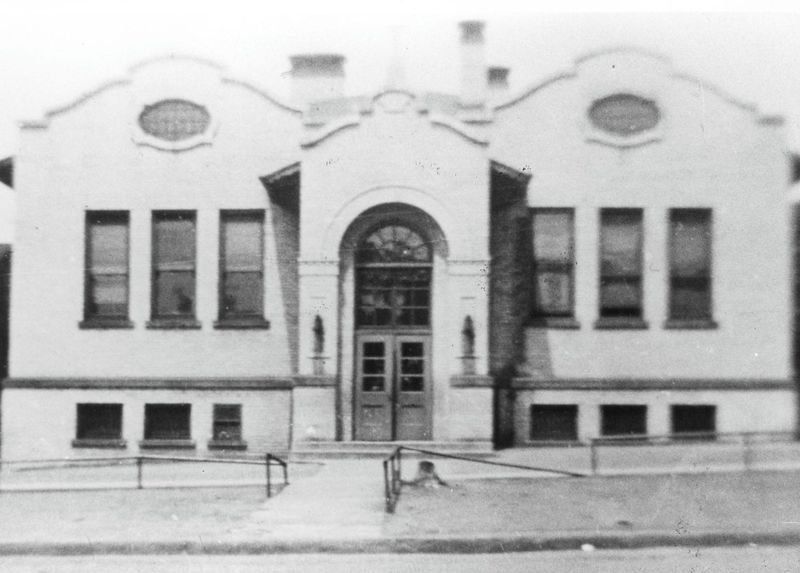
Under the direction of Sister Angelica, the academy built a new school on the adjacent property at 284 S. Broadway. The two-level brick structure cost $28,000 (about $921,000 today).
Monsignor Thomas Charles O’Reilly, chancellor of the Cleveland Diocese, dedicated the building Nov. 8, 1914, with the assistance of eight priests.
“He spoke eloquently concerning the work of higher education,” the Catholic Universe reported. “He also took occasion to admonish the girls to cling to the so-called old-fashioned ideals of womanhood, saying that most of the standards set by our modern women’s movements were false, and that men could pay no greater tribute to woman than to designate her position in life as ‘queen of the home.’”
Nearly 700 attended the ceremony. Pupils sang “The Star-Spangled Banner.”
Sister Helen loved teaching
Over the decades, the academy’s teachers included Sisters Agnes, Angelica, Bernadette, Bernard, Celine, Clarice, Constantia, Dominica, Eucharia, Ferrer, Florentine, Helen, Hilda, Jeannette, Jordani, Josepha, Josephine, Josita, Matilda, Rosalia, Yolanda and Victoria.
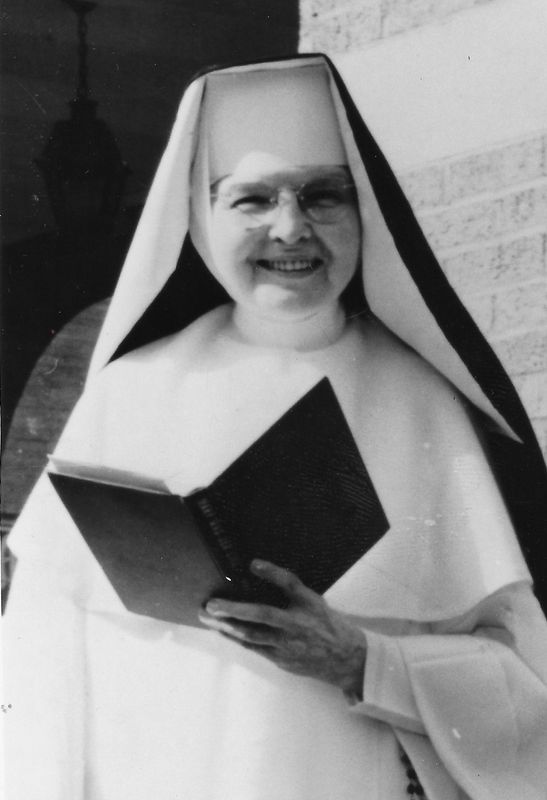
Sister Helen (1899-1985), a native of Rochester, New York, began teaching there in 1917.
“My early years of teaching were carefree and happy,” she recalled years later. “And while I know that my poor efforts were pitifully small, nevertheless, I hope that the Eternal Father has mercifully overlooked my littleness in his own bigness and generosity.”
As the years passed, she began to understand the significance of her work. Every day was a fresh start, a chance to communicate her joy of learning and share it with students.
“In what other vocation would I have the chance to stay young with young people, for every day I live their lives vicariously,” Sister Helen noted. “To get the confidence of the students in the classroom, to feel that one has a part in molding the future citizens of our country — these two facts alone make a teacher’s life worthwhile.”
Student Rose Kraus, 18, was the toast of the town when she captured first prize in a citywide essay contest in 1921. The senior won $50 in gold on the topic of “Why I Want a Home in Akron.”
“One of the many reasons why I should build a home in Akron is because Father Akron looks after his citizens in a very parental way,” she wrote. “He is amply providing for us all, surrounding us with a myriad of roads, each leading to success.
“The school child follows the path leading to knowledge. Our educational system ranks among the best, and only the most capable teachers are employed.”
As its enrollment neared 300, Sacred Heart welcomed a rival school. A sister school, if you will.
In 1923, the Sisters of St. Dominic bought the former West Market Street mansion of B.F. Goodrich executive Arthur Marks and renamed it Our Lady of the Elms, a school for girls.
Prospective students had a new choice.
Beware of vile influences
The downtown academy remained vigilant in developing young minds, presenting cautionary tales about the perils of outside influences.
The Rev. Edward J. Bracken, dean of John Carroll University, spoke at commencement in 1929.
“There is very little serious thought exercised in the world today,” he informed the class of 19 graduates. “The American people as a whole are not given to thought: They are easygoing and take things as they come.
“That’s why the movies have captivated us all and newspapers and magazines and books are filled with irreligious, meaningless words, and vile deductions — a subterfuge to mislead us. If we could only think, these erroneous ideas and false philosophy could not be thrust upon us.”
In 1932, Sacred Heart became a girls-only school. Sister Helen was named principal a year later.
The academy added a two-year course on home economics, including family living, child development, home management and home furnishings.
“Home is, or should be, the place where we are most nearly our whole selves, where we live the most unified life, that education in family living therefore offers and opportunity to unify experiences and to bring them within the range of a girl’s comprehension,” Sister Helen noted.
In 1941, the Rev. Clarence E. Elwell, director of education for the Cleveland Diocese, told a Sacred Heart assembly of 150 students that motherhood was one of the greatest careers.
“When you come right down to it, 10 years from today, nearly every last one of you will be married,” he told the girls. “The peculiar thing is that you spend most of your time preparing for some temporary vocation, with only meager preparation for the occupation which will take 30 or 40 years of your lives.”
Religious life was “the highest vocation,” Elwell said.
“Many also forego marriage because they like their independence,” he said. “The end of it is loneliness when the woman is older.”
Polsky’s buys Sacred Heart
Mother Clare announced in February 1946 that Sacred Heart Academy would close that June.
The Dominican sisters sold the property to the A. Polsky Co. for $50,000 (nearly $844,000 today) and used the money to improve Our Lady of the Elms.
The department store added 360 parking spaces on a block bounded by High Street, Buchtel Avenue, Broadway and State Street.
It used the academy as a warehouse.
Students were invited to transfer to the Elms. Juniors could maintain their Sacred Heart identity until graduating in 1947.
Final graduates at school
Monsignor Ferdinand Schreiber, St. Bernard’s pastor, presented 30 diplomas.
The final class: Josephine Biltz, Sally Ann Carter, Angeline Cucuzza, Elizabeth D’Alessio, Edith M. Donatelli, Patricia A. Fichtner, Helen M. Flanagan, Virginia Fox, Barbara Jean Gill, Frances A. Gill, Grace C. Givler, Patricia Harlacher, Mary Louise Haus, Elizabeth L. Heller, Dorothy M. Herman, Mary Jean Knight, Florence Kolodziejczak, Marie A. LaPenna, Mary T. Lehner, Mary E. Leyden, Vivian Ann Martini, Marcella E. Massaro, Doris P. Merlitti, Alice M. Mickel, Colleen O’Donnell, Mary Eileen Quinn, Hope E. Reilly, Helen N. Scarpitti, Elsie R. Schaber and Dorothy Stampfli.
In 1960, Polsky’s tore down the old academy to make room for a $4.5 million, four-story parking deck — a structure that stands today.
By then, Sister Helen was principal of Our Lady of the Elms. She went on to celebrate 68 years as a nun before passing away in 1985 at age 86.
“In our little world at school, every day is a fresh beginning,” she reflected during her golden jubilee. “The day is made new for all of us, for I have another chance also. What a challenge the new day brings! What a feeling of adventure.”
Mark J. Price can be reached at mprice@thebeaconjournal.com
This article originally appeared on Akron Beacon Journal: Sacred Heart Academy was Catholic school in Akron | Local history
Reporting by Mark J. Price, Akron Beacon Journal / Akron Beacon Journal
USA TODAY Network via Reuters Connect