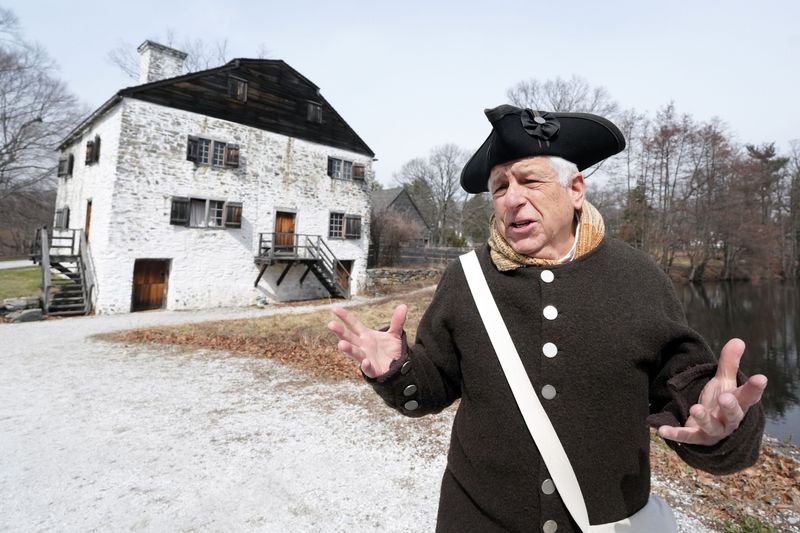
Philipsburg Manor, in Sleepy Hollow, New York, commemorates the American history of slavery during the Colonial era.
Why it matters

Stepping into Philipsburg Manor transports visitors to the 1700s, offering a window into a prominent Colonial-era trading center and the lives of the enslaved people who lived and worked there for generations.
Owned by Adolphus Philipse — one of the Colonial-era’s wealthiest merchants, who also served on the Governor’s Council and as speaker of the General Assembly — Philipsburg Manor was both a major economic engine and home to 23 enslaved people of African descent.
The mill, manor house and barn along the Pocantico River produced flour and butter that were exported to the Caribbean in exchange for sugar. During the Revolutionary War, the area became part of the “neutral zone,” leaving it vulnerable to raids by uniformed troops, militiamen and vigilantes.
What to see today
Crossing a bridge over the Mill Pond and the Pocantico River, visitors encounter a towering mill that reveals how flour was produced centuries ago. Interconnected gears transformed flowing water into mechanical power, grinding grain into flour. More than 200 years ago, the mill functioned as both a sophisticated engineering feat and a global economic engine.
Behind that profitable enterprise were 23 enslaved people, the youngest just 3 years old. Their names were recorded in an inventory compiled after Philipse’s death in 1749, alongside a list of cattle and horses owned on the property. Among them were Ceaser, a skillful miller, Dina, Massey and Sue who operated butter production.
Ask a local
Andrew Halpern, a guide of Philipsburg Manor, said the site offers critical insight into an often overlooked history of slavery in the North. In 1750, about one in five people in Manhattan was enslaved, making it the second-largest enslaved population in the colony.
“It’s a great example of local history,” Halpern said. “You not only get a sense of what life was like in the 1750s, but also a very important, sometimes underrepresented enslaved African American community.”
The property was confiscated during the American Revolution after Loyalist Frederick Philipse III, the third lord of the manor, was attainted for treason in 1779. While he fled to England, some of the slaves were sold to New York City.
Philipsburg Manor opens for tours on May 8. It also hosts events, including Summer Saturdays throughout the season and The Pinkster Festival on May 23. The site has been featured in People Not Property, a project that explores the history of slavery in the colonial North.
Visitors interested in the history of the Philipse family can also visit Philipse Manor Hall in Yonkers, part of the family’s former 52,000-acres landholdings that once stretched from Yonkers to Croton-on-Hudson.
Plan your visit
Helu Wang covers economic growth, real estate and education for The Journal News/lohud and USA Today Network. Reach her at hwang@gannett.com and follow her @helu.wangny on Instagram.
This article originally appeared on Rockland/Westchester Journal News: Discover overlooked Colonial-era slavery at NY’s Philipsburg Manor
Reporting by Helu Wang, Rockland/Westchester Journal News / Rockland/Westchester Journal News
USA TODAY Network via Reuters Connect