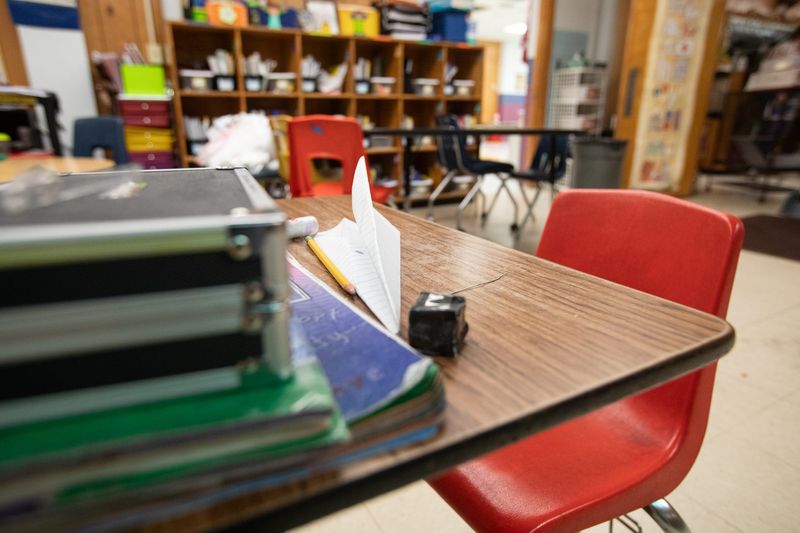
April is STAAR season in Texas public schools.
STAAR, the State of Texas Assessments of Academic Readiness, are the standardized tests Texas students take at the end of the school year starting in third grade.

The tests measure how much each student has learned and are an important indicator for how likely a student is to succeed in the next grade level or course. Schools typically use STAAR results for determinations such as whether a student should attend summer school or tutoring.
To graduate, students need to pass several STAAR end-of-course assessments in core content areas.
The Texas Education Agency also uses STAAR results to assign A-F school accountability ratings, with consistently low-performing schools at risk of a state takeover.
Due to a new state law, the assessment program will change significantly in two years, but for this year, there are only minor changes.
As students prepare to test this spring, here’s what families need to know about STAAR:
When are the tests?
Schools have flexibility for when they schedule tests, though the state does mandate a specific testing window. Families should check with their child’s school for exact test days.
Here’s the spring 2026 STAAR testing window:
An alternate assessment, STAAR Alternate 2, is administered to eligible students with significant cognitive disabilities who receive special education services. The testing window for this alternate exam began March 16 and continues until April 17.
How can parents support students before testing?
Last year, Corpus Christi Independent School District counselors told the Caller-Times that it’s important for students to feel confident, calm, fed and rested before testing.
The Texas Education Agency has released test questions from previous years online.
When will results be available?
High school end-of-course assessment results will be available online at texasassessment.gov on June 10.
Grade 3-8 assessment results will be available online at texasassessment.gov on June 16.
Results for alternate assessments for students with significant cognitive disabilities will be available at texasassessment.gov on June 24.
The state’s online family portal allows parents and guardians to see their child’s results, down to every question. The portal also provides information on strengths and areas where the student might need additional support.
How are state assessments changing?
This fall, the Texas Legislature approved sweeping changes to the state’s assessment program. Most of those changes won’t be seen until 2027-28.
But here’s what is new this year:
In 2027-28, the STAAR will be replaced with the Student Success Tool, a new assessment program that includes three shorter tests in the beginning, middle and end of the school year for grades 3-8.
Currently, at the high school level, end-of-course assessments are required for algebra I, biology, English I and II and U.S. history. By 2027-28, the state will drop the English II assessment.
Under the new law, schools can choose to administer beginning- and middle-of-the-year courses, but only the end-of-course exams are required.
In addition to state-created beginning- and middle-of-the-year assessments, the law directs the Texas Education Agency to approve a list of alternative assessments that school districts can administer instead.
The law also significantly speeds up the timeline for delivering results to families. Once the new assessment program is implemented in two years, the Texas Education Agency will notify school systems of results on beginning-, middle- and end-of-year assessments no later than two business days after the testing window ends.
In the second year of implementation, 2028-29, results for beginning- and middle-of-the-year assessments will be provided immediately upon completion.
This article originally appeared on Corpus Christi Caller Times: 2026 STAAR tests are coming. Here’s what’s new, when you can see scores
Reporting by Olivia Garrett, Corpus Christi Caller Times / Corpus Christi Caller Times
USA TODAY Network via Reuters Connect