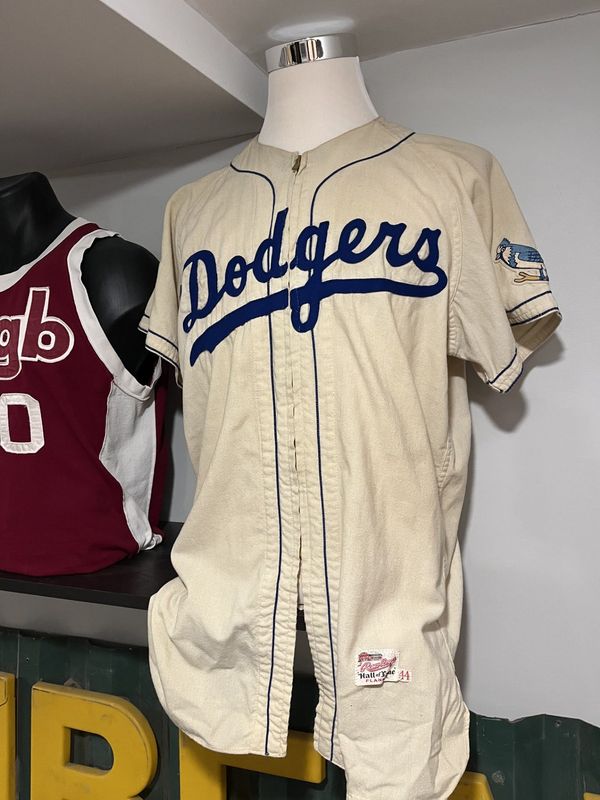
Chris Nerat is known by many in the sports memorabilia community as one of the top Green Bay Packers collectors in the country.
But it doesn’t keep him from picking up oddball items that help tell some of the history of Green Bay.

He has a ticket stub from a sold-out Elvis Presley concert at Brown County Veterans Memorial Arena on April 28, 1977, just four months before the legendary singer died.
The 2001 University of Wisconsin-Green Bay graduate has a UWGB basketball jersey from the 1970s on display at his home.
He owns the W-E-S-T letters that once stood above the West Theatre marquee.
When Nerat came across an auction item on eBay earlier this year while doing his daily Packers search, it immediately caught his eye.
It was a 1960 Green Bay Dodgers baseball jersey, representing the former local minor league team affiliated with the Los Angeles Dodgers.
As soon as Nerat saw the jersey, he had to have it.
He was willing to bid as much as $4,000 but won it for a total of $1,077.08.
“I just thought it was beautiful and didn’t want to lose it,” he said.
It will never be worth anything close to many of the Packers items he buys and sells, but the pickup was far more about the history of the piece than potential profit.
Nerat doesn’t have interest in selling it at this point. It’s displayed right next to that UWGB jersey he owns.
“I can’t wait to have people over for football season and show them that baseball jersey as well,” said Nerat, who is a consignment director for Heritage Auctions and a Green Bay Packers Hall of Fame board member. “I’d be open to letting the public view it, maybe at the Neville Museum or something. Let thousands of people see it instead of just the dozens that would see it at my house.
“Eventually, I plan to sell my collection. I think it’s 10 or 20 years away from that, but you never know what life holds. When it’s time, it’s time.”
How does Nerat know the jersey is genuine?
He certainly has extensive experience in the collectible hobby. He could tell immediately that it was a professional-style jersey that would have been issued to a pro team and comparable to what a major league player would have worn.
But that wasn’t enough.
He reached out to Lou Lampson, a 50-year hobby veteran whose expertise is utilized by several auction companies to authenticate game-worn jerseys.
It was clear on examination of the jersey that it had previously been used when the team was known as the Bluejays, considering an observer can still see the stitching marks of where it used to say “Bluejays.”
A Bluejays team patch is still on the left shoulder of the jersey, and a photo from that 1960 season indeed shows Dodgers players wearing jerseys with the old patch still affixed.
Lampson spent 20 minutes going over all the reasons he believes the jersey is authentic, enough to fill half a book.
“I am very confident,” Lampson said. “We spent ample time going through this before it was picked up, and ample time since then.
“Everything logically, the way I was taught to examine uniforms, fits.”
Green Bay Bluejays were the Dodgers in 1960
Before being named the Dodgers in 1960, the team had been the Bluejays for two decades. They were named after Otto Bluege, who was the organization’s first manager.
Part of the reason for the change to the Dodgers was that local fans believed the Bluejays reminded them of the Class D team they had been before moving to a Class B team in 1958 as a Dodgers affiliate.
Those fans had the opportunity to watch some notable players from 1958 to 1960.
They included four-time All-Star and 1960 National League rookie of the year Frank Howard, who spent his first year of pro ball playing at Joannes Park in 1958.
Howard made a home in Green Bay for decades after marrying Carol Johanski, who worked in the circulation department at the Green Bay Press-Gazette.
He died in 2023 and is interred at Allouez Catholic Cemetery.
The Dodgers withdrew from the Illinois-Iowa-Indiana League after the 1960 season, just one year after winning a championship.
Part of the reason was the poor gate for home games at Joannes. Green Bay finished 65-73 that season and was sixth in the eight-team IIIL.
The franchise not only moved its Class B location after that year from Green Bay to Salem, Oregon, but it took manager Stan Wasiak with it.
Baseball remained in Green Bay in 1961, with a team that was part of the Fox River Valley Amateur Baseball League. The roster even featured Green Bay Bobcats hockey legend Paul Coppo, who was a pitcher.
After starting the season as the Dodgers, the team went back to the Bluejays name by the end of May.
As for that 1960 Green Bay Dodgers jersey, there haven’t been many, if any, sold in the past 66 years.
“I didn’t even know a lot about the team, I knew a little bit,” Nerat said. “But it’s right up there with the coolest item I’ve ever purchased. I focus mainly on Packers items, but I’m a Green Bay guy. I just can’t get over the fact that the team in big Los Angeles and formally in Brooklyn, that won all the championships in the major leagues, was connected to little old Green Bay.
“You hear the folklore about the Packers being the small-town team, and this is just another example how little old Green Bay was somehow connected with the big time of professional sports.”
This article originally appeared on Green Bay Press-Gazette: Local collector Chris Nerat finds Green Bay Dodgers jersey on eBay
Reporting by Scott Venci, Green Bay Press-Gazette / Green Bay Press-Gazette
USA TODAY Network via Reuters Connect