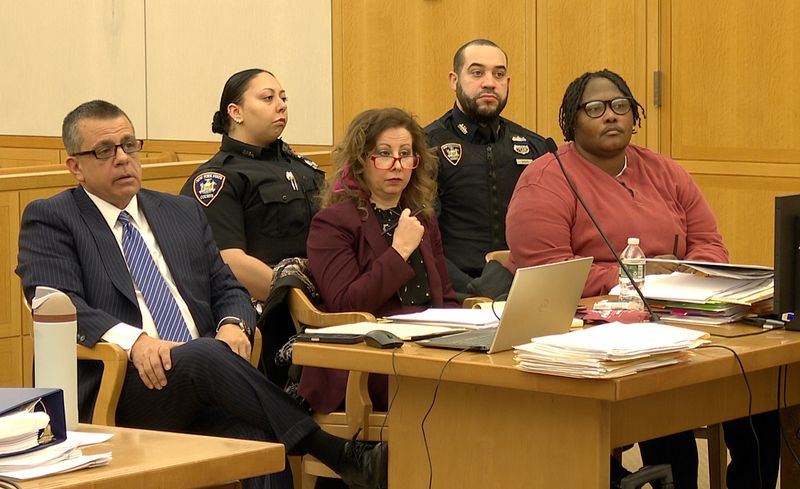
Two forensic pathologists found that a 27-year-old woman was suffocated to death even though their physical observations of the body did not allow them to draw that conclusion, the two told jurors at the murder trial of the woman’s girlfriend.
Dr. Ben Bristol, an associate Westchester medical examiner, and Dr. Susan Ely, a former senior pathologist in New York City, testified Friday, March 13, that the full circumstances surrounding the death of Concetta Morton in New Rochelle led them to determine she had been the victim of asphyxiation.

But lawyers for Kenya Tilford hope to raise reasonable doubt for jurors based on the lack of physical injuries and the prosecution’s reliance on an outside consultant.
Among the 18 charges Tilford faces are first- and second-degree murder in Morton’s death; aggravated sexual abuse against two former romantic partners; menacing of a neighbor; and intimidation of a witness, a woman who Tilford allegedly tried to recruit to help her get rid of Morton’s body.
It is the first time Westchester prosecutors have brought a first-degree murder charge under the theory that a victim was tortured. They contend that Tilford subjected Morton to months of physical and psychological abuse, much of which was captured in pictures and videos on Tilford’s cell phone.
But the defense is not only challenging whether Morton was tortured but even that she was a homicide victim – and both sides agree that the medical testimony is the crux of the case.
Morton’s decomposing body was discovered in a bin covered by a tarp on Sept. 15, 2023, after Tilford’s cousin directed police to her third floor apartment at 155 Franklin Ave. She had tried to get him to help her remove the body.
Bristol performed the autopsy the next day. The decomposition of the body required dental records to make a positive identification and also might have prevented some injuries from being observed. He could not initially determine a cause or manner of death, saying those were pending further study.
But on Jan. 10, 2024, he issued his final autopsy report, ruling Morton’s death was a homicide as a result of asphyxiation.
He told Assistant District Attorney Lana Hochheiser that his eventual finding was not a result of his review of the body but of the entire circumstances, including toxicology reports showing Morton might have been sedated with Benadryl, items observed at the crime scene, police reports and a statement from Tilford’s cousin, Clarence Sharrock.
Sharrock was recruited by Tilford to help dispose of the body but after seeing it, he got her a hotel room and reported the body to police. He testified last week that Tilford had given conflicting accounts of how Morton died, including that she drank bleach to kill herself but also that Tilford had put a bag over Morton’s head and choked her.
Both Bristol and Ely testified that there was no evidence of traumatic injury, natural death or bleach in Morton’s system. They said that the use of a bag would have meant typical injuries from manual or ligature strangulation would not have occurred. Both testified that Morton’s hyoid bone under her chin was intact and there were no petechiae, dark spots caused by pressure to the head that ruptures blood vessels.
The final report came the same day that Bristol met with Hochheiser and another prosecutor. Defense lawyer Anthony Mattesi sought to impress upon the jurors that the two happening the same day suggested the prosecution might have steered the pathologist to his finding.
He focused on the lack of any physical injuries.
“Doctor, based upon your examination of the deceased and limiting your opinion and your findings to your autopsy and nothing else, would it be fair to say you are not able to determine to a reasonable degree of medical certainty that the deceased in this case died as a result of asphyxiation?”
Hochheiser objected, saying that wasn’t how forensic pathology worked. Westchester Judge George Fufidio asked if she was a forensic pathologist and when she acknowledged she wasn’t told Bristol to answer the question.
“On the basis of the autopsy, there is not,” Bristol said. “However, as an expert witness, which I have been qualified as, I can render an opinion based on the scene and other findings.”
Ely concurred with the finding of asphyxiation after reviewing the same evidence as Bristol and conducting her own autopsy of Morton in late January 2024. An expert on asphyxiation, she is a former longtime pathologist at the Office of the Chief Medical Examiner in New York City. Last year she joined the pathology department at Yale School of Medicine and is director of autopsy service there.
She discussed the importance of context and emphasized that “one of the kind of mantras of forensic pathology is that we don’t perform autopsies in a vacuum.” She reached her conclusion after ruling out natural death, death by injury or toxicological death. “The only injury you can’t exclude by looking at the body in certain circumstances is asphyxial deaths,” she testified.
Although Bristol conducted the original autopsy, it was Ely who testified before the grand jury in May 2024.
Bristol testified that it was the first time a consultant had ever been brought in to review his work in a homicide case. But he called it “a wise move” to seek an expert opinion, especially because the office has fewer pathologists to review each others’ work before autopsy reports are finalized.
The prosecution is expected to wrap up its case this week with DNA evidence and the testimony of a Las Vegas woman who became friends with Tilford in the months leading up to Morton’s death. She is expected to detail several phone calls that week in September in which Tilford urged her to come to New York to help dispose of the body.
Westchester Judge George Fufidio told jurors the trial had proceeded much faster than anticipated and that they could begin deliberating by the end of the week – at least two weeks sooner than originally thought.
This article originally appeared on Rockland/Westchester Journal News: Pathologists testify at New Rochelle trial that woman was asphyxiated
Reporting by Jonathan Bandler, Rockland/Westchester Journal News / Rockland/Westchester Journal News
USA TODAY Network via Reuters Connect