Port Washington residents will see a novel question on their April 7 spring election ballots, pertaining to a resident-proposed ordinance that could give voters a say in approving large tax incentives for developers, including those for future data centers.
The referendum has been a lightning rod for discussion among residents, a source of confusion for city officials and the subject of a lawsuit brought by business groups, including the Metropolitan Milwaukee Association of Commerce.

What exactly will voters see on their ballots? What is the meaning of a ‘yes’ or ‘no’ vote? What’s the status of the lawsuit?
The Journal Sentinel obtained a copy of the ballot question language from the Ozaukee County Clerk’s Office on March 2, right up against the deadline for finalizing ballot language.
Here’s what to know:
What does Port Washington’s TIF referendum question in April 7 spring election say?
The ballot question on large tax incentives for developers, which city voters will see on April 7 ballots, reads as follows:
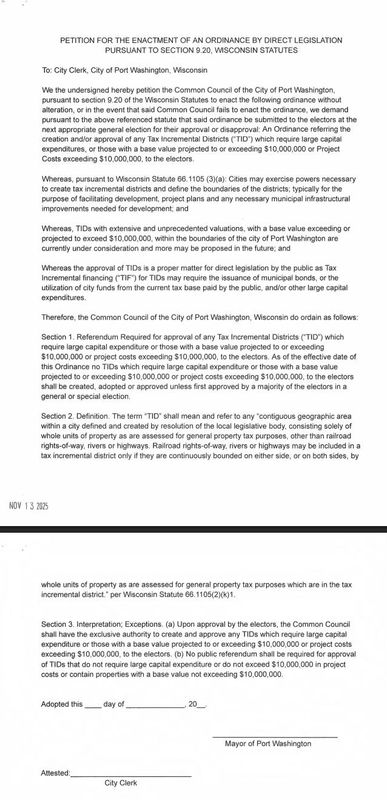
“Pursuant to Wisconsin Statute § 66.1105, the City of Port Washington may, through its Plan Commission and Common Council, exercise the powers necessary to create Tax Incremental Districts. Pursuant to Wis. Stat. § 9.20, through the power of direct legislation, the electors of the City of Port Washington have put forward a proposed ordinance. Shall the City of Port Washington adopt the proposed ordinance, which, if adopted, would bar the City from creating or approving a Tax Incremental District that requires a large capital expenditure, or with a base value projected to or exceeding $10,000,000.00, or project costs exceeding $10,000,000.00, unless the creation or approval of such a Tax Incremental District has been approved by the majority of electors in a general or special election?”
A ‘yes’ vote would express support for adding a public vote to the city’s approval process for any developers’ new requests for over $10 million in tax incremental financing. If approved, the ordinance would not necessarily remove the common council’s or plan commission’s authority to also hold votes on new TIFs, which is outlined in Wisconsin TIF laws. But the ordinance would add a new checkpoint in the form of future ballot referendums. It would only apply to new TIF requests, not existing ones, like TIF No. 5 for Vantage, OpenAI and Oracle’s $15 billion artificial intelligence data center on the north side of the city.
A ‘no’ vote would leave authority over TIF approval where it currently lies – solely with the city’s common council and plan commission, though members of the public could express their perspectives during public hearings.
The ballot question includes much of the same language as is written in ordinance.
Proposed TIF ordinance would give voters a say in large tax incentives for developers
The proposed TIF ordinance up for referendum was proposed through a petition by the local, grassroots anti-data center group Great Lakes Neighbors United.
It all started as the city’s common council moved to approve $458 million in tax incremental financing for the data center in November 2025. At the time, members of Great Lakes Neighbors United had been regularly opposing the data center and the tax incentives at city meetings for several weeks. In early November, they took on a new effort to propose an ordinance that would add a voter checkpoint for new TIF approvals under Wisconsin direct legislation law.
Over the course of a week, the group collected roughly 1,000 signatures from city residents in support of the new measure, and their proposal was certified by the clerk near the end of November.
At the common council’s Dec. 16 meeting, city officials expressed serious concerns about the proposal but voted to place it on the spring election ballots, since their only options under state law were to either adopt the ordinance as written or hold a referendum.
Proposed TIF ordinance likely to face legal challenge from business groups if approved by voters
On Jan. 29, several Wisconsin business and trade groups, including MMAC, filed a lawsuit against the city and its clerk, seeking to halt the referendum. They argued the proposed ordinance is too vague, would slow development, conflict with state laws and set a “dangerous precedent,” according to the suit filed Jan. 29 in Ozaukee County Circuit Court.
The city’s response, filed on Feb. 3, says officials “largely agree” with the business groups but have no choice but to advance the referendum, citing Wisconsin’s direct legislation law.
On Feb. 23, Judge Adam Gerol rejected the business groups’ motion to halt the referendum, saying it was not appropriate for the courts to end an election or rule on the constitutionality of a hypothetical ordinance that hasn’t become law.
However, he said the court may take up the business groups’ challenges to the ordinance’s constitutionality if and when it’s passed by a majority of Port Washington voters.
After the ruling, the business groups issued a statement on Feb. 24, expressing disappointment with Gerol’s decision and reiterating their intent to continue litigation if the ordinance passes.
Contact Claudia Levens at clevens@usatodayco.com. Follow her on X at @levensc13.
This article originally appeared on Milwaukee Journal Sentinel: What to know about Port Washington’s novel TIF referendum ballot question
Reporting by Claudia Levens, Milwaukee Journal Sentinel / Milwaukee Journal Sentinel
USA TODAY Network via Reuters Connect