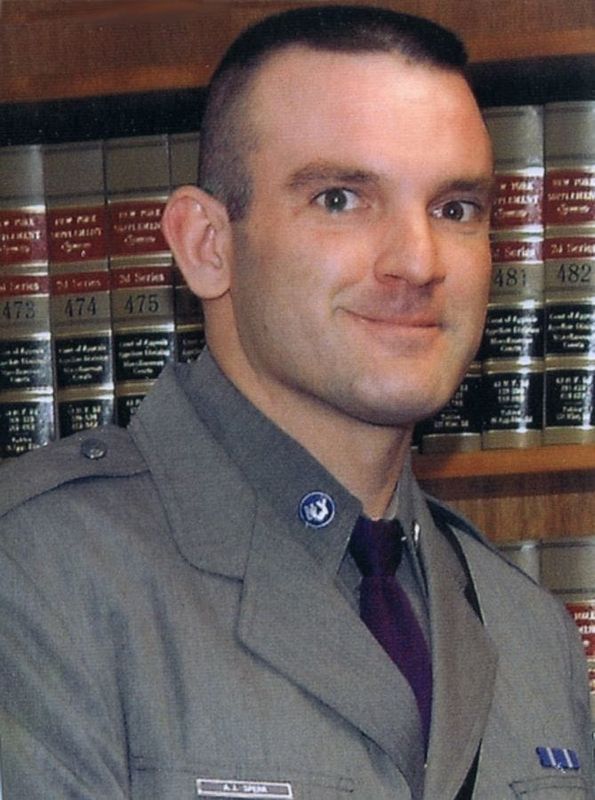
He still has a locker at the Horseheads state police barracks, even though it has been two decades since state Trooper Andrew J. Sperr last used it.
Sperr once utilized that locker to store his clothing and other personal items, but these days, it holds a few simple mementos that offer mute testimony to Sperr’s service to the community — and his ultimate sacrifice.

It was March 1, 2006, when Sperr was shot and killed while on routine patrol in the Town of Big Flats, and on the 20th anniversary of his violent death, family members and state police colleagues reflect on the impact of his career, and the day it all came to an abrupt end.
“The New York State Police continues to honor the memory and sacrifice of Andrew J. Sperr, who was tragically killed in the line of duty on March 1, 2006, in Chemung County,” said state police Troop E Public Information Officer Lynnea Crane. “Twenty years later, his service and dedication remain an enduring example of courage, professionalism, and commitment to protecting the people of New York state.”
What happened on March 1, 2006?
When Sperr, who was assigned to the Horseheads state police barracks in 1999, stepped into his patrol vehicle to begin his tour of duty March 1, 2006, he had no way of knowing it would be for the last time.
Part of Sperr’s routine was making a pass down little-used Lowe Road, a dead-end stretch off Kahler Road in the Town of Big Flats near a former dairy farm. The area was a known hangout for drug users.
Sperr made that pass on this day as well, unaware that he would encounter two desperate men who had just robbed the Big Flats branch of Chemung Canal Trust Co. The suspects — driver Bryan Adams and passenger Anthony Horton — were about to ditch a stolen pickup truck they used in the holdup for a getaway car they had parked earlier on Lowe Road.
Curious about where the truck was coming from after he noticed the rear license plate dangling loose, Sperr turned around and pulled Adams over. As the trooper approached the vehicle, Horton tightened his grip around the handle of a stolen .357 Magnum revolver.
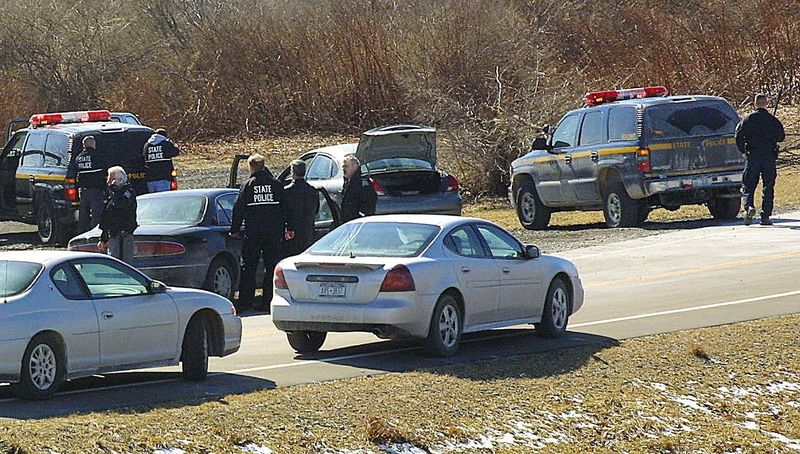
A few minutes later, after a furious exchange of gunfire, Sperr lay mortally wounded near his vehicle, and Horton and Adams were scrambling for the getaway car. They didn’t make a clean escape, however. Sperr managed to hit both of them before he died, hastening their capture later that day.
It wasn’t until after the deadly encounter that a bank employee reported the robbery, and police units were dispatched.
Due to the remote location, the shooting scene wasn’t discovered for nearly an hour, when a passing motorist noticed the flashing police car lights. A short time later, another, more chilling call went out.
“Officer down.”
A crime that shocked the Southern Tier community and beyond
News of Trooper Sperr’s death spread quickly.
For former Chemung County District Attorney John Trice, who prosecuted Horton and two accomplices, the killing was shocking because Horton was willing to risk everything for a paltry sum of cash.
“I mean, you take some money from a bank, what 1,900 bucks? And it’s like you’re going to kill someone for that?” Trice asked. “You’re going to end a life and especially the life of someone of Andy’s stature and nature?”
Sperr showed the strength of his character by returning fire and striking his assailants even after being wounded, when he could have simply sought cover and survived, Trice said.
That act of bravery cost him his life, as Horton fired the fatal shot as he and Adams ran toward the getaway car.
“Andy did all he could. It’s remarkable what it said about his character,” Trice said. “He was losing blood, but doing everything he could to make sure those guys could not get away and harm anyone else.”
The grief over the trooper’s death was felt by state police colleagues and other law enforcement, and many people who had never even met the man affectionately known as “A.J.”
It also extended beyond the Southern Tier to the Rochester area, where Sperr was from and where most of his family still lived.
“So much time has passed but I can remember March 1, 20 years ago, like it was yesterday,” said Sperr’s mother, Jean Sperr. “It’s hard to forget that day and how much pain it brought the entire family. I don’t think of Anthony Horton, the person, he doesn’t deserve that, but I do think about what he took that day.”
An emotional trial
In addition to Horton, prosecutors also charged Bryan Adams and his brother, Wayne, who acted as a lookout for the bank robbery, with second-degree murder.
Horton, meanwhile, was charged with multiple crimes, including aggravated murder, the most serious homicide charge in New York, involving the intentional killing of an on-duty police officer or correction officer. The penalty for a conviction is life in prison without possibility of parole.
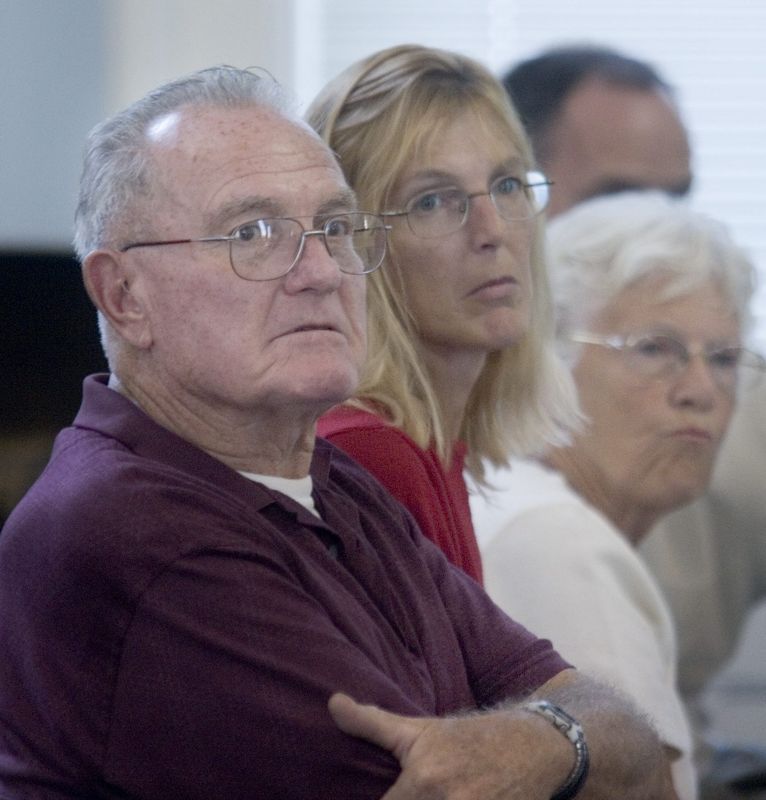
Sperr’s parents and several of his siblings traveled to Elmira in September 2006 to observe the trial as it unfolded.
Then-Chemung County Public Advocate Richard W. Rich Jr., who is now a county judge, faced the daunting task of defending Horton against overwhelming evidence.
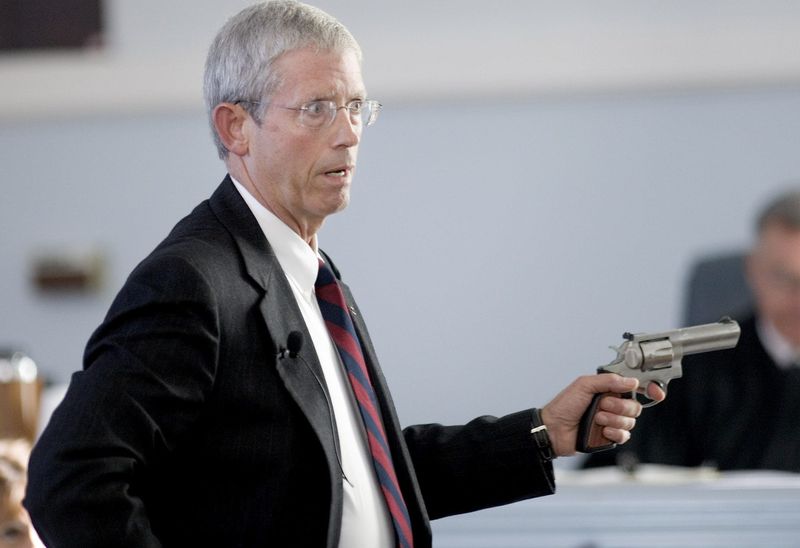
Rich conceded at the outset of the trial that Horton did indeed fire the shots that killed Trooper Sperr. His goal was to convince the jury Horton was only trying to escape, and did not intend to kill the trooper.
“You’ll have to find it was Horton’s conscious purpose,” Rich told the jury during his summation, in hopes of persuading them to convict Horton on the lesser charge of second-degree murder.
“He did have a gun. None of the people involved in the planning said Mr. Horton said he planned to use the gun,” Rich argued. “The purpose of the gun was to scare the teller. There was no specific mention that he planned to use it to kill anybody.”
Bryan and Wayne Adams, meanwhile, both pleaded guilty and Bryan Adams testified against Horton in exchange for a recommended lighter sentence.
After a weeklong trial that included hours of emotional testimony from a variety of witnesses, the jury deliberated for only a few hours before coming back with a verdict against Horton — guilty on all counts.
A month later, Chemung County Judge James Hayden had praise for Sperr when he sentenced Horton to life in prison without parole.
“Trooper Sperr displayed valor, he exhibited courage, fearlessness and bravery. This valor was especially uncommon, because it was displayed when no one was watching,” Hayden said.
Horton is serving his life sentence at the Wende Correctional Facility in Erie County.
Bryan Adams, who pleaded guilty to second-degree murder and first- and second-degree robbery, is serving a 22-year-to-life sentence at the Elmira Correctional Facility and will be eligible for parole in March 2028.
Wayne Adams served a 15-year determinate sentence in state prison and has since been released.
The convictions were the result of outstanding and exhaustive investigative work, an indication of the high esteem law enforcement colleagues had for Sperr, Trice said.
“Because of the determination of the police to make sure everyone involved be held accountable, the case was incredibly well-documented and proven,” he said. “They did it out of respect and admiration. It was a tough case with the emotions involved. They made it very easy to prove.”
The aftermath: A community shows its support
While Trooper Sperr’s family and state police colleagues mourned his death, they were pleasantly surprised at how readily the Southern Tier community embraced A.J. as one of their own and wanted to celebrate his heroism and preserve his memory.
Within weeks of Trooper Sperr’s tragic death, there was already talk of turning the murder scene into a memorial park.
The property, once part of the former Rhodes dairy farm, was now owned by Chemung County, and local business and community leaders started talking with officials from the county and the Town of Big Flats about the idea.
Like most of his family, Sperr was an avid sportsman, and the consensus was a memorial park with a pond for fishing, a walking trail and observation deck for bird watching, and other amenities was a perfect tribute to his love of the outdoors.
Rich Falls, owner of the Lawnmower Center in Elmira, was one of the early organizers who pushed for a public park to honor Sperr’s legacy.
“I think some of it was about A.J. the trooper,” Falls said at the time. “Some of it was about ‘Let’s draw a line.’ To let something like this happen in our community and in any way dismiss it would have been totally wrong.”
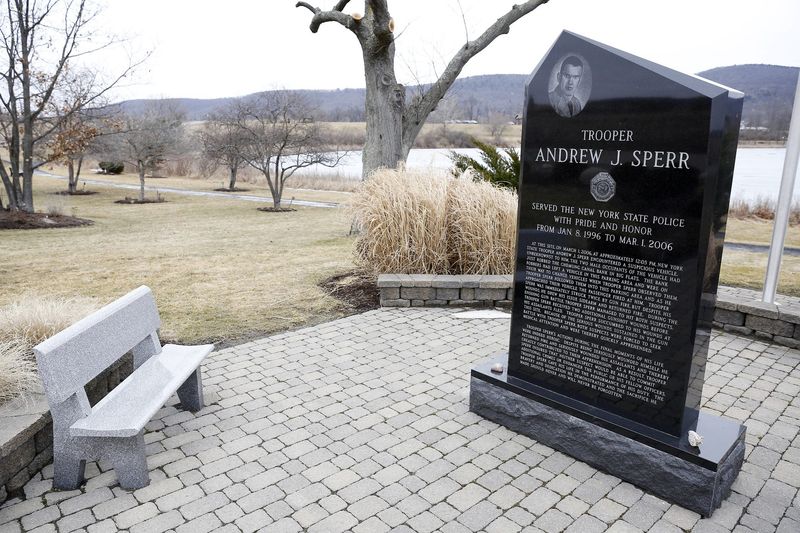
Over the years, the Sperr Memorial Park has hosted special events such as the “Time to Sperr” memorial race.
“The memorial park established in his honor also stands as a powerful place of reflection for both our members and the community,” Trooper Crane said. “We are grateful that members of the public continue to visit and remember Trooper Sperr’s legacy. His dedication and bravery continue to inspire those who serve today and future generations of troopers.”
The passage of time since her son’s untimely demise hasn’t eased the pain, Jean Sperr said, but she is heartened by the good that came out of the tragedy, such as the park and scholarships established to benefit young students studying for law enforcement careers.
Jean Sperr said she visits the park when she can and marvels at its beauty and the outpouring of community support that led to its creation.
She also muses on those occasions about what might have been.
“I think about what A.J.’s life would have been like, what his children would be doing today and how he would be enjoying retirement today with (fiancee) Sue, hiking, hunting and fishing, had he not been robbed of his future,” she said. “The world lost an amazing person that day, and it shows with how people are still talking about him, 20 years later.”
Follow Jeff Murray on X (Twitter) @SGJeffMurray. To get unlimited access to the latest news, please subscribe or activate your digital account today.
This article originally appeared on Elmira Star-Gazette: ‘Like it was yesterday.’ 20 years ago, trooper’s murder shocked region
Reporting by Jeff Murray, Elmira Star-Gazette / Elmira Star-Gazette
USA TODAY Network via Reuters Connect