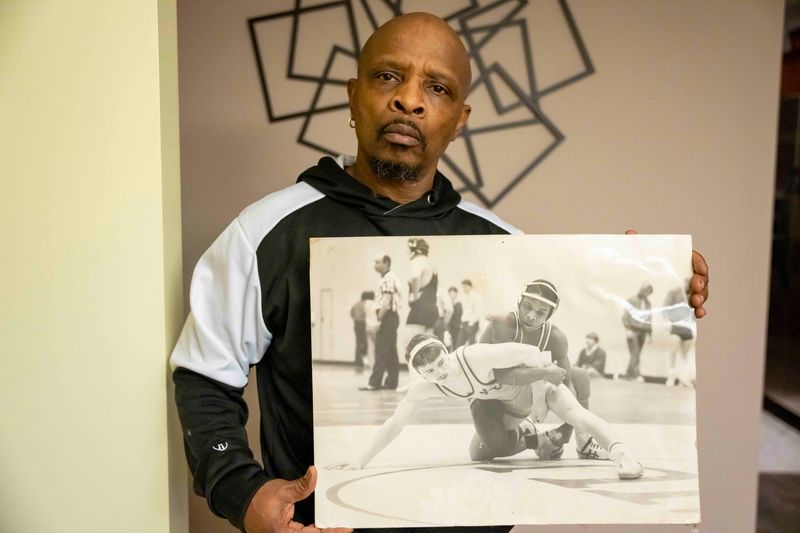
INDIANAPOLIS — The moments surrounding his victory nearly 40 years ago are a blur for Timothy Wright. He remembers some of it, but mostly he remembers that feeling in his soul. Looking up and seeing his mom, dad, sisters, brothers, cousins and friends going crazy in the bleachers.
Standing on the mat in his home venue, the Vadalabene Center at Southern Illinois University Edwardsville, which happened to host the Division II NCAA wrestling tournament that year.

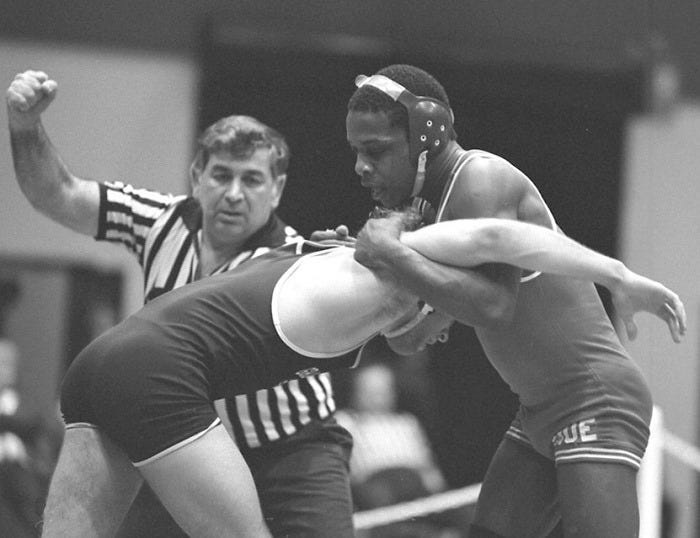
Becoming a star in one of the most significant moments to play out in NCAA wrestling history, when at the 1987 Division II tournament, Wright became the first athlete in any sport at any college level to win four NCAA titles.
Wright was overjoyed and emotional, and all those years of wrestling came flooding back. The intense workouts and the emotional battles. The victories, all those victories (141-8-2) he’d fought for to get to this moment.
And in that blur, without thinking about it, after becoming the first four-time champion in NCAA history, Wright did a little dance. It was a few hip thrusts with a pump of his arms.
He turned to shake his opponent Roger Singleton’s hand. Then, the official walked up and raised Wright’s arm in victory. Wright took a couple steps, jumped into the air, pumping his fists.
When he landed, he thrust his hips a few more times before walking off the mat to the arms of his coaches and teammates.
The celebration wasn’t planned. It was an off-the-cuff, emotion-induced reaction. If he had planned it, Wright says, it would have been much cooler than that. Instead, Wright describes what he did as a “smoother version” of the goofy move PeeWee Herman did in his kids’ television show.
“Just something went over me and I just did it, just boom,” Wright, 61, said. “I just kind of realized, man, you know, what I had just accomplished.”
And with that dance, Wright believes his historic feat faded almost as soon as it happened.
Wright didn’t really think about it at the time, how odd it was that not one reporter came up to interview him inside the Vadalabene Center after he had accomplished something that had never been done in the 81-year history of the NCAA.
He’d been interviewed by television announcers before the match. He thought they’d interview him after. They didn’t.
“I was right there, you know, right there,” Wright said. “Didn’t even get an interview. Not even from my school. The first ever four-time NCAA champion in the history of wrestling.”
Wright got a little love from his hometown newspaper in Rock Island, Ill., the next day with a front page story. But he didn’t get what an athlete who had done what he had just done should have gotten. A search of newspaper archives from 1987 found few mentions of what Wright had accomplished.
But even more insulting, Wright says, was the “MVP snub” from that tournament. He didn’t win the Outstanding Wrestler award. That went to Darryl Pope, who was a two-time NCAA champion with Cal State Bakersfield, who won the 1987 team title.
Wright had led his SIUE team to three straight titles in 1984, 1985 and 1986, and the team placed second in the 1987 tournament. Yet Wright had made the kind of history at that tournament in 1987 that rarely gets written in sports.
It’s a puzzle to Al Sears, a teammate of Wright’s at SIUE, who was at the match as an assistant coach. It’s a puzzle why Wright didn’t get the Outstanding Wrestler award in 1987. The dance Wright did was not even close to offensive in any way, Sears said.
“If you see what these guys do after a single catch in the NFL, what Timmy did was nothing,” said Sears, who wrestled in the top weight class at 6-2 and 270 pounds. “What he did was so spectacular in the six minutes leading up to that moment, he should have been able to go out there stripped naked and run around the place and nobody should have said anything because what he did was so, so unbelievable.”
At the time, Wright said he didn’t think about not getting the MVP.
“But as time went on, I knew what it was all about. I ain’t gonna lie and say I didn’t know. It was some racist (crap),” Wright said. “But when you’ve been bull(crapped) half your life and just accept it is what it is, nothing you can do about it, you move on. I ain’t mad at nobody. I ain’t gonna go looking for somebody.”
And so, 39 years ago, Wright tucked away that magical moment in his life and moved on.
‘He got snubbed’
After graduating from SIUE, Wright worked forging steel for a few years. In 2000, he moved to Indy where he helped coach Cathedral and Warren Central to state titles. These days, Wright gets up in the wee hours of the morning to make his daily trek from Indy to St. Louis as a CDL driver.
Through the years, old teammates and friends have reached out to Wright still furious that he didn’t get that Outstanding Wrestler award in 1987. Wright always responded. “Yeah, but what can we do about it?”
Unbeknownst to Wright, a few of his college teammates got together last year and wrote an email to SIUE Chancellor Dr. James T. Minor, pleading for “justice” for Wright, asking Minor to do something to give Wright the recognition he deserves.
“A great racial injustice occurred on the campus of SIUE in 1987 when upon becoming the first man to win four consecutive NCAA championships in NCAA history in any sport (DI, DII or DIII), the award for the Outstanding Wrestler was denied to him by men who sought any reason to disqualify him based on his color alone,” the letter to Minor reads, in part.
“A less than five second celebratory dance at the end of his victory and accomplishment was enough to set the fire to racial prejudices by the coaches who voted for the Outstanding Wrestler award.”
IndyStar reached out to Chancellor Minor through his assistant for comment on that letter and Wright’s accomplishment. Minor did not respond.
Wright’s teammates say the school should step up for “the little kid from Rock Island, Illinois, who helped change a whole lot of what we had going on at SIU Edwardsville,” Sears said.
“He should not have been denied (that MVP) because what he’d done is just break NCAA history. He got snubbed there and I’m not sure what the exact circumstances were. He should really be praised for what he did there. He opened the door for lots of people.”
When Wright learned his teammates had sent that letter to Minor, he was shocked and flattered. But he says he isn’t expecting any recognition, not after all these years. He is just thankful that his story is finally being told.
No one worked harder than Wright
Wright’s journey to wrestling came with a bit of pushback — by him. He grew up in Rock Island, Ill., in a large middle class family. His father worked for International Harvester for more than 40 years. His mother worked for John Deere then at Community Hospital East when the family moved to Indy.
Sports were a big deal among the Wright kids, three boys and four girls. And Wright was one of those kids who played every sport and was really good at all of them. He particularly loved basketball.
But Wright was small, barely five feet tall in seventh grade, so when it came time to try out for the basketball team, Wright noticed the coach was paying a lot more attention to another point guard, a bigger kid. He was giving him more playing time in practice games, and Wright was not happy.
“It was like he already, coach’s mind was set. And so one day I just said, pissed off, ‘I’m going to wrestling practice,'” Wright said. “So, I walked into the wrestling room.”
There was one sport Wright had never done in his life — wrestling — but he started doing pull-ups and pushups with the team, beating every single one of those wrestlers. Then, as the team started practicing, the coach noticed Wright was picking up the moves fast.
At the end of that practice, Wright said he was told to get on the mat with the team’s star, who had gone 12-2 the year before.
“And I took him down.,” Wright said. “Coach was like, ‘OK, wait a minute. Go again.’ I took him down again. Then he said, ‘OK one more time.’ I took him down again, three times in a row.”
As Wright left that day, the coach told him what a great job he had done and asked him to come back to practice the next day. Wright told him, “Nah, I’m a basketball player.” The coach said, “No, you’re a wrestler.”
Wright went back to basketball tryouts and, three days later, when the coach made his cuts, he was off the team. Wright later found out that the wrestling coach had talked to the basketball coach.
“So, he cut me. It was the best thing that ever happened to me,” Wright said. “Looking back at it now, instead of me going out playing basketball, sitting on the bench, when I could have been in the wrestling room. So, God works in mysterious ways.”
Wright was undefeated his seventh and eighth grade seasons and, by the time he was in high school, he was gaining national attention winning summer tournaments across the country, beating the state’s elite and dominating at Rock Island as a two-time state champion who was named Illinois Outstanding Wrestler his senior season.
When SIUE coach Larry Kristoff caught wind of this 5-2, 118-pound wrestling phenom, he wanted him on his team.
“All of a sudden, Timmy showed up, and he’s on the wrestling team at SIU Edwardsville with us,” said Sears, who was two years older than Wright and knew all about this star wrestler. Sears had grown up wrestling in Illinois and seen Wright at tournaments.
“The first time I ever laid eyes on him, I was like, ‘Wow, that kid is special,'” Sears said. His admiration of Wright only grew as they were teammates at SIUE
“You know, he’s a little guy. He’s got a little stature, but he is a man amongst boys, even with guys my size, because of his attitude. It’s amazing,” Sears said. “He’s just a tough guy who didn’t put up with any (crap) with anybody, but he carried himself everywhere with the same championship demeanor that he did on the mat.”
For Wright, college was a whole different level of wrestling than he’d seen before. Guys in the locker room who could make him better, guys at higher weight classes who could beat him. Wright went all in.
He showed up to run stairs before practice, and he stayed after practice to run more stairs. He lifted weights, jumped rope, did extra pushups, extra pull-ups — and it paid off.
During his college career, Wright wrestled Division I schools — Iowa, Iowa State, Oklahoma, Oklahoma State, Nebraska, Minnesota — and beat them. At one match against Iowa, the top team in the country, just two SIUE wrestlers won. The 177-pounder and Wright.
By the time he was ready to wrestle the final match of his college career in 1987 for the national championship, Wright’s SIUE team had won the past three Division II national titles and Wright was a household name in collegiate wrestling.
Before the match, coach Kristoff approached Wright: “You know if you win this, you will be the first wrestler to win four championships. First ever in the history of the NCAA.”
‘I didn’t disrespect nobody’
Wright entered the 118-pound NCAA Division II championship match in 1987 with a 29-2-1 record. His opponent was Grand Valley’s Singleton, 32-3.
“No one in the history of the NCAA has won four individual championships in any sport,” television broadcasters said before the match. “The only thing standing between him and that awesome accomplishment is Roger Singleton.”
The broadcast then showed the pre-game interview with Wright, asking him about his chance at making NCAA history.
“It’s pretty exciting for me but, right now, I’m trying not to worry about it,” Wright said. “Hopefully (I’ll) go out and wrestle my style the way I’ve been doing all year. I think I can do it. I think I have a good shot at doing it.”
And Wright did it, winning the match by an 11-7 decision.
But that dance he did afterward seemed to fuel something among the coaches who voted for the Outstanding Wrestler award for the tournament, says Wright and his teammates.
IndyStar reached out to the NCAA for comment on Wright’s accomplishment and the MVP vote. It declined but suggested the National Wrestling Coaches Association, which handles the voting on Outstanding Wrestler for NCAA championship meets.
In 1987, a paper ballot was used by coaches to vote on the Outstanding Wrestler award, said Jim Fallis, collegiate leadership group coordinator for the NWCA. Coaches were asked to turn in their ballots as close to the end of the championships as possible, and the president of the coaches association handled counting the votes.
“As for how Tim may have demonstrated his success in winning four championships, that certainly could have had an impact (on voting),” Fallis said. “But keep in mind that as coaches vote, some may look at a wrestler’s body of work over his career, while some may look strictly at the body of work in this specific championship. The Outstanding Wrestler is for that championship.”
Historically, Wright’s post-match dance stood out in the 1980s, said Sears, a time when wrestlers celebrated more conservatively with hand raises, fist pumps, bows or hugs and high fives with coaches and teammates. Wright’s victory performance was edgy, but not offensive, Sears says.
“He’s doing his dance,” the TV announcers said, laughing as Wright celebrated. “He has set a precedent here. He has set a precedent. … Tim Wright does what no one has ever accomplished in the NCAA — four individual national championships.”
The relics of those memories from Wright’s historic college career are dusty, hidden away much like his accomplishments have been through the years. There are dozens and dozens of medals and trophies and plaques.
But not that one — the 1987 Outstanding Wrestler.
While Wright seemed the likely candidate for MVP given his historic performance, the winner Darryl Pope was on the championship team in 1987. He and Cal State-Bakersfield scored 90.5 points to SIUE’s 69.5, and Pope became a two-time individual champion.
While some allege Wright’s dance set off a racial controversy that impacted the MVP voting, three years before Wright’s prolific run, John Davis became the first Black athlete to win the NCAA Division II Outstanding Wrestler. Davis was a two-time national champion (158 pounds) with the Morgan State Bears when he won in 1984.
But Sears and Wright’s other teammates are adamant. Wright made such monumental history at that tournament in 1987, becoming the first athlete in the 81-year history of the NCAA to win four titles, that he is unequivocally the Outstanding Wrestler.
That match nearly 40 years ago, and that snub, still sometimes plays over in Wright’s mind. Of all the awards he has won, that 1987 MVP is the one he thinks he deserved the most.
“Had I been somebody else, it might have been a little different for them,” said Wright. “The little dance I did afterwards, I don’t think I did anything to discriminate against the guy I wrestled. I didn’t disrespect nobody, I just did a little dance, you know, and they took that from me.”
Follow IndyStar sports reporter Dana Benbow on X: @DanaBenbow. Reach her via email: dbenbow@indystar.com.
This article originally appeared on Indianapolis Star: He was first athlete to win four NCAA titles, but the celebration never came
Reporting by Dana Hunsinger Benbow, Indianapolis Star / Indianapolis Star
USA TODAY Network via Reuters Connect