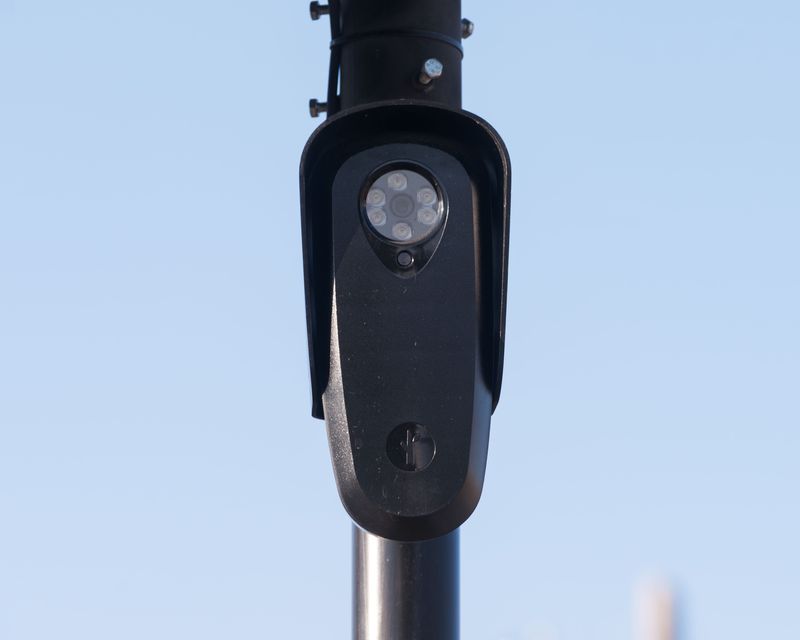
EVANSVILLE — In May 2025, a sheriff’s deputy in Johnson County, Texas, logged into a nationwide network of artificial intelligence-powered license plate cameras to perform a search that would soon become a flashpoint in the national debate over government surveillance.

“Had an abortion, search for female.”
The search swept across more than 83,000 Flock Safety cameras — devices mounted on telephone poles and traffic lights in thousands of cities and towns across the country, including in Evansville and Vanderburgh County. The Johnson County Sheriff’s Office initially told reporters the search amounted to a welfare check. Flock Safety officials backed that account, calling it a missing person search.
Law enforcement records told a different story.
Documents obtained by the Electronic Frontier Foundation showed that when the search was conducted, Texas investigators had opened a death investigation into the woman’s fetus and had consulted with the district attorney’s office about whether the woman could be charged with a crime under the state’s abortion laws. A document justifying the search as a welfare check, it would turn out, had only been created after 404 Media reported on the case.
The fallout from an otherwise isolated search ricocheted across the country in large part because of how Flock Safety’s cameras work: A search in one jurisdiction can tap cameras in others. Evansville’s cameras were part of the same network the Texas deputy queried because the city had opted in to a data-sharing arrangement granting thousands of law enforcement agencies access to locally installed cameras.
It’s not clear whether the Texas abortion search tapped cameras in Evansville specifically since not all Flock searches successfully query each available network, but the city’s cameras were open to the same types of searches during the same time frame, according to a police official’s description of the city’s network settings.
Questions about exactly how open Evansville’s cameras are to searches by outside agencies surfaced this month when the Courier & Press asked city officials to describe the city’s Flock policies as part of ongoing public safety reporting. What emerged from their answers — and from subsequent exchanges with a Flock Safety official — suggested the city may have extended access to search its cameras to third parties in ways some local officials did not fully understand.
Amid a deluge of reports detailing how Flock’s integrated network exposed local cameras to controversial searches, dozens of cities cut ties with Flock in recent months or restricted data sharing. About a two-hour drive north of Evansville, officials in Bloomington addressed mounting local opposition to the cameras at first by pairing down data sharing, launching a public review and ultimately ending the city’s contract with Flock in April.
Local officials in cities big and small have grappled with whether they truly had control over how their Flock cameras were used if they opted in to the product’s most enticing feature — the national network.
Evansville mayor described Flock data sharing as regional in scope
In April, the Courier & Press directed written questions about the city’s Flock policies to Mayor Stephanie Terry and each member of the Evansville City Council to broaden the public’s understanding of how local elected officials viewed a hotly debated issue. Terry was the only recipient to address all of the questions individually.
In a written statement describing her understanding of the city’s Flock system, Terry on April 20 laid out the city’s data-sharing arrangement in concrete terms. License plate data sharing, she wrote, “is enabled for non-federal agencies within a 500-mile radius,” along with a small number of specifically named agencies, including the U.S. Postal Inspection Service.
Terry did not mention Flock’s nationwide network or the potential for Evansville’s cameras to be queried by agencies outside of the 500-mile radius.
“This helps us support public safety efforts, including solving crimes, locating stolen vehicles and assisting in investigations,” Terry wrote. “Like any technology, ongoing oversight is required to ensure appropriate and responsible use.”
But the Evansville Police Department confirmed to the Courier & Press that the city also enabled national lookup — the feature that allows Flock-equipped agencies anywhere in the country to query local cameras. It’s also the feature that has attracted heightened scrutiny from privacy and legal advocates because it could allow agencies in one jurisdiction to conduct searches that would violate or run counter to policies in another, such as for immigration enforcement.
EPD Capt. Patrick McDonald, who administers the city’s Flock network, said in a July 2025 email that Evansville opted in to nationwide searches.
“Yes, the Evansville Police Department has enabled ‘National Lookup,'” McDonald wrote. “For a user agency to be able to access Flock cameras across the nation, they have to allow reciprocal access.”
Last year, the Courier & Press utilized public records listing searches of the Vanderburgh County Sheriff’s Office’s Flock network to report that agencies in Florida, Texas, Arizona, Kentucky and elsewhere had utilized national lookup to query county-operated Flock cameras for immigration-related investigations.
The Electronic Frontier Foundation (EFF) and 404 Media found that Flock’s national network allowed for immigration-related searches to tap cameras even in states that barred such uses, such as Illinois, so long as the search came from outside that jurisdiction. Flock has since removed or curtailed national network access in Illinois and other states where it could violate local laws, though in Indiana it remains up to each Flock customer to opt-in or out of the network.
Researchers and media outlets have documented other controversial searches, too. Through an analysis of more than 12 million Flock searches logged by more than 3,900 agencies between December 2024 and October 2025, EFF found that more than 50 federal, state and local agencies ran hundreds of Flock searches, including through the national network, in connection with protest activity.
EFF identified 19 agencies — including U.S. Border Patrol — that performed dozens of searches associated with the so-called No Kings protests in June and October 2025.
“Some agencies have adopted policies that prohibit using (Flock cameras) from monitoring activities protected by the First Amendment,” the EFF wrote. “Yet many officers probed the nationwide network with terms like ‘protest’ without articulating an actual crime under investigation.”
McDonald confirmed in a phone interview this week that the city had configured its Flock system to “auto-accept” incoming data-sharing requests by agencies located within a 500-mile radius, as the mayor described, but that it also still enabled national lookup.
“‘National lookup’ does not include agencies with whom you do not have a reciprocal agreement,” McDonald said in an April 21 email, indicating the city believed the 500-mile radius limit would also apply to national lookup searches.
But when the Courier & Press put questions about Flock’s data-sharing settings to a company spokeswoman, Holly Beilin, she said Thursday that national lookup did not take into account the reciprocal agreements McDonald described or the 500-mile radius cited by Terry.
The national network is “separate from the 1:1 relationships and is reciprocal,” Beilin said. In a previous interview earlier this week, Beilin described the national network as being separate from Flock customers’ other data-sharing relationships, and she put the burden on state and local governments to decide how agencies should configure the settings.
“The national network, that’s a separate network,” Beilin said. “Any agency that joins the national network is in a reciprocal sharing relationship, so if they’re sharing, then every agency that’s in the network is also able to share with them.”
Asked for comment on Beilin’s characterization of the system, McDonald said, “If that’s what they’re saying, I have no reason to dispute it.”
When the Courier & Press asked Terry’s office to clarify whether the city allowed for nationwide searches beyond the 500-mile radius she described, her spokesperson deferred further questions to EPD. The mayor, the spokesperson said, had described the city’s data-sharing policies “in good faith” based on what she had learned from police.
Terry’s office did not immediately respond to additional questions Thursday about whether she understood Evansville’s Flock cameras to allow nationwide searches or whether she had sought clarification on the matter.
Beilin said the national network is different from the data-sharing agreements Evansville police may sign with an individual agency or those they would limit through the 500-mile radius setting. An agency with a direct data-sharing arrangement with another can use Flock’s broader AI-powered search functions to hunt down vehicles based only on a partial license plate number or a description, whereas the national network requires investigators to search for a single vehicle based on a full plate number.
“We could turn off the nationwide (setting),” McDonald said. “We could turn off statewide, because that’s another option, and then we could only pick the individual, specific agencies we would want to use. Then you would be limited to being able to search your cameras and that particular agency’s cameras.”
City Council president says officials grappling with ‘learning curve’
Two City Council members responded to questions the Courier & Press addressed to each member of the body earlier this month: Councilwoman Mary Allen, D-At Large, and Councilwoman Angela Koehler Lindsey, R-Fifth Ward. City Council President Ben Trockman did not respond to the written questions by the April 20 deadline but took questions during an interview on Thursday.
The questions addressed the city’s Flock data sharing policies, whether the council members would seek to limit Flock searches by outside agencies for uses such as immigration enforcement and how they viewed their oversight role as it relates to the city’s adoption of advanced policing technology.
“At this time, I don’t feel like I have enough information to answer these questions,” Lindsey said in an April 13 email to the Courier & Press.
Allen, who is seeking the Democratic Party’s nomination to run for Indiana’s Eighth Congressional District, said that after receiving the questions, she met with Evansville Police Chief Phil Smith and Vanderburgh County Sheriff Noah Robinson to discuss local law enforcement’s Flock policies.
“We have heard concerns from residents, including several presenting at the city council meeting last night,” Allen said in an April 16 statement. “I confirmed that Evansville utilizes the least invasive configuration of this technology: the cameras are strictly for License Plate Recognition (LPR) and do not utilize facial recognition or audio surveillance.”
Allen went on to say she came away from the conversation believing that searches of Evansville’s Flock camera data by outside agencies were strictly controlled by local personnel and that the system has not been used for immigration enforcement. In response to follow-up questions about the city’s data-sharing policies, Allen said she needed to learn more about the city’s national network integration.
In an interview Thursday afternoon, City Council President Ben Trockman, D-First Ward, said the city was grappling with a steep learning curve as it sought to balance public safety interests against privacy and ethical concerns.
“Flock is a powerful tool that can be the future of law enforcement, but there is a strong learning curve, and I think that we all, from council to all of our law enforcement agencies, are still learning the best ways to implement Flock while also going after the bad guys, while also protecting our people,” Trockman said.
In her April 20 statements, Terry indicated she would consider reviewing recent Flock policy changes implemented in other cities.
“I’m aware that some cities have taken a more geographically limited approach, and I think it’s important to evaluate what adopting a similar approach would mean for our community,” Terry said with regard to data sharing. “Any potential changes to our policies should be informed by facts, specifically, what impact it would have on our ability to solve crimes…
“I have not asked EPD to formally evaluate this, but I’m open to doing so to ensure we can make informed decisions based on what’s best for our community,” Terry added.
Beyond the data sharing debate, Terry defended the city’s adoption of Flock’s technology, saying the system was “focused on public safety” and that EPD was “operating within its existing policies and the capabilities of the platform.”
“So, this is not about reacting to headlines, but about making sure we are continuously evaluating whether our policies strike the right balance between safety, privacy and accountability,” Terry said.
The comments come as Trockman and at least two other council members and a police representative plan to meet Friday with a newly founded local group, DeFlock Evansville, that seeks the outright removal of the city’s Flock cameras, citing privacy, legal and data security concerns.
DeFlock Evansville representative Adam Carey told the Courier & Press the group’s opposition to Flock cameras goes beyond the city’s data-sharing agreements or the cameras’ use for immigration enforcement. Carey fears the cameras could be leveraged for more invasive forms of surveillance without local input and said he does not trust Flock to manage the data Evansville and other cities entrust to it.
“If you implement an untrustworthy system and you just swap it for another untrustworthy system that also partners and aligns with other big tech conglomerates, then replacing the system isn’t really a fix,” Carey said with regard to his opposition to simply restricting data sharing or replacing Evansville’s Flock cameras with another brand of license plate reader. “It would still be an invasion of privacy.”
In social media videos that have since garnered tens of thousands of views, Carey lobbies for Evansville residents to call for the cameras’ removal. In one video, he can be seen triggering what he said was an infrared light on a local Flock camera by walking past it, which he said undercuts the company’s claims that its license-plate cameras don’t photograph people.
Lavender Timmons, another DeFlock Evansville member, said in response to questions about whether the group would be satisfied if Evansville opted out of Flock’s national network that her concerns trace to the fundamental customer relationship between the city and Flock, citing the company’s control over access to local data.
“This is functionally a city-operated location-tracking system on every resident with a car, and Indiana currently has almost no legal guardrails for how that data can be used or misused,” Timmons said.
McDonald maintains that Flock cameras constitute a leap forward for the city in its fight against crime. He understands the concerns over data-sharing or specific use cases such as immigration enforcement, but he can’t understand wanting to get rid of the cameras entirely.
“If we find evidence that something is being misused, we’ll take the appropriate steps to address it,” McDonald said. “But you can’t do a disservice to the victims of crime in Evansville by saying, ‘What if somebody misuses something somewhere else?'”
It remains to be seen whether Evansville officials will push for a review of the city’s Flock data-sharing arrangements, more restricted settings — or the Flock contract cancellation favored by DeFlock Evansville. Trockman said he thinks there’s appetite for a “middle” solution.
“We hear concerns from friends and neighbors frequently,” Trockman said. “We’ve got to be flexible along the way to make changes that make things better… Maybe I’ll speak for myself, but I think that we’re all open to amending the way that we do things as we learn more and hear from others, and that’s just what we should be doing as community leaders.”
This article originally appeared on Evansville Courier & Press: Evansville shared Flock camera data nationwide. Did officials know?
Reporting by Houston Harwood, Evansville Courier & Press / Evansville Courier & Press
USA TODAY Network via Reuters Connect