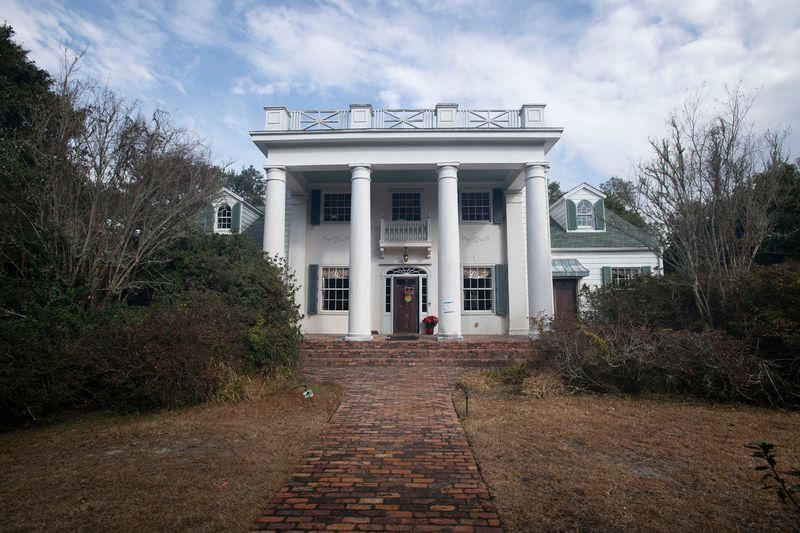
The “Fairnie Hall” house on Lakeview Avenue has a 60-day reprieve from demolition and is back on the housing market for someone to buy to preserve, while a group of East Hill residents is trying to organize to create a preservation movement to save notable homes in the city.
The Pensacola Architectural Review Board voted unanimously to delay the issuance of the demolition permit of the home at 1182 E. Lakeview Ave. The ARB members made clear that if they were legally able to stop the demolition altogether, they would, but under city code, the board only has the power to delay the demolition of a home of historical significance for 60 days.

Pensacola home builder George Sitton was seeking the demolition permit for two homes that included the large five-bedroom, four-bathroom house known as Fairnie Hall at 1182 E. Lakeview Ave. While the ARB delayed the demolition permit for that house, it granted the permit for the smaller house next door at 1150 E. Lakeview Ave. built in 1947.
Sitton’s company bought the property for $1.5 million earlier this month. City officials say the property is large enough that five new homes could be built on it in place of the two current homes.
Sitton did not appear before the board to speak at the meeting, but several members of the public did to ask the ARB to delay the demolition.
Nannette Chandler, owner of Chandler & Company Construction, informed the ARB that just a couple of hours before the meeting, the 1182 E. Lakeview Ave. home had been listed for sale.
Chandler has restored several older historic homes and said she was interested in doing the same here.
“Whether or not Mr. Sitton and I can come to an agreement for me to purchase this, and what all that $1.5 million includes of this property, because it is a larger property, we shall see,” Chandler said.
Beyond this home, she said that the growing number of demolitions of older homes concerns her, and she wants to organize residents to create a Pensacola Preservation initiative to save them.
“We are going to involve citizen participation in the preservation of Pensacola,” Chandler said. “We’re going to identify all the remaining significant structures that may be at risk, and then we’re going to go after purchasing them, renovating them, and maintaining them in perpetuity for the community, one way or another.”
Chandler also called on the ARB to formally request the City Council to consider a survey of residents to see their opinion for creating a “light overlay” in zoning to preserve homes in East Hill and the area of East Pensacola Heights, where the Tristan de Luna landing took place in 1559.
“There are significant archeological findings there that can’t even be thoroughly explored,” Chandler said. “I’m not going to interrupt anyone’s land rights to do that, but for people knowing what they’re buying into and what the district entails, I think a lot of homeowners would probably enjoy knowing that they have a part of history under their feet.”
Chandler added that homes like this should have stronger protections.
“This property alone, we’re talking about several hundred-year-old live oaks and other trees that would be completely gone,” Chandler said. “The wall surrounding this property is ballast stone from ships that brought stuff over here in the 1500s, and we’re talking about bulldozing it. When you put it in perspective, it’s a little outrageous.”
Why is the house historically significant?
Ross Pristera, a historic preservationist at the University of West Florida Historic Trust and advisor to the ARB, noted that the house appears to have been built in 1940 by E.C. Work, who was an accountant for lumber mill companies that still dominated the economy at that time period.
Pristera noted that the house was a “showpiece” of the time and even featured a full-page article and advertisement in the News Journal on its construction. He said it’s the first time he’s come across that for a single house rather than a larger development.
“This house has been a centerpiece on that corner,” Pristera said. “It’s very different from the houses around it, in that everybody kind of knows this grand house is there.”
The house was built on the site of a home known as Fairnie Hill Place that was once a 20-acre estate and farm owned by 19th-century Pensacola businessman Alexander Stoddart. Stoddart was the largest landowner in the area that would become East Hill and donated the land that became Bayview Park to the city.
His 19th-century home was sold in 1906, and Pristera said by the 1920s the home was gone, either by demolition or a fire—accounts differ.
When Work opened his home, it was named Fairnie Hall, according to articles in the News Journal over the years, likely after the Fairnie Hill Place home that stood on the site before.
“It’s important not just because of the earlier history of that site of Alexander Stoddard in his big estate, but if it didn’t have that tie, it’s significant enough for the architecture and the person (Work) that developed it and built it because of his connection with the Lumber companies, which was of huge importance to this area and an example of the the wealth that was created at that time,” Pristera said.
This article originally appeared on Pensacola News Journal: East Hill ‘Fairnie Hall’ demo delayed 60 days, home listed for sale again
Reporting by Jim Little, Pensacola News Journal / Pensacola News Journal
USA TODAY Network via Reuters Connect