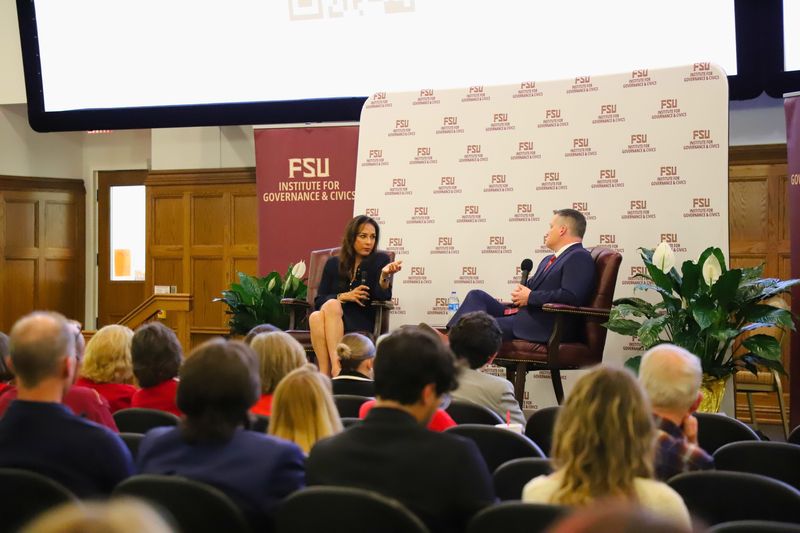
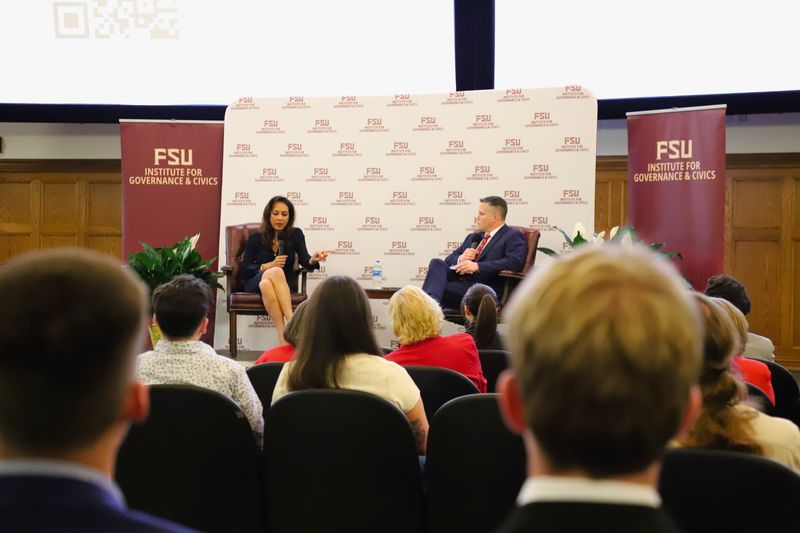
Assistant Attorney General for Civil Rights in the U.S. Department of Justice (DOJ) Harmeet Dhillon spoke about the state of civil rights with the Institute for Governance and Civic (IGC)’s Director, Ryan Owens, on Thursday, Feb. 12. Hosted by Florida State’s IGC, the event allowed Dhillon to share her experience with the DOJ and answer questions.
Before entering her current DOJ position, Dhillon was a prominent civil rights attorney and the founder of the Dhillon Law Group. She was sworn in to her position on April 7, 2025, after being nominated in December of 2024 by President Donald Trump.

“She’s got a very lengthy legal history,” Owens said to the FSView. “We thought she would be a really impressive person to bring here on campus to talk about what it’s like to lead the Civil Rights Division … ultimately, we saw her as a real opportunity to help students expand their base of understanding of what the federal government does, why it does it, how it does it.”
Recent policy shifts spark curiosity ahead of campus appearance
During her time as leader of the DOJ’s Civil Rights Division, Dhillon’s actions and policies have garnered controversy and confusion from former members of the department as well as members of the Tallahassee community.
Since she started her position leading the Civil Rights Division of the DOJ, Dhillon has taken an adamant stance against race-based affirmative action policies and DEI initiatives. The DOJ has also sued states over voter record access and expanded the Freedom of Access to Clinic Entrances (FACE) Act to protect religious institutions from violence.
The latter cause recently resulted in charges brought against journalist Don Lemon for reporting on an anti-ICE protest in a Minnesota church.
Laurel Alfson, an administrative specialist at FSU’s Center for the Advancement of Teaching, received an email advertising the event that same morning. She was interested in Dhillon’s discussion due to the uncertainty surrounding the DOJ’s recent actions.
“I think that she probably has insights that I haven’t considered before, and it sounds like she has a very important job … standing up for people who have been marginalized. And so, I’m very curious as to how that is playing out given the current political climate,” Laurel said to the FSView.
Recently, the DOJ’s Civil Rights Division faced criticism due to its lack of transparency in its investigation surrounding the Minneapolis shootings after choosing not to investigate Renee Good’s death and its lack of transparency in the investigation surrounding Alex Pretti. Dhillon touched on the nuances of these types of investigations at the event.
“There are many checks and balances within the Department of Justice … and nothing happens off the cuff,” Dhillon said to the audience. “Now the public gets frustrated with that, because it makes people think. When what they consider to be a federal civil rights violation [is] happening, or misuse of police force, or excessive force … why hasn’t there been a lawsuit, why isn’t there an investigation?”
She continued to describe the process, noting the lengthy procedural requirements.
“To get to that point, you have to write justification memos … you have to work with the Department of Homeland Security or the … FBI, to do an investigation, we have to get the facts in place,” Dhillon said. “And so we can’t communicate to the public all those background issues.”
Dhillon defends ‘colorblind’ DOJ
During the first thirty minutes of the hour-long talk, Dhillon and Owens discussed the specifics of her position and her experience leading the Civil Rights Division. Afterwards, she took questions from the audience.
Dhillon touched on her stance against affirmative action and DEI language in public higher education institutions.
“This DOJ wants to be colorblind,” Dhillon said to the audience. “We have found some institutions to be smart alecks, keeping the same faculty or the same DEI officers doing the same job, but changing their job description to ‘inclusion office’ or something like that, [so] that they think we aren’t going to pick it up. We are going to pick it up because there’s thousands of whistleblowers out there who are telling us.”
After the discussion between Dhillon and Owens, the event was opened up to audience members’ questions about the Civil Rights Division.
While some questions centered on the complexities of free speech and social media, one audience member asked a question about ICE officers’ abilities to enter citizens’ homes without a judge’s warrant, and Dhillon’s opinion on how this could breach civil rights for privacy.
“I think the law and our administration’s position has [been] articulated in many court cases on the question you just raised, is very clear. We believe that those warrants are not required,” Dhillon said.
The final question of the event centered around a British audience member who asked Dhillon her opinion on whether free speech rights override the potential spread of disinformation, specifically mentioning the false claim that Donald Trump lost the 2020 election due to “rigged” voting.
“I’ve never wanted to see this country become the UK, where people show up at your door and arrest you for having unpopular opinions. Or, frankly, very popular opinions that are out of favor with people in power,” Dhillon said.
She went on to say that her opinions are grounded in what she believes the founders of the U.S. sought out.
“That is a decision that the founders of this country made early on, that they would rather err on the side of free speech … Even if that errs on the side of ‘wrongthink’ and views that … people who think they’re well-educated would disagree with,” Dhillon said.
Tallahassee community reacts to Dhillon’s visit
Dhillon’s presence allowed students to engage with federal policy decisions here in Tallahassee.
“I think she’s done a good job from the Department of Justice to advocate for the American people’s agenda, which I think is also the president’s agenda … making sure the law is applied in a neutral way, I think that’s good. I think we may have got away from that in the past administration,” economics major Chris Lynch said to the FSView.
Not everyone enjoyed Dhillon’s talk, with some holding mixed or negative opinions.
“I mainly heard rambles and deflections, and nothing about civil rights issues,” human rights and social justice major Brooke Wolfinger said to the FSView. “I feel like she focused more on … the white conservative male and their struggles … I didn’t really hear how we can do anything to fight systemic racism or defend people just getting killed on the streets and not receiving due process.”
Undergraduate interdisciplinary social science major Andrea Cabanas shared similar opinions and concerns about the talk.
“I know that one gentleman asked about immigration … and she [Dhillon] was quick to say I’m not going to speak on it … one of my questions was going to be why is due process not afforded to everyone in our jurisdiction?” Cabanas said to the FSView.
Cabanas has doubts about Dhillon’s and the Trump Administration’s intentions in promoting civil rights.
“She is pushing an agenda that is following things that are completely unconstitutional and completely illegal,” Cabanas said. “You can interpret and misinterpret the law all you want. But when it comes to fundamental human rights, those are fundamental, right?”
Gregory Rusin is a Senior Staff Writer for the FSView & Florida Flambeau, the student-run, independent online news service for the FSU community. Email our staff at contact@fsview.com.
This article originally appeared on FSU News: DOJ’s Harmeet Dhillon speaks at FSU on immigration, higher ed policy
Reporting by Gregory Rusin, Senior Staff Writer, FSView / FSU News
USA TODAY Network via Reuters Connect