What a difference consistently frigid January weather made.
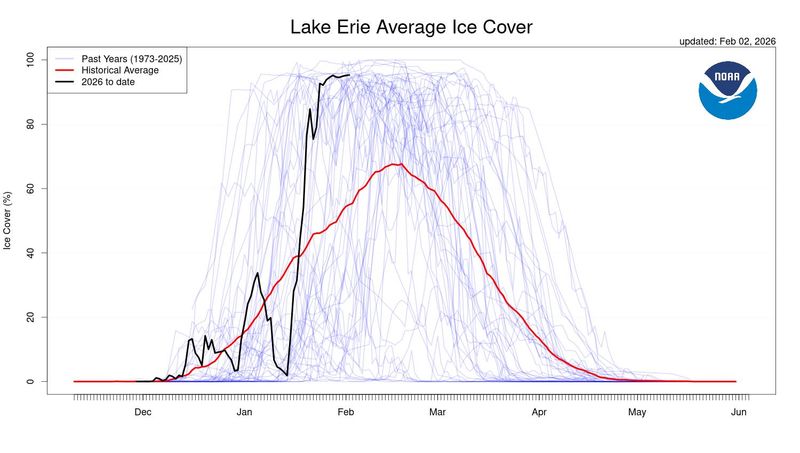
On Jan. 14, Lake Erie was less than 2% ice-covered. Ten days later, it was more than 92% ice-covered. Lake Erie is the most iced-over it has been to start the month of February in 23 years, at 95.17% coverage. Similarly, non-Great Lake St. Clair has been very nearly to completely ice-covered since about Jan. 22.

It’s a complication for ongoing winter Great Lakes freighter shipping, but ice-covered lakes have some benefits as well, including helping to prevent shoreline erosion.
A chart from the National Oceanic and Atmospheric Administration’s Great Lakes Environmental Research Laboratory showing the ice extent on Lake Erie over 52 winters shows how dramatically different things are this year than normal. The red line shows the 52-year average; the black line the ice levels this year as of Feb. 2.
“We have had years in the past where ice cover reached today’s level, more than 95%, earlier in the season — most of those likely occurred between 1973 and 2000, in the 20th century,” said R. Michael McKay, director and professor for the Great Lakes Institute for Environmental Research at the University of Windsor, whose team has been working on winter science in the Great Lakes since 2007.
All that lake ice has kept U.S. Coast Guard icebreakers busy keeping shipping lanes open for the scaled-back but always moving Great Lakes freighter industry — and it’s meant booming sales for stores catering to ice fishermen, after some recent mild winters.
“To me as a scientist, what really stands out is the year-to-year variability we have seen since 2020,” McKay said. “In this period, we have had three very mild winters — 2020, 2023 and 2024 — with very little ice cover in Lake Erie. This has been interspersed with three years of significant ice cover — 2022, 2025 and now this year.”
As shallow lakes, Erie and St. Clair tend to ice over more quickly and completely than other Great Lakes. As of Feb. 2, Lake Superior was at more than 34% covered; Lake Michigan at more than 33%; Lake Huron at more than 77% and Lake Ontario at more than 37%. Overall, the Great Lakes are more than half ice-covered.
The lakes being ice-covered in the winter has its benefits — it protects shoreline habitats, reduces erosion and lessens lake-effect snow, McKay said.
“Another benefit that is less publicized are the plentiful algae that grow under the ice in Lake Erie, which we documented during our early surveys,” he said.
Unlike the problematic so-called blue-green algae of summers on western Lake Erie, which have occasionally caused water crises with their toxins, the winter algae, known as diatoms, “are lipid rich and nutritious and may play an important role in Lake Erie’s productive fishery,” McKay said.
Disappearing ice cover
This icy winter notwithstanding, the long-term trend is clear, he said: a substantial decline in ice cover.
“Models that account for future temperature trends predict that ice cover on Lake Erie could be the exception by 2100,” McKay said.
Scientists in recent years have expanded their more logistically difficult winter studies of the Great Lakes to help better understand the impacts of ongoing changes.
“No longer do people believe that winter is simply a time of rest in the Great Lakes, but rather represents an important season in Great Lakes ecosystems,” McKay said.
Contact Keith Matheny: kmatheny@freepress.com.
This article originally appeared on Detroit Free Press: Lake Erie has most ice coverage to start February in 23 years
Reporting by Keith Matheny, Detroit Free Press / Detroit Free Press
USA TODAY Network via Reuters Connect