For the first time in more than a decade, Southwest Florida growers are bracing for what could be a catastrophic freeze.
On Saturday, the region’s growers continued their multi-day preparations for an overnight freeze, and the potential for a repeat of those same crop-killing conditions for another day — or even two.

The threat came with hundreds of millions of dollars on the line, including the value of what agricultural producers have already invested in their nurseries, fields, ranches and groves, and the potential for major crop and commodity losses.
Among the growers prepping for the worst: Alfie Oakes, the founder and CEO of Oakes Farms in Collier County, a big producer of fruit and vegetables in Southwest Florida.
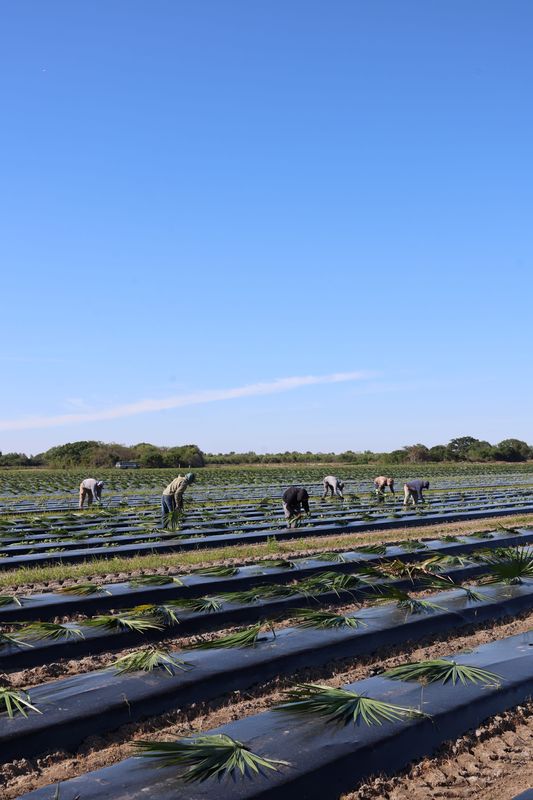
“We are covering up almost 1,000 acres of plants. We are doing them different ways,” Oakes said.
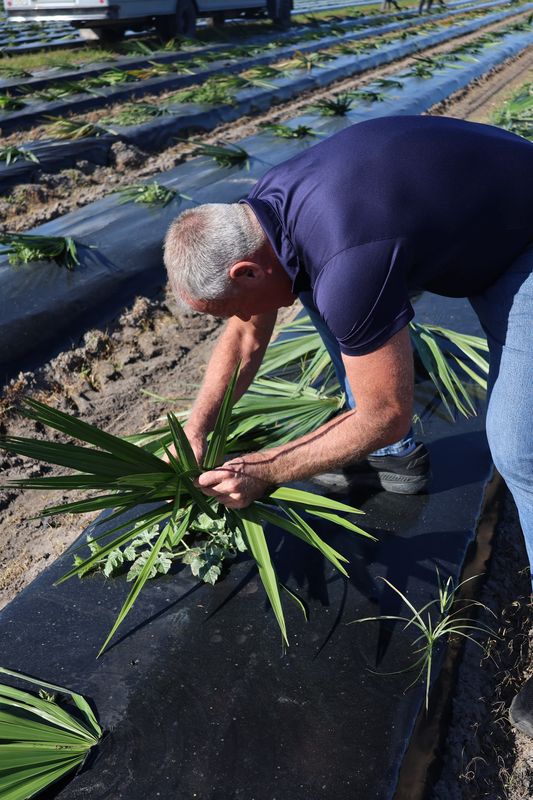
“We’ve got 1.5 million plates and cups covering over the small plants, then we’ve got 100 full truckloads of Palmetto leaves that we’ve cut to lay over the big plants,” he said.
The biggest effort has been at his largest farm in Immokalee, near the Hendry County line, which spans about 1,000 acres.
“We’ve got 700 acres of watermelon we are covering — and the young peppers and tomatoes we are covering,” he said. “The older peppers and tomatoes we are not covering. They are stronger, and even if it freezes and burns the bush, the fruit inside will probably be good.”
The effort, he said, began more than four days ago, involving hundreds of workers, who were expected to be at it until near midnight on Saturday.
If there’s a hard freeze and the plants can’t be saved, Oakes said he’d lose $10 million of input costs, but if the plants can be saved, he stands to make $10 million off his investment, describing it as an “$18 million to $20 million swing.”
“It will probably cost $300,00 or $400,000 to do this, as an insurance policy,” he said of his aggressive crop preparations. “And let’s hope we are able to save a decent portion of it, if not all of it.”
He shared that he doesn’t have any insurance on his crops.
Risk of freeze could be extended another day or two
Oakes is just one of many agricultural producers concerned about the potential for freeze damage in Southwest Florida.
The fear is shared by farmers and growers across the state, as well. To the north, temperatures are expected to be even colder for even longer.
Late Saturday morning, Ana Torres-Vazquez, a meteorologist for the National Weather Service in Miami, said temperatures could drop below freezing for three to four hours in the interior parts of Collier County, east of Interstate 75, which include Immokalee.
Meanwhile, in Henry and Glades counties, there could be seven to eight hours of freezing temperatures, which would be even more devastating to agriculture in those more eastern rural areas, she said.
There are warnings of a hard freeze in those two counties.
“It all comes down to how far inland you are, the farther inland and the farther north, the longer the event,” Torres-Vazquez said.
The freeze advisory extended from Saturday at 10 p.m. to Sunday at 10 a.m.
Virtually the same chilly conditions are expected Sunday night, into Monday, and they could push into a third day with the potential for frost, Torres-Vasquez said, due to the same powerful Arctic blast.
“There is definitely a potential (for frost), but things still could change, either warmer or cooler conditions, so we are still monitoring that,” she said.
The freeze warning extended into interior Lee County, with temperatures as low as 30 expected overnight.
With higher winds anticipated on Saturday night and Sunday morning, the risk for damage to plants and trees was an even bigger concern.
Freeze could be ‘catastrophic in Florida’
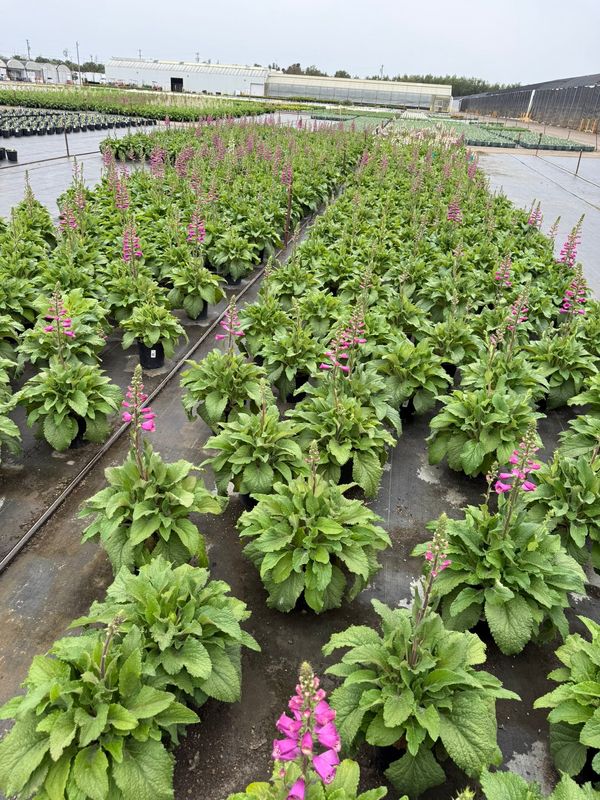
John Hardiman, managing director for American Farms, a grower of annual and perennial plants with two farms in Golden Gate, said: “This isn’t going to be pretty. This is going to be catastrophic in Florida.”
He, too, was bracing for the worst, with the coldest temperatures he’s seen in his more than 10 years with the Collier County ornamental grower.
“We’ve already had our insurance company contact us about possible losses. So, it’s not going to be fun,” Hardiman said.
He was in Europe for a business meeting and had to cut it short, he said, so he could help with his company’s preparations to protect the millions of plants sitting vulnerable to below-freezing temperatures — especially if those temperatures last for more than a few hours.
“We started back last Wednesday preparing for everything,” Hardiman said. “The prolonged cold is the big problem. Below freezing and prolonged cold is bad.”
With the two farms sitting in a “valley,” he fears temperatures could be in the high 20s for three or four hours, and on multiple days.
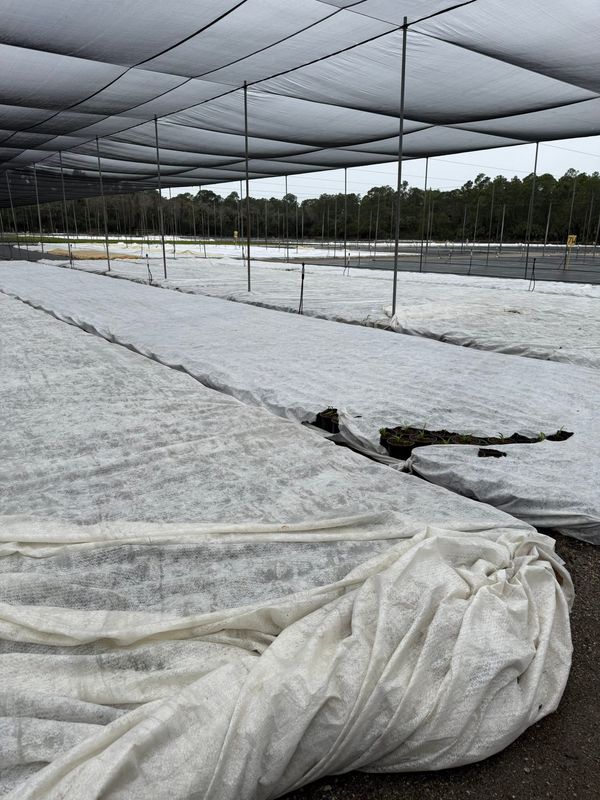
“We’ve got a lot covered,” Hardiman said. “There are 10 to 12 million plants on the ground, and we don’t have that kind of ground cover to cover all of them, but we try to get the most tender stuff covered as best we can.”
Overhead water, he said, would be running all night to help protect the plants on the two farms, which combined span about 100 acres.
“I’ll be up all night,” he said. “We’ve got people at each farm that monitor the temperatures, and when it gets to 36, we start firing everything up.”
American Farms is a large supplier of plants to golf courses, gated communities, garden centers and landscapers in Southwest Florida. Those plants include impatiens, petunias and geraniums, to name a few.
While covering the plants can help, if the ground gets too cold for too long “you’re done,” Hardiman said.
Additionally, he said, high winds can blow the covers off or whip the covers across the plants, causing serious damage.
Weather ‘doesn’t look good’ for growers
Gene McAvoy, a longtime vegetable and horticultural agent for UF/IFAS in Southwest Florida, who still holds the title of “emeritus” for his continued involvement, said the last “big event” in the region — meaning a freeze event — came in 2010.
“It doesn’t look good,” he said of the threatening weather.
Most of the region’s winter vegetable and fruit crops are already in the ground, including tomatoes, peppers, sweet corn, green beans and basil, which are all very sensitive to cold weather. McAvoy emphasized that the high winds could do damage of their own, as well as reduce the effectiveness of the interventions producers are trying.
“If we get temperatures below 28 for four hours or more that will affect citrus as well,” McAvoy said.
Recently, he said he visited a citrus grove to the north, in Charlotte County, damaged by frost a few weeks ago.
“It didn’t harm the trees really, but it burned off all the flowers and the pinhead-sized fruit,” McAvoy said. “It’s all burned off and in the process of dying.”
Citrus growers continue to battle the incurable citrus greening disease that has ravaged the industry, killing trees across the Sunshine State. With more fertilizer and rounds of antibiotics, trees have been looking “really good” for those who have been diligent and made the investments, McAvoy said.
“They were hoping for a better year. But they might not have it,” he said.
Statewide, he estimates the agriculture industry could suffer billions of dollars in losses from a freeze, especially if there’s a two-, or even three-day event.
“All of South Florida is basically at risk. They are calling for low temperatures all the way into the Homestead area,” McAvoy noted.
If there are losses, much of them could be seen in the five-county region that includes Lee and Collier counties.
“It’s easily hundreds of thousands. This our peak season, right now — in Southwest Florida,” McAvoy said.
Growers in Southwest Florida already hurting
While it wasn’t a hard freeze, the last cold front a few weeks ago was enough to destroy much of the pastureland in Southwest Florida, forcing ranchers to buy more feed for their livestock, which is costly. The higher costs make it hard to turn a profit, even with the high cattle prices, McAvoy said.
“We’ve had a pretty severe drought,” he said. “Those pastures are not going to come back as quickly as they might have otherwise if the ground was wet, and we get a warmup.”
With cattle of his own, McAvoy said he recently had to purchase six round bales of hay for $65 a piece.
As for fruit and vegetable growers, McAvoy explained they aren’t in the best financial position. They didn’t make much money with their fall crops because of an oversupply of produce, which forced them to sell many of their products at prices below cost, including tomatoes, so more losses from a freeze could really “put a hurt on them,” he said.
If the destruction of plants is widespread, they’d be hard to replace, especially at this point.
“No one is sitting on enough replacement plants to make everyone whole again, even if they (the affected growers) had the money to buy them,” McAvoy said.
“We have windows,” he said. “So, if we lose our products down here and we replant, we are going to fall into somebody else’s window three months down the line. Again, that will result in an oversupply situation when everybody comes back in.”
Many of the area’s growers don’t have crop insurance because it’s so expensive. Sharing one statistic, McAvoy said probably 30% or less of green pepper growers carry it.
“It only pays pennies on the dollar,” he said. “And it’s a fight to get the money oftentimes.”
Laura Layden is a business and government reporter. Reach her by email at laura.layden@naplesnews.com.
Please support local community journalism and stay informed about Southwest Florida news by subscribing to The News-Press and Naples Daily News; download the free News-Press or Naples Daily News app, and sign up for daily briefing email newsletter, food & dining and growth & development newsletters here and here.
This article originally appeared on Fort Myers News-Press: Southwest Florida growers bracing for cold weather ‘catastrophe’
Reporting by Laura Layden, Fort Myers News-Press & Naples Daily News / Fort Myers News-Press
USA TODAY Network via Reuters Connect