Brevard County just made it more affordable to improve your septic tank situation, in light of and the Indian River Lagoon’s ailing health.
On Tuesday, county commissioners voted unanimously to make homeowners along the lagoon — the ones that the state is requiring to upgrade their septic systems by 2030 — eligible for at least $6,000 in financial help to do so, even if their current system doesn’t pollute that much.

Why is this happening?
Under Brevard’s current program, county funding is based on how much nitrogen a homeowner’s septic system adds. If the impact is small, they might get less than $1,000, or nothing.
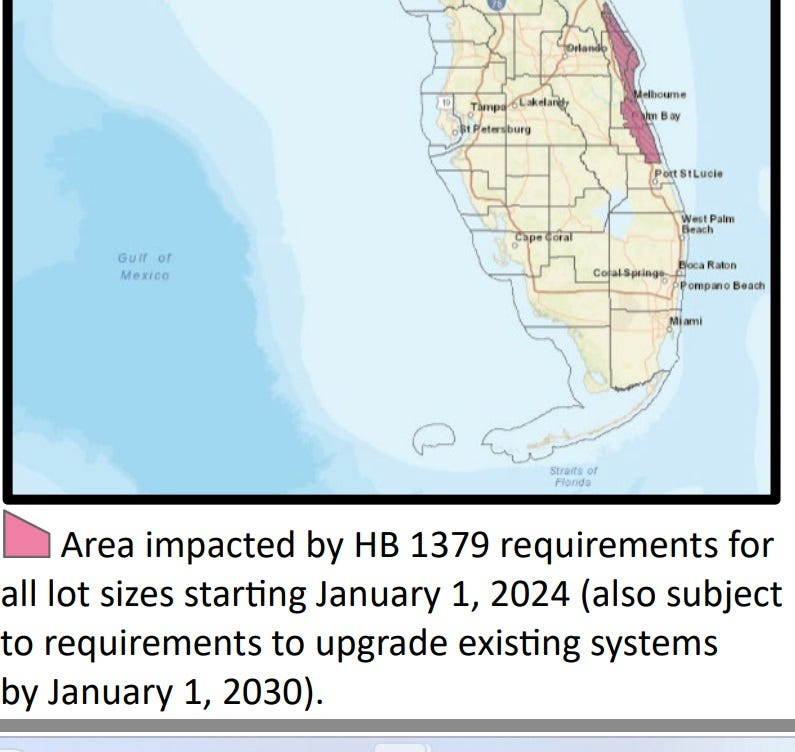
A 2023 law (House Bill 1379) mandates that by 2030 any commercial or residential development within the Indian River Lagoon Protection Program area (parts of Brevard, Indian River, St. Lucie and Volusia counties) must connect to central sewer if available or upgrade to a nitrogen-reducing system or other sewage treatment system that removes at least 65% nitrogen.
What did Tuesday’s vote do?
Based on Tuesday’s vote:
An oversight committee on Brevard’s lagoon spending recommended offering the minimum cost-share of $6,000 to all properties, regardless of a homeowner’s nitrogen loading for a one-year trial period. Staff would report participating and nitrogen reduction back to the committee after six months.
Why is this happening?
House Bill 1379 requires all existing septic within the watershed to be connected to sewer or upgraded by 2030
Homeowners have been frustrated about septic system upgrade costs in excess of $20,000, and the state mandate leaves them no choice.
Manatee case also nudges more action on Brevard septic tanks
Per a 2025 court injunction, properties within the North Indian River Lagoon Basin Management Action Plan can’t get a repair or modification permit for conventional septic systems. Along the watershed north of the Melbourne Causeway, all failing septic systems must be upgraded to a nitrogen-reducing system.
A federal judge ruled in May that Florida has to temporarily stop approving new septic tanks in areas near the Northern Indian River Lagoon and plan to start feeding manatees again when they are faced with starvation.
Excess nitrogen in the lagoon can fuel algal overgrowth that smothers seagrass, the lagoon’s ecological linchpin.
What’s next for the lagoon?
Brevard’s 10-year ½-cent lagoon sales tax was passed by 62% of voters in November 2016, establishing the Save Our Indian River Lagoon Trust Fund. Over its decade-long life, the tax will have raised more than $580 million, county officials estimate.
Brevard commissioners voted in November move ahead with the initial steps for a voter referendum next year to renew the ½-cent infrastructure sales tax for the Save Our Indian River Lagoon Program.
The Commission will hold a public hearing on the matter in April or May.
But first, it will seek public input at workshops to be held at 5 p.m. on Monday, Jan. 5 at Titusville City Hall and 5 p.m. Monday, Jan. 12 at Palm Bay City Hall.
How much is the lagoon worth?
A recent study by the National Estuary Program estimates the lagoon’s economic impact at $28.3 billion per year to the seven-county lagoon region.
Tuesday’s vote comes in the wake of the nonprofit Marine Resources Council’s yearly report on the lagoon’s health, which found the central lagoon had a better year “with overall health improving from ‘poor’ to ‘okay’ due to lower algae concentrations and increased seagrass coverage.”
What’s the problem?
Decades of development, draining wetlands, excess fertilizing, failing septic tank systems and sewage spills added excess nutrients and pollution to the lagoon, which feed algae blooms that smother seagrass.
But resource managers say it will take about $5 billion and 20 years to save the stressed ecosystem over the 156-mile-long estuary.
Seagrass is the linchpin of the lagoon’s ecosystem. Fish, shrimp, sea turtles and crabs are among the thousands of species that rely upon the bottom habitat to hide, feed and breed.
Muck — a mix of soils, clays and rotted plants — is like a “black death” to the lagoon, plaguing the estuary with dead zones wherever the stuff oozes to. Often likened to “black mayonnaise,” muck blocks sunlight to seagrass and contributes to bacterial decay, which consumes oxygen in the water, causing fish kills.
Contact Waymer at (321) 261-5903 or jwaymer@floridatoday.com.
This article originally appeared on Florida Today: Brevard approves help for those on septic tanks
Reporting by Jim Waymer, Florida Today / Florida Today
USA TODAY Network via Reuters Connect