New Albany resident Philip Derrow is a retired business owner. He was a two-term member of the New Albany-Plain Local Board of Education.
You’d be surprised how many young people can’t read this.

I’ve written repeatedly about K-12 schools’ failure to effectively teach foundational reading skills. Yet a Nov. 6 report about the decline of first-year University of California San Diego students’ math skills was even more shocking.
One of its conclusions tells the sad tale.
“Between 2020 and 2025, the number of students whose math skills fall below high school level has increased nearly thirtyfold; moreover 70% of those students fall below middle school levels, reaching roughly one in twelve members of the entering cohort.”
The report rightly drew widespread attention from several news outlets across the ideological spectrum. That’s because the modern world runs on math.
Every major public policy debate is rooted in or better understood with math. It’s the language of logic and problem-solving. And, no, you can’t rely on AI for help.
The consequence will be great if students don’t ‘get’ math
I recently tasked a leading AI app to do a tedious calculation. Reviewing its answer, I saw it was obviously wrong and noted the error to the chatbot. It apologized and then made a different error the next time.
It wasn’t an important question, and I noticed the mistakes. What happens when false answers to important questions go unnoticed?
If incoming college freshmen lack even middle school math skills, imagine the deficits across the rest of their age group. The report looked at California, but the issue no doubt applies, to varying degrees, to schools across the country.
We don’t have to imagine here in Ohio.
According to Chris Booker, an Ohio State University spokesperson, for the past five years, roughly 10 to 12 percent of first-year students admitted to the Columbus campus require remedial math instruction.
I respect that my alma mater and Ohio’s flagship public university is committed to providing opportunities for students who might be otherwise qualified for college-level studies, but the reality is that many of those students really aren’t up to it and fail to graduate.
That doesn’t serve either the degree-less students or the public. Students who lack foundational knowledge and skills in one subject area are often deficient in others. And remedial education simply doesn’t work at the scale necessary.
How we teach math
Learning loss during Covid, grade inflation, declining standards, and objections to standardized testing are all part of the problem but they stem from much more fundamental cultural and pedagogical shifts.
Until the last few decades, most teaching – especially in K-6 – was in the form of “explicit” instruction. The teacher, imbued with superior knowledge, explanatory skills, and clear authority supported by parents and administrators, conveyed the requisite knowledge to students. Some teachers derisively called it “drill and kill” – as in killing the passion for learning.
But whatever you called it, the practice worked, at least for most kids.
Regardless, many teachers and students hated it. So schools began to adopt different methods of “constructivist” or “exploratory” learning – using structured play and exercises to allow students, especially younger kids, to develop conceptual understanding.
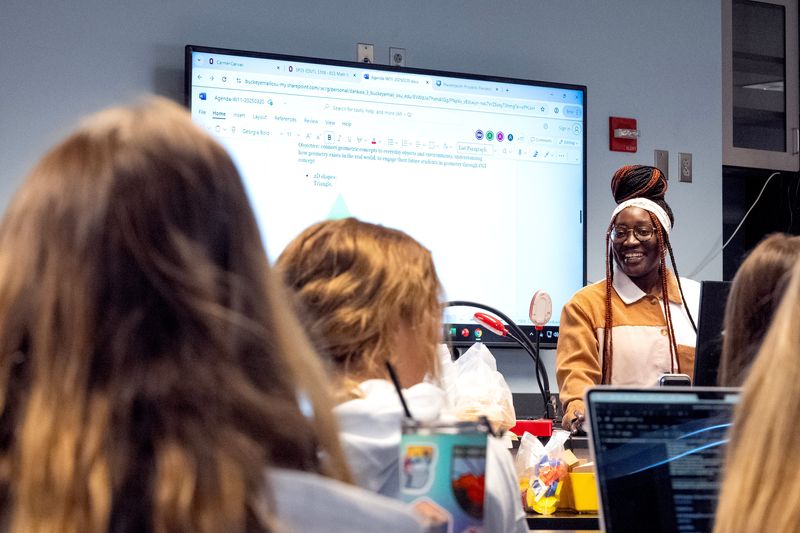
Though different than the way I was taught, some of these methods apparently have good theoretical and evidentiary support, as I learned in a conversation with Terri Bucci, an OSU College of Education math associate professor.
As a life-long learner, I’m glad to have access to the resources at Ohio State to acquire further insights, and Bucci was generous with her time.
It remains to be seen if the longer-term outcomes show the newer methods will work any better for learning math than they did for reading. Ohio State got the latter spectacularly wrong, continuing to support a widely discredited reading methodology that’s now prohibited under Ohio law.
Given their life-long impact on kids, new and existing teaching methods and curricula should be subject to the types of randomized trials that did so much to improve outcomes in medical care. Few have.
Some things — like multiplication tables —simply must be memorized for instant recall or every subsequent math skill becomes far more difficult to learn.
There’s a price to unearned achievement
In many cases, parents or school administrators push back against a child’s deserved bad grades or their need to repeat a year. That’s often because of misplaced concerns for the child’s self-esteem, or, in later years, the grades necessary to get into college.
Unearned achievement doesn’t build self-esteem; it guarantees future disappointment.
These problems must be solved at the source before we fail another generation of kids.
First, we should recommit ourselves in principle and in law that the purpose of K-6 education is to instill foundational knowledge of reading, writing, math, science, history, geography, civics, music, and the arts.
That’s it. That’s the job.
The earliest years should, of course, be filled with fun. And we have a public duty to help children with special needs. There’s also plenty of nuance and other things that are nice to have here and there. Fortunately, much of those details exist in current law. But overall state support must be explicitly directed toward assuring every student at least starts with a firm foundation on which to build further.
This isn’t a rap on teachers. Far from it.
The elephants in and out of the classroom
During my eight years of school board service, I developed a great appreciation for the professionalism and genuine care for kids that the overwhelming majority of our teachers and administrators —most of whom started as classroom teachers — bring to school every day. I have little doubt the same is true in most districts.
Instead, this is very much a problem for legislative leadership. Ohio has a long history of local control of public schools, which is appropriate given that most school funding comes from local property taxes.
But every Ohio taxpayer contributes to the more than $8 billion in state funding for K-12 schools.
The next problem is curricula.
Our lawmakers have made significant strides, first by requiring school districts to use curricula aligned with The Science of Reading. Senate Bill 19 was passed in November with the intention of driving similar reforms for math. The legislation has only been introduced in the House.
Fewer choices are needed
While both of these measures are positive steps, they fall short in providing solid guidance to help districts make better curricular choices.
The options in the curricula buffet line are many but few have solid empirical evidence of efficacy. Ohio also chose to largely outsource curriculum review to EdReports, an independent non-profit education resource organization.
While that might have seemed like a good idea, a blistering report about the deficiencies of EdReports reviews by education writer Karen Vaites calls that choice into serious question.
Ohio should instead conduct a systematic, evidence-based curriculum review of its own for both reading and math, building on the work of other states, and substantially narrow the list of approved choices.
The legislature should also further tighten the exceptions to the standards of achievement already established for reading and math.
Professor Bucci reminded me about how few people would willingly admit to being bad readers, but many are perfectly comfortable proclaiming their math misses. It’s almost worn as a badge of honor. Yet, innumeracy can be as harmful to future success as illiteracy and the language of math is no more difficult than learning to read English.
It’s clear; if we fail at building their foundations, we fail our children before they even begin.
New Albany resident Philip Derrow is a retired business owner. He was a two-term member of the New Albany-Plain Local Board of Education. He is a regular Columbus Dispatch contributor. Reach him at philderrowdispatch@gmail.com.
This article originally appeared on The Columbus Dispatch: Math problem. We’re falling behind. Everyone should be scared | Opinion
Reporting by Philip Derrow, Columnist / The Columbus Dispatch
USA TODAY Network via Reuters Connect