By Fred Fuller

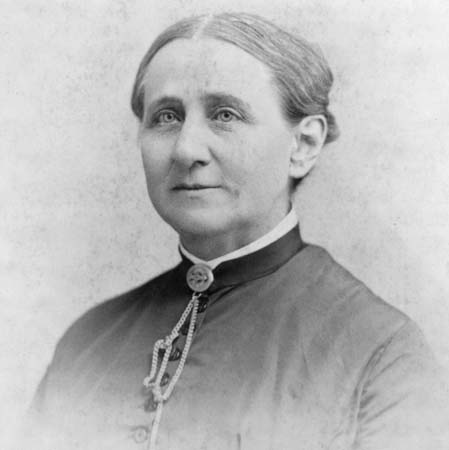
Antoinette Louisa Brown Blackwell didn’t prove Darwin wrong about everything, but she did prove that he was wrong about his assertion that, in nature, males were always smarter and more powerful than females.
Antoinette Brown was born May 25, 1825, the youngest child of seven, in Henrietta, New York State, to Joseph Brown and Abby Morse. She was a precocious child. The preaching of the great evangelist Charles Grandison Finney during the “Second Great Awakening” in upstate New York, led the Brown family to join the Congregational Church in Henrietta. Antoinette began preaching in the church at the age of nine. After completing school at Monroe County Academy at the age of 16, she taught school herself. She saved enough money from four years of teaching to pay for tuition at Oberlin College in Ohio in 1846. Her parents supported her ambitions. They believed in equal education for men and women, and also for black people.

After obtaining her Bachelor’s Degree, she lobbied Oberlin College to allow her to take its theology courses toward a degree in Congregationalist ministry. The college was opposed to women training for the ministry, but it eventually let her enroll in courses with the stipulation that she would not receive a formal degree. Never-the-less, Antoinette Brown was a prolific writer and charismatic public speaker. An analysis she wrote about the Apostle Paul’s chapters in the Bible was published in the Oberlin Quarterly Review. In that article, she stated, “Paul meant only to warn against ‘excesses, irregularities, and unwarrantable liberties’ in public worship.” She insisted that the Bible and its various pronouncements about women were for a specific span of time and not applicable to the 19th century.
Without having been granted a preaching license upon her graduation, Brown began writing for Frederick Douglass’s abolitionist paper, The North Star. In 1850, she was one of the speakers at the first National Women’s Rights Convention in Worcester, Massachusetts. That speech launched her on speaking tours in which she addressed issues such as the abolition of slavery, temperance, and women’s rights.
In 1853, Brown became the first woman in the United States to be ordained as a mainstream Protestant minister, after the Congregational Church finally gave her a license to preach. She served as the minister of a Congregational church in South Butler, New York, but after a few years, she returned to her work as an orator and reformer.
She had believed that it was best to remain single because single women experienced greater levels of independence than married women, but upon meeting Samuel Charles Blackwell, a British-born American abolitionist, she decided to marry. The couple wed in 1856 and eventually had seven children, two of whom died in infancy. Samuel Blackwell came from a family of social reformers who believed in working for the betterment of humanity. His sister,
Elizabeth Blackwell, became the first woman to receive an MD degree in the United States and the first to practice medicine. His brother, Henry Blackwell, was involved in the beginnings of the Republican Party and the American Woman Suffrage Association. Henry married Lucy Stone, a friend of Antoinette Brown’s at Oberlin, and a prominent abolitionist and women’s rights advocate.
With marriage and the birth of her children, Antoinette Brown Blackwell gave up speaking tours and turned to writing to encourage social change. She published several works in the fields of theology, science, and philosophy. She was inspired by the writings of Charles Darwin and Herbert Spencer, whom she considered the most influential thinkers of the time. Darwin published his theory of evolution, On the Origin of Species, in 1859. Herbert Spencer was a famous English biologist and philosopher who coined the term “survival of the fittest” after reading Darwin’s book.
While Antoinette Blackwell admired those men, she also disagreed with some of their ideas. In 1869, she published Studies in General Science, and she sent a copy to Darwin. He wrote her a letter, thanking her and complimenting her on her book. It was to her an acknowledgement that her scholarship was legitimate, so she forged on with it.
In 1871, Darwin published The Descent of Man, in which he extended his evolutionary theory to human beings. In it, he stated: “Man is more courageous, pugnacious, and energetic than woman, and has a more inventive genius….” Blackwell recognized that he was off the mark on this and that he had let his own Victorian biases cloud his scientific thinking.
Four years later, in 1875, she published The Sexes Throughout Nature, a book that with diligent scientific observation refuted Darwin’s sexist claims. She argued that he had confused cultural conditioning with biological destiny. Women appeared less intellectual, she said, not because of evolution, but because they were systematically denied education, barred from universities, excluded from scientific societies, and told from birth that thinking was unfeminine.
“It has been the special philosophic problem of the ages,” she wrote, “to account for the genesis of the anomalies we see in human society—anomalies which are the result, not of natural law, but of the artificial conditions that have been imposed on women.”
She argued that Darwin and Spencer had built their gender theories on circular logic: they assumed male superiority—a prejudice of their era—and interpreted nature through that assumption, then claimed that nature proved what they had assumed.
She pointed out that across nature, females of many species were larger, stronger, and more complex than males. Female spiders were often bigger and more aggressive. Female birds of prey were larger and fiercer. Female insects frequently outlived and outweighed males.
While Darwin had emphasized competition and the “struggle for existence” between males for access to females, Blackwell highlighted the role of cooperation. She argued that the survival of species depended equally on the collaborative rearing of offspring and domestic partnership, viewing the female not as a passive prize for the victor, but as an active agent in evolutionary continuity.
Darwin never responded to her critiques, and she was largely ignored by the male-dominated scientific establishment, which is why she is little known today. But suffragists used her arguments to fight for women’s right to vote, and women scientists were inspired by her pioneering work. Her book is available on the Internet Archive at: https://archive.org/details/cu31924031174372/mode/2up
Blackwell continued to work for the advancement of women and of other disenfranchised people, such as those suffering from poverty in New York City. In 1878, she returned to organized religion and became a Unitarian minister. She lived to the age of 96, and in 1920, she was the only surviving participant of the 1850 Women’s Rights Convention to see the passage of the Nineteenth Amendment to the Constitution, which gave women the right to vote. She voted in the 1920 presidential election.