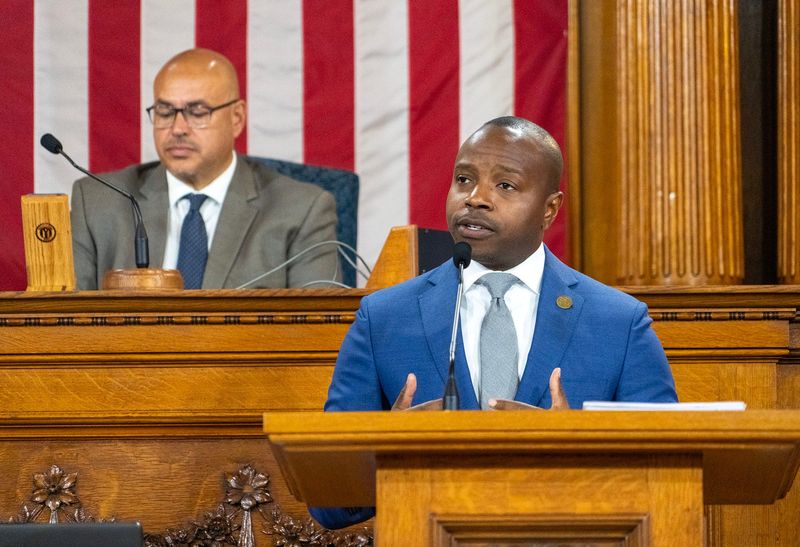
Milwaukee Mayor Cavalier Johnson vetoed parts of the 2026 budget adopted by the city’s Common Council, citing concerns about its burden on taxpayers and its potential impact on budgets in years to come.
Through his line item vetoes Nov. 18, Johnson struck out council-approved additional funding that would expand Sunday library hours, divert $8 million to the fire department to tackle its aging equipment, and add a 1% increase to residency incentives for city employees.

“Perhaps the most important question for this item, and all the changes to my proposed budget, is this one: are the changes sustainable?” Johnson asked in a statement on Nov. 18. “Difficult decisions must be made now so that decision-making in the future is not calamitous.”
The mayor’s vetoes also aim to restore a position that had its funding cut in the city’s Office of Innovation, address attempts to internally restructure some parts of City Hall, and scale back Common Council accounts, including for travel expenses and funding toward the Big Clean and Hip-Hop Week.
Additionally, Johnson’s veto would see fire department funding for next year shift to include $4 million in borrowing for fire trucks in addition to the $2 million he initially proposed, instead of the $8 million that was adopted by the Common Council.
Many of the amendments were a result of community input and feedback during the monthslong budget process. Ald. Marina Dimitrijevic, the chairwoman of the city’s finance committee, continues to stand by the changes that she and council members made to address residents’ concerns and needs. She said she was particularly disappointed by the mayor’s veto to expand library hours.
“It’s about more than words. It’s actually action,” Dimitrijevic said of the council’s efforts to restore services and programming as well as to work with the Mayor’s Office to find sustainable options to fund amendments. “A lot of this, I thought, was somewhere meeting in the middle, and, again, being responsive to what we heard.”
The vetoes send the budget back to the council, where they could vote Nov. 25 to either override or sustain Johnson’s vetoes.
In a three-page letter to the city’s Common Council, Johnson noted that despite council members being informed that the budgets over the coming years will be “increasingly tight with obligations” and “expectations exceeding anticipated revenue,” amendments were still made to his proposed budget.
The move is not uncommon in the history of the city’s budgets, with a smattering of vetoes sprinkled into the process when sent over to the sitting mayor for final approval.
The decision, however, comes a more than a week after council members spent more than five hours marking up the mayor’s proposed budget, with efforts to boost programming and city services, including the city’s fire department, and increase raises for city employees by 3%.
“I think the council put together a very thoughtful and thorough budget being mindful of our shared community values,” Ald. Peter Burgelis, vice-chair of the city’s finance committee, told the Journal Sentinel after he learned of the mayoral vetoes.
The council’s budget also saw an increase in user and vehicle registration fees — the later, in part, due to the city missing a crucial deadline for the city to formally introduce an increase to the vehicle registration fee, or “wheel tax.”
In the lead up to their vote on Nov. 7, Johnson had raised red flags when it came to the amended — and later adopted — budget that set aside $2 billion for 2026. The mayor worried that such budget amendments could negatively impact taxpayers and city services as they increased the budget by $10 million and the city’s tax levy by roughly $3.81 million compared to Johnson’s proposal.
In his letter to the Common Council, Johnson emphasized that homeowners in the 7th, 8th, 12th, and 15th Aldermanic Districts are likely to see an “even bigger increase” as assessments in those districts have trended higher than the citywide average.
“City government must be sensitive to the financial pressures facing our constituents. Their wallets are already hurting from inflation and federal benefit cuts. We have to keep our tax bills as low as reasonably possible,” Johnson said.
Johnson, however, did not rule out the possibility of some of the changes proposed in the amendments and invited council members to have a broader discussion and seek analysis of how to implement some of those suggestions, including expanding library hours and increase the percentage of residency incentives for city workers.
The Common Council is also poised to vote on a new contract for the city’s rank-and-file police officers on Nov. 25 after a yearslong impasse between the City of Milwaukee and the Milwaukee Police Association. The union-ratified, four-year contract gives a 14.25% raise and backpay. At the committee level, council members aired concerns about the fiscal impact of the agreement, as its approval would add an additional $51 million to the budget.
The Common Council will take a vote on the mayor’s vetoes during their monthly meeting on Nov. 25, during which they can vote to sustain, or approve, the mayoral vetoes or override them. A veto override would require approval from 10 of the 15 council members, and would ultimately result in the original adopted budget, sans vetoes, being back on the table for final approval from the mayor.
“I am confident that the council collectively will stand up for what our residents have asked us, will stand up for the priorities that the residents have given us,” Burgelis said.
With both outcomes, Johnson will then have seven days to sign off on the budget.
This article originally appeared on Milwaukee Journal Sentinel: Milwaukee Mayor Johnson vetoes parts of council’s adopted budget, fearful of its toll on city taxpayers
Reporting by Vanessa Swales, Milwaukee Journal Sentinel / Milwaukee Journal Sentinel
USA TODAY Network via Reuters Connect