With Congress poised to end the longest federal government shutdown in history, central Ohio’s largest hunger relief organization is warning the community to not get ahead of itself and ignore continued need.
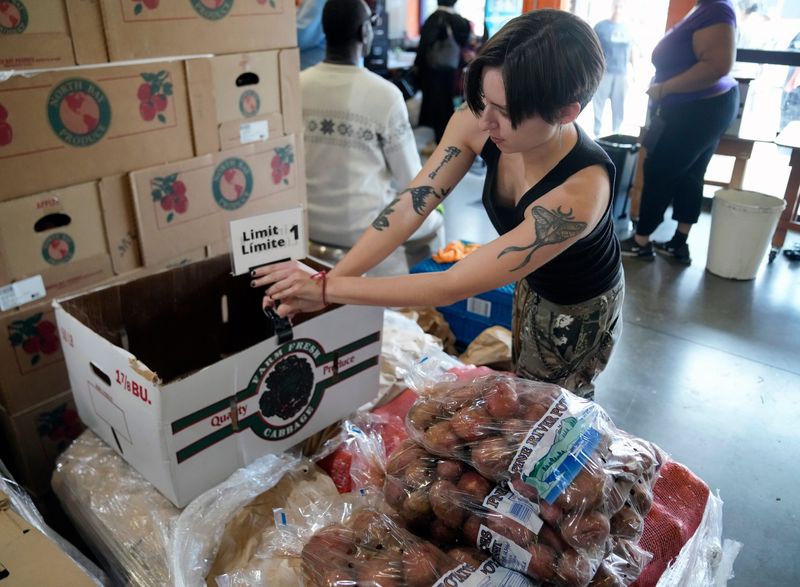
Days after Supplemental Nutrition Assistance Program (SNAP) benefits lapsed Nov. 1, increased needs were felt across central and eastern Ohio food pantries, said Mike Hochron, Mid-Ohio Food Collective’s senior vice president of communications and public affairs.

Not including the spike in demand the Food Collective marks each year around the holidays, Nov. 5 and Nov. 6 were the two single busiest days across its network since the summer of 2024.
This strain on the Food Collective’s network was felt alongside a days-long, back-and-forth legal battle between the Trump administration and a federal judge in Rhode Island on the future of November SNAP benefits.
This culminated in the U.S. Supreme Court allowing the federal government to continue withholding contingency funding from 42 million Americans, including 1.45 million Ohioans. However, a tentative agreement was reached on Nov. 9 that would reopen the government and fund SNAP through September 2026. Eight moderate Senate Democrats joined majority Republican senators and broke from their party, which was holding out to include extension of federal subsidies for the Affordable Care Act.
If the bill to reopen the government and fund SNAP is now given final approval by the Senate, it would then be sent to the Republican-controlled House for approval and on to President Trump for his signature.
Partial SNAP to be provided in Ohio
The Ohio Department of Job and Family Services (ODJFS) announced Nov. 10, that it is taking steps to distribute partial benefits this week — as early as Nov. 12.
The distribution will continue daily until it is complete. The announcement followed new federal guidance from the U.S. Department of Agriculture’s Food and Nutrition Service (FNS), according to a release from ODJFS.
The latest guidance instructed the Ohio JFS department to reduce the maximum amount each household can receive in November by 35% and to recalculate each household’s payment based on that new maximum payment amount.
Nearly all recipients will receive less than 65% of their normal payment, which was the previously announced partial benefit amount. Some recipients may receive no benefits this week under the revised calculation, the ODJFS release adds. An official notice explaining each household’s specific benefit change will be issued.
‘Not out of the woods’
Michael Corey, executive director of the Human Service Chamber of Franklin County, which represents some 220 nonprofits, said it is a “positive step” that some SNAP dollars would start flowing. However, he warned the weeks-long disruption would continue to have ripple effects.
“We’re going to have to continue rallying around people, food pantries and those feeding folks for a couple more weeks after the shutdown has ended,” Corey said.
Hochron, with the Mid-Ohio Food Collective, also emphasized that even if the federal shutdown is resolved, it is still unclear when full benefits would process.
Until then, he said, the neediest in the community still need help.
“We’re not out of the woods,” Hochron said. “Until that help starts to flow, we’re still in the same place that we were just with more days having passed and more of those impacts being felt.”
In Columbus, the NNEMAP Food Pantry, 677 East 11th Ave., reported its single busiest day on Nov. 5, with 285 people served. At the Mid-Ohio Market at Gantz Road in Grove City, more than 200 people are getting in the queue online each day before the resource even opens, Hochron said.
Roy Clark, NNEMAP’s director, said the pantry is running low on food and cannot keep up with the demand. As Hochron noted, this increased need isn’t unique across the sector.
As a result of cutbacks, the pantry has been supplementing food by purchasing it from a local distributor. This is an added cost for nonprofit food banks facing skyrocketing demand, less food and tighter budgets.
Throughout another incredibly busy day on Nov. 10, Clark said he spent most of his day handling donations and fixing carts.
“Right now, it’s kind of ‘all hands on deck,'” he said.
Hochron added that the last several days and weeks have been an eye-opening depiction of what a world without SNAP would be like. Even after the government shutdown finally ends, he said it will take time for families to recover from the difficult financial decisions they are being forced to make now.
“SNAP is not cash. It’s a benefit. You can use it at the grocery store, but it doesn’t replace the dollars,” Hochron said. “I just want to emphasize that, for many families who have had to navigate through this, that the disruption to their household finances and the impacts of that don’t go away the minute the shutdown ends.”
“. . . It’s not over yet, and even when it’s over, it’s not really over for the families who have been affected.”
Reporter Sophia Veneziano may be reached at sveneziano@dispatch.com.
This article originally appeared on The Columbus Dispatch: Even when fed shutdown ends, ‘We’re not out of the woods,’ food bank official warns
Reporting by Sophia Veneziano, Columbus Dispatch / The Columbus Dispatch
USA TODAY Network via Reuters Connect