WEST LAFAYETTE — When Purdue professor Xiulin Ruan unveiled the “world’s whitest paint” in 2021, it was heralded nationwide as being history’s next most important invention.

Guinness declared it the whitest paint ever created. Activists, experts and media rushed to shower praise. The New York Times called it “superheroic.” PBS wondered openly whether it could “save the Earth.”
If communities across the United States began painting buildings white with this new coating, invented by Ruan and a team of Purdue researchers, it would reflect enough heat to keep homes and offices cooler than ever before, Ruan said. Enough of the paint could supposedly bring down rising global temperatures, alleviate strain on communities’ electric grids and combat climate change.
“This not only saves money, but it reduces energy usage, which in turn reduces greenhouse gas emissions,” Ruan said at the time of the paint’s announcement. “And unlike other cooling methods, this paint radiates all the heat into deep space, which also directly cools down our planet. It’s pretty amazing that a paint can do all that.”
But four years later, Ruan’s paint has yet to hit the market.
A series of back-and-forths between Purdue and the federal government over the paint’s patent, continued changes to the paint by Ruan and his team and unresolved promises of a distributor have left activists and researchers scratching their heads: If the whitest paint, still being advertised by university officials as one of Purdue’s next great contributions to science, has the potential to save the Earth, they asked, then where has it gone?
“The science of it is a home run. In its effect, it’s a home run,” Daniel Overbey, an Indiana-based architect and professor of sustainable architecture at Ball State University, said recently. “So what gives? Now we just need to use it.”
Purdue spokesperson Trevor Peters this month hinted that “movement and innovations” on the paint could be announced by officials eventually, perhaps by November, but he declined to elaborate on what they were.
Ruan did not respond to requests for comment or a detailed list of questions. He and his team, Peters said, wouldn’t comment until “there was something new.”
Inventing the paint that could ‘save the earth’
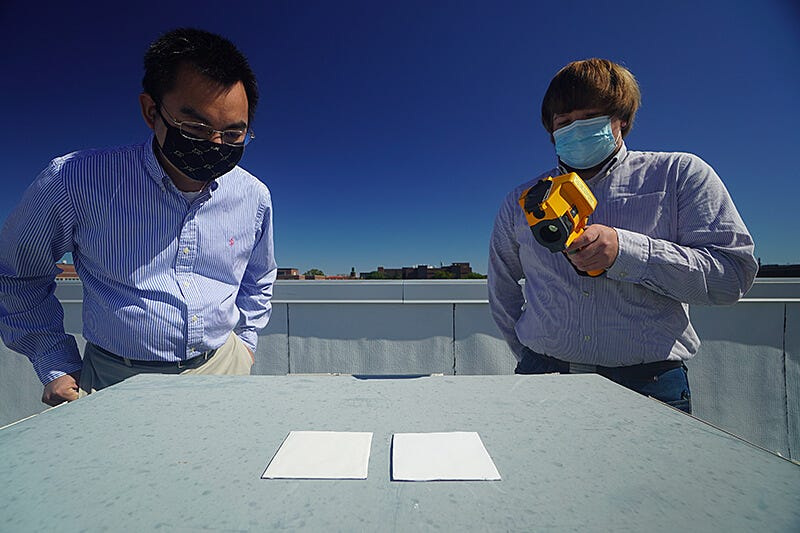
Ruan, a mechanical engineering professor at Purdue, and a team of graduate students and researchers announced the new paint in an academic journal article published halfway through 2020.
When Purdue began blasting the news of the “whitest paint in the world” across social media and newsletters, the invention became a media spectacle.
Articles, TV programs and press releases excitedly shared the news: Purdue’s new paint could reflect more than 98% of sunlight — 4% more than any other white paint on the market. That meant less heat, brought about by rising temperatures linked with climate change, would be absorbed into homes painted with the product, and less need for commercial air conditioning units to work to keep up.
The paint is so white because of its composition, Purdue said in its press release at the time. A high concentration of a chemical compound called barium sulfate makes the paint highly reflective, innovating on previous similar inventions that used different building blocks.
“We weren’t really trying to develop the world’s whitest paint,” Ruan told the New York Times in 2023. “We wanted to help with climate change, and now it’s more of a crisis, and getting worse. We wanted to see if it was possible to help save energy while cooling down the Earth.”
In major cities across the United States, rising temperatures have quickly become especially dangerous, Overbey said. Dark surfaces common in urban areas, like asphalt streets and concrete buildings, absorb more heat than they release. The result is that large cities typically become “islands” of temperatures much hotter than the surrounding area.
The higher temperatures, of course, pose a serious risk to anyone living in the cities, Overbey said, especially people with pre-existing health conditions or the homeless populations.
“It gets hot outside your building, it gets hot inside your building, and addressing the urban heat island effect is one of the best things we can do,” he said. “From a community resilience standpoint, from an equity standpoint, from a dignity standpoint, it’s low-hanging fruit.”
And as heat rises, air conditioners have to work harder to keep up.
“It’s going to create higher loads, greater demand for electricity, requiring a greater burden on the infrastructure,” Overbey said. “We could begin to have situations where there are rolling blackouts. To the degree that the grid is vulnerable, it’ll make it even more vulnerable.”
Purdue’s paint is meant to be the answer to that problem.
Paints like Ruan and his team’s are already common in sustainable architecture, Overbey said. Cities across the United States, including Chicago, Los Angeles and New York, regularly paint many rooftops and infrastructure in white, reflective paint, aiming to alleviate strain on overburdened electrical grids struggling to keep up with rising temperatures.
In Las Vegas, for example, where Overbey worked as a sustainable architect before moving to Indiana, painting buildings white has had a massive effect on the heat, he said.
“You could coat concrete with a light-colored paint and you could sometimes see not just a 5-degree drop,” Overbey said. “You could see like 20. I think at times I’ve seen even like 30-degree differences. So it makes a huge difference.”
Paired with cooler concrete, the construction of more shaded areas and other traditional ways of combatting climate change, “the whitest paint in the world” could be one of the best available options to fight the heat — that is, whenever it actually goes to market.
“The next step in the story here would be if it became more apparent where we can actually use this,” Overbey said, “because it’s a fantastic product.”
‘A few more issues to be addressed’
It’s been five years since Ruan and his team first published their journal article announcing the creation of the paint.
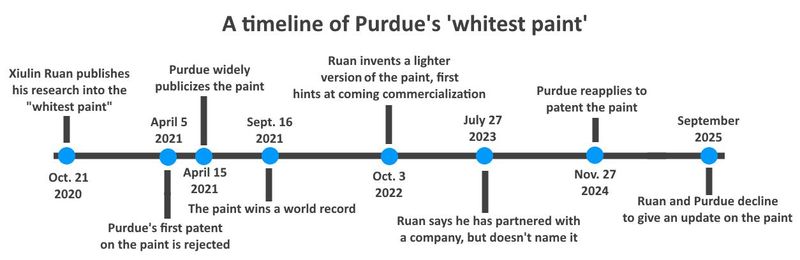
But 10 days before Purdue began advertising the invention in 2021, the U.S. Patent and Trademark Office rejected Ruan and the university’s application to patent it. The patent would be too broad, officials said, and couldn’t reasonably be limited to a single paint.
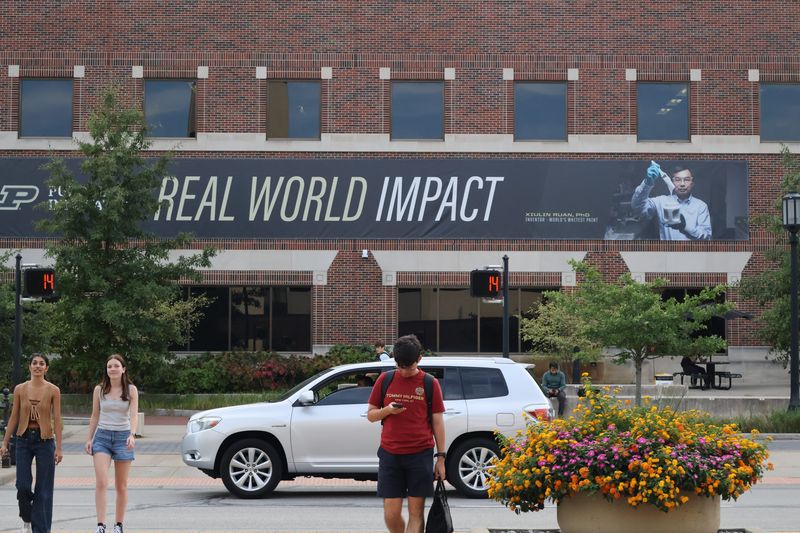
Meanwhile, Ruan hit the media junket, giving interviews to national outlets and publicly accepting awards for the invention. Purdue hung banners on the side of a prominent campus building advertising the paint. National television shows like “Saturday Night Live” and “The Late Show With Stephen Colbert” dedicated segments to it.
In 2022, Ruan and his team announced they had figured out a way to make the paint thinner when applied to a surface, meaning it would be more lightweight and able to be used on vehicles, too. At the time, he said discussions were underway over how to begin selling it, and there were only a “few more issues to be addressed.”
Then in 2023, Ruan again hinted at future commercialization but announced that his team was now looking at ways to make the paint colored while retaining its cooling properties.
“The paint is at least a year from being ready for commercial use, and work is underway to increase its durability and dirt resistance,” the New York Times wrote. “Dr. Ruan said the Purdue team has partnered with a company, but can’t yet name it.”
Ruan and Purdue didn’t apply again to patent the paint until November 2024, more than three years after it had first been announced. This time, they altered the language of the patent, narrowing it to be more specific and including slight alterations describing the paint’s chemical makeup.
By 2025, Ruan still hadn’t announced the paint’s commercialization or named the company he had been speaking with.
Ruan appears to have not spoken publicly about the status of the paint in at least a year and didn’t answer when asked whether the delays in patenting it have affected the process of taking it to market.
A spokesperson for the Purdue Research Foundation, the non-profit wing of the university that handles taking inventions to the market, said in an email the process of commercializing the paint will remain “confidential” to “safeguard the technology and the product” but that Ruan is “working toward significant milestones.”
“Some technologies and applications commercialize quickly while others take much longer,” the spokesperson said.
‘Nobody gets a chance’
Small, mostly rural Placer County, California, just north of Sacramento, is renowned for its natural beauty: rolling hills, towering waterfalls and dense forests stretch out for more than 1,500 square miles, concealing the occasional town.
But as temperatures have begun to rise around the world and California’s naturally dry climate has worsened, Placer County’s stretches of trees have become hotbeds for wildfires.
According to data from First Street, a climate modeling firm, there have been 17 major wildfires in Placer County since 1984, not including fires in surrounding counties that have creeped in. In 2021, an 11-square-mile fire spread throughout the county and burned down 216 homes.
About 94% of the county’s buildings are at risk of being burned by wildfire in the next 30 years, according to the data. As global warming worsens, that might worsen, too.
“I’m very concerned. We don’t have a lot of time,” said Ken Winter, the president of the county’s local climate group.
Fires in California have only become more common and threatened more and more homes. So Winter and his group began looking for different solutions for the county.
That’s when he stumbled on Purdue’s whitest paint in 2021.
If the paint could decrease temperatures, he said, it could be a solution to lowering the heat in Placer County.
“I thought that this ought to be something we put on roofs here,” he said. “So I was excited. I kept checking to see when it would be manufactured and launched, because I would be a strong advocate for it out here.”
Four years later, Winter said he’s been left wondering.
“Since then, crickets,” he said. “Nothing.”
And temperatures in Placer County have continued to climb. In 2024, the summer was the hottest in California on record, according to the National Oceanic and Atmospheric Administration. In Auburn, California, the seat of Placer County, temperatures reached as high as 106 degrees that year, and the risk of wildfires grew.
“There are 200 things we all need to do to stop this, and the whitest paint is just one of those things,” Winter said. “But if it isn’t available, nobody gets a chance.”
Indiana hasn’t felt nearly as harsh of an impact as California, but it’s only a matter of time, said Overbey, the Indianapolis-based architect and Ball State professor.
If temperatures keep rising, he said, by 2050, Indiana’s climate could be as hot as Mississippi. By 2080, it could be more similar to El Paso, Texas — and that’s by conservative estimates.
“Nature doesn’t draw a boundary at state lines,” Overbey said. “This is something that we’re all involved in.”
Putting the paint to the test
Architects like Overbey have been working with paints like Purdue’s whitest for decades.
In fact, sustainable paints make up an entire industry themselves. The Cool Roof Rating Council, a national nonprofit that tracks and rates the efficacy of sustainable coatings, lists 573 heat-reflecting, “bright white” paints on its online directory.
Typically, sustainable coatings like Purdue’s have to be thoroughly tested before it becomes apparent how effective they are, said Ronnen Levinson, a researcher at the Lawrence Berkeley National Laboratory in California who specializes in heat-reflecting paints. The CRRC bases its ratings for each paint on its “three year value” — how effective the paints are after three years of exposure to sunlight and weather.
“It’s the age reflectance that we care about more, because the roof material will be in place somewhere between five and 50 years, depending on the type of roofing material,” Levinson said. “And roofs especially get very dirty over time.”
Purdue says its paint reflects 98% of light, but that’s likely before the paint has been tested for three years, Levinson said. Until the paint actually goes to market, scientists won’t be able to judge the paint’s real effectiveness.
Ruan didn’t answer when asked whether the paint has been tested for three years and whether it would still be as effective.
Although it could be an important tool in fighting heat, Overbey said, it’ll be impossible to be sure until the paint is actually available.
“This isn’t the first time I’ve seen a solution that, if deployed at scale, would have a huge impact,” he said. “This is kind of a perpetual story in sustainable design, these amazing solutions that are cost-effective, but the design and construction community haven’t done as good of a job as we should at uptaking it.”
Contact Seth Nelson at nelso615@purdue.edu or 574-315-8649.
This article originally appeared on Lafayette Journal & Courier: Purdue said its ‘whitest paint’ could fight climate change. 4 years later, some ask where it’s gone
Reporting by Seth Nelson / Lafayette Journal & Courier
USA TODAY Network via Reuters Connect