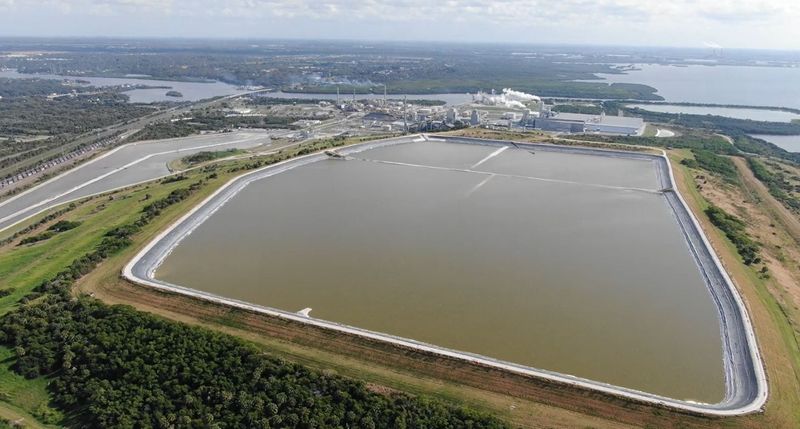
The Mosaic Company, a major player in the fertilizer industry, has initiated a controversial plan to dispose of contaminated wastewater by injecting it deep underground in Polk County.
The move has garnered significant attention and concern from environmental groups, even as the company asserts the safety and scientific rigor of its proposed methods. The Florida Department of Environmental Protection has already taken the first step by issuing a draft permit, signaling a potential shift in how the state manages industrial waste.

Mosaic presents the deep well injection as a highly regulated and common practice, emphasizing that the water would be treated to be compatible with the deep, saline aquifers it would be injected into. On the other hand, environmental advocates point to the fertilizer industry’s history of environmental incidents, including sinkholes and leaks, and argue that injecting hazardous waste underground is an irreversible and risky gamble with Florida’s drinking water supply.
As the debate unfolds, it raises critical questions about regulatory oversight, corporate responsibility, and the long-term environmental health of the state. Understanding the nuances of the permit, the scientific process involved, and the deep-seated concerns of activists is key to grasping the full scope of the situation.
Here are five key things to know about Mosaic’s plan and concerns raised by environmental advocates:
Florida Department of Environmental Protection grants Mosaic a permit is for exploration, not injection
The Florida DEP issued a Class V exploratory permit to the Mosaic Company in August. It allows Mosaic to drill a well at its Bartow facility in Polk County to a depth of 8,000 feet to study the geology and determine the feasibility of deep well injection. The company cannot dispose of any wastewater with this permit. To do that, Mosaic would need to apply for a separate Class I permit, a process that would involve further scrutiny and public input.
Mosaic argues the injection underground is a safe way to dispose of wastewater
Mosaic hydrologist David Brown has stated that deep well injection is a common and safe practice in Florida, with over 200 such wells already in operation for various types of wastewater. He emphasized that the wastewater would be treated to ensure it is compatible with the 65-million-year-old rock formations and saline water found at a depth of 8,000 feet underground. The process would also involve safety measures like a nearby monitoring well and a requirement to re-prove the well’s integrity every five years.
Mosaic’s effort to inject wastewater underground would be a first for active fertilizer operations in Florida
If Mosaic’s plan is ultimately approved, it would be the first time an active fertilizer production facility in Florida is permitted to inject its operational wastewater underground. While the former Piney Point plant in Manatee County—which is not a Mosaic property—was granted a similar permit in 2021, that facility had ceased operations two decades prior, and its wastewater was primarily a mix of some legacy process water, water from dredging Berth 12 in SeaPort Manatee, and stormwater.
Environmentalists are concerned about potential misshaps that could cause irreversible contamination
Critics, including the Center for Biological Diversity and Manasota-88, are deeply concerned about the potential for long-term environmental damage. They argue that all wells eventually fail and that once contaminated water containing heavy metals like arsenic and cadmium is underground, any leak or mishap would be irreversible. They point to Florida’s unique and porous geology as an additional risk factor, raising concerns about the potential for sinkholes or other events to compromise the injection well and contaminate drinking water aquifers.
Environmental advocates distrist the fertilizer industry, and the government agencies that regulate them
Opposition to Mosaic’s plan is rooted in a profound distrust of both the fertilizer industry as well as state and federal regulators. Environmental groups cite a history of environmental disasters, such as sinkholes at Mosaic’s own facilities and multiple disasters at the Piney Point facility in Manatee County, as evidence that the industry cannot be trusted to dispose of its waste. They believe the Florida DEP and the federal Environmental Protection Agency as having a track record of failing to hold the industry accountable. This distrust is so significant that the Center for Biological Diversity is currently involved in lawsuits against the EPA to have phosphogypsum, a fertilizer byproduct, classified as hazardous waste.
This article originally appeared on Sarasota Herald-Tribune: Top 5 things to know about the Mosaic Company’s plan to inject wastewater deep underground
Reporting by Jesse Mendoza, Sarasota Herald-Tribune / Sarasota Herald-Tribune
USA TODAY Network via Reuters Connect