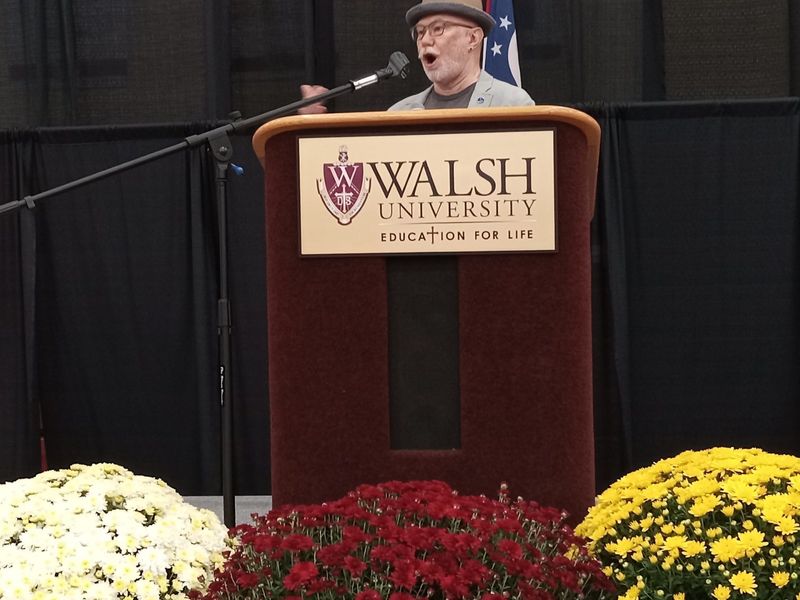
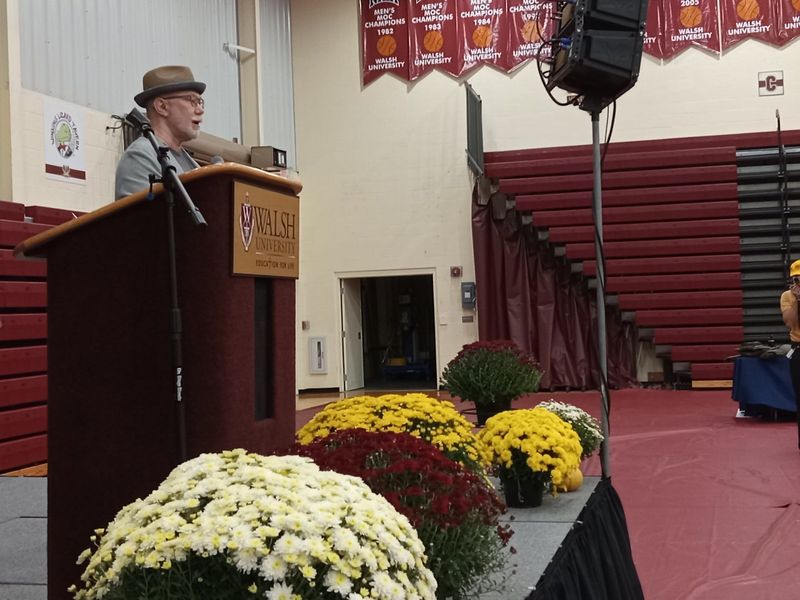
NORTH CANTON ‒ Tony Talbott’s experience in the U.S. Navy gave him a good lesson about the role culture plays in normalizing human trafficking.
When the ship that carried 500 men docked at a liberty port for rest and recreation, the chaplain handed out condoms and told the sailors to have fun and be careful.

Most of the young men on the ship would head for bars and brothels, paying for sex with prostitutes, he told an audience at Walsh University on the morning of Sept. 20.
“I saw a lot of pain and a lot of suffering, a lot of really terrible stuff,” Talbott said. “I was seeing the consequences of an authoritarian government. I was seeing extreme poverty. I was seeing hunger and malnutrition. And I was seeing things like sex trafficking, forced labor, child sex trafficking, child labor.”
The crowd of some 800 people listened in the Cecchini Center Arena to Talbott’s speech, “Reducing the Demand: How to Help Disrupt Human Trafficking.”
He said the same kind of trafficking that he saw overseas also occurs in the U.S. and Ohio, in cities, small towns and in rural areas.
Talbott, director of advocacy at the University of Dayton Human Rights Center, said economics points to a solution: Reduced demand will lower prices, and criminal abusers who can’t make enough money exploiting vulnerable people will get out of the business.
What can be done about human trafficking?
He said men must get engaged in fighting the exploitation of women and children for sex, and men, women and children for their labor, because men are the most common perpetrators, while women ― who do much of the work to fight the abuse ― are the most common victims.
Talbott said coaches, male teachers, other influencers and boys need to tell male athletes, students and their peers that paying for sex is wrong.
He offered these ideas for eliminating the demand for human trafficking:
Survivors: Attack demand, screen potential victims
Two trafficking survivors who listened to Talbott’s speech said he is on the right track.
“I absolutely, 1,000 percent support that we must focus on demand in order to eliminate and reduce trafficking,” said Michelle Brewer of Brewster.
Teresa Merriweather advocated for the use of the FOCUS screening tool in schools, hospitals or other venues to detect adult and child victims and those at risk of being trafficked. It was developed by Celia Williamson, director of the Human Trafficking and Social Justice Institute at The University of Toledo.
Both woman said they believe a statistic, cited by Talbott, that the most common occupation of sex buyers is law enforcement, according to Williamson’s research.
Brewer is trained in facilitating use of the screening tool.
Pedro “P.J.” Chavez offered a prayer before Talbott’s keynote address.
“Help us to recognize the dignity, the dignity, in every human life,” he said. “We pray for the victims, that they may find solace and restoration, and for those who exploit, that their hearts be transformed.”
The gathering was part of Walsh University’s seventh annual Community Freedom Summit about human trafficking.
Reach Nancy at 330-580-8382 or nancy.molnar@cantonrep.com.
This article originally appeared on The Repository: Walsh University speaker: To stop human trafficking, attack the demand
Reporting by Nancy Molnar, Canton Repository / The Repository
USA TODAY Network via Reuters Connect