Last September, Roshunda Parker snapped a picture of her 4-year-old great niece on her first day of kindergarten.

It shows Jai’Nadia Little beaming, wearing a red-and-black first-day outfit, just before running inside.
Five months later, Jai’Nadia was shot and killed after a gun was left unsecured in a bedroom. It was only weeks before her fifth birthday.
“You don’t expect that K4 is the only grade she’ll ever have seen,” Parker said. “She didn’t get a fair chance at life. She didn’t. She wasn’t here long enough.”
In July, Parker and her sister learned a boy the same age had been shot and killed.
“We both just, like, bust out crying, grieving for this family as well,” Parker said. “It’s like, this should not happen. This is not normal, to lose so many young children to gun violence.”
But in Milwaukee, it happens with regularity.
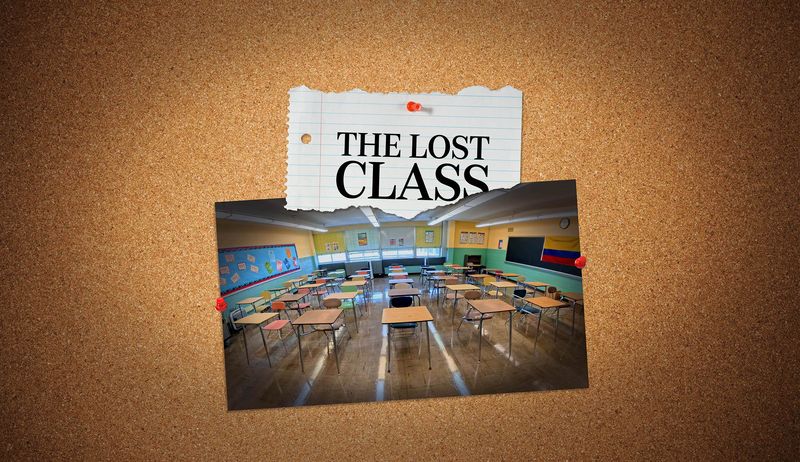
Among the city’s largest community of youth, Milwaukee Public Schools, 23 students died from gun violence between June 2024 and 2025.
Many children and teens who attended other schools died as the result of gunfire, too. Yet no one community better reflects the cascade of consequences that gun violence wreaks on kids’ classrooms, homes and relationships.
Brenda Cassellius worked in Minneapolis, Memphis and Boston before becoming MPS’ superintendent in March. She said she’s never seen gun violence so bad and was shocked by the lack of public outcry.
“At what point do you think that this is actually a public health crisis that’s going on, and an epidemic, and how do we fix it?” Cassellius said in an interview.
Since taking over the district, Cassellius has repeatedly decried the devastating effects of gun violence on students and teachers. She has urged everyone from the mayor on down to take action. Her students are not dying at school, but in acts of community violence, and most shootings occurred outside school hours.
Efforts to address the violence do exist, spanning from prevention to enforcement. Each summer, hundreds of young people participate in summer camps, city-organized job placements and other prevention programs.
The goals often overlap: Give kids and teens a safe space after school. Connect them with mentors. Teach conflict resolution. Show them pathways into jobs and education.
Still, young people in Milwaukee continue to get shot and killed.
And as a new school year begins, everyone agrees: That should be unacceptable.
Deaths of MPS students mirror broader trends in gun violence across the city
When a young person dies, everyone just wants to know what happened.
The answers are never simple.
Young people are mirrors to their environments, and the deaths of the 23 MPS students reflect broader trends in the city.
Of those deaths, two were ruled accidental shootings. Seventeen were homicides, all but three of which have been solved by police. Many of those convicted were teenagers, the youngest 14. At least four were deemed shootings in self-defense.
Four schools lost two students each in the timeframe analyzed by the Journal Sentinel.
One additional student died by suicide using a gun.
A key factor is how prevalent guns are — carried for protection and, at times, social status and power — and how accessible they have become.
“They’re taking it from your closet, under your bed, in your couch, in your car,” Milwaukee Police Chief Jeffrey Norman said in an interview.
Many guns weren’t secured. That fact led to the loss of the youngest MPS students: 4-year-old Jai’Nadia Little and 6-year-old Daquell Collins.
The gun that caused Daquell’s death had been stored on the floor of the living room closet alongside a gun lock in its original packaging. It had never been used.
For some families, the violence is pervasive.
Last October, 12-year-old Marquell Newburn was shot and killed by a 15-year-old friend, who told police the shooting was an accident. Two years earlier, Marquell’s 2-year-old sister had been killed in another accidental shooting.
Court records show the teen convicted in Marquell’s death developed a fascination with guns, and struggled with mental health, ever since being held at gunpoint with his mother as a toddler.
Some guns used in the shootings were stolen, or bought and sold between groups of teenagers. Six people charged in connection to students’ deaths weren’t supposed to have guns in the first place because of prior criminal convictions.
Sometimes, bystanders were caught in the crossfire.
Among them was 9-year-old Jonael Zambrano-Cardona, who was shot and killed after bullets tore into his fifth-floor window while he was in bed. He attended a private school.
One of the two teenagers convicted in Jonael’s death told police he and a friend intended to shoot into the home of Sherrone Thornton Jr., 17, a student at Vincent High School.
Sherrone was killed in a shooting six days later. One of those teenagers has been charged in connection to Sherrone’s death.
Kids have always fought, said Norman, the police chief.
It’s just that today, it’s easier to end someone’s life.
“The changing of the flavor of these disagreements: they’re deadly. They’re deadly,” Norman said. “The thing is, you have firearms interjected in the conflict.”
1 teacher, nearly 17 years in the district and 40 students killed by gunfire
Jennifer Koss will never forget her second day as an English teacher in 2006, when her classroom of seventh graders heard a bang from outside.
“Every single one of my students hit the floor,” she said.
The sound came from a backfired car, not a gunshot. Her students’ gut reaction showed how exposure to gun violence outside school followed them to class.
Kids who are repeatedly exposed to gun violence face serious educational consequences. Studies have found they’re more likely to miss class, experience depression, anxiety or post-traumatic stress, and perform worse on standardized tests after a violent incident occurs in their neighborhood.
Gun violence doesn’t impact all kids in Milwaukee equally. Instead, it’s concentrated in areas with higher rates of poverty, unemployment and low homeownership, which experts have suggested is the long-term result of systemic racism, residential segregation and a lack of access to resources.
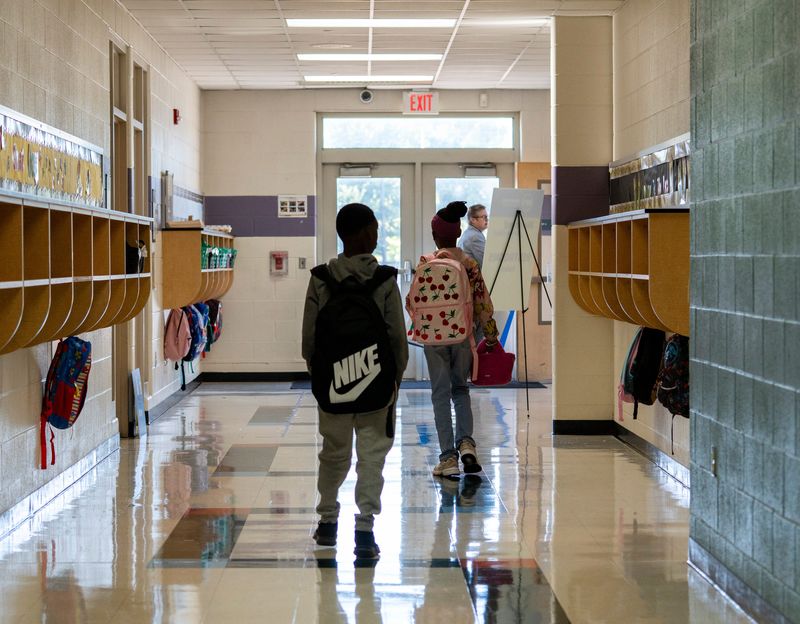
Against that backdrop, MPS educators work to help students learn and grow, knowing that schools are among the safest places for kids.
Koss witnessed that firsthand.
She remembers when three students sprinted to the school early in the morning, pleading to be let inside to escape someone firing at them. If kids’ parents or guardians were late to pick them up from an after-school program, staff drove them home, even if it was just one block away.
Koss used to choose a weekly discussion question for her classes, like asking how students would spend $1 million. When she asked how crime had impacted their lives, the question repeated for six weeks because the class had so much to say.
“A lot of kids are taught to just kind of bottle it up, and deal with it,” she said.
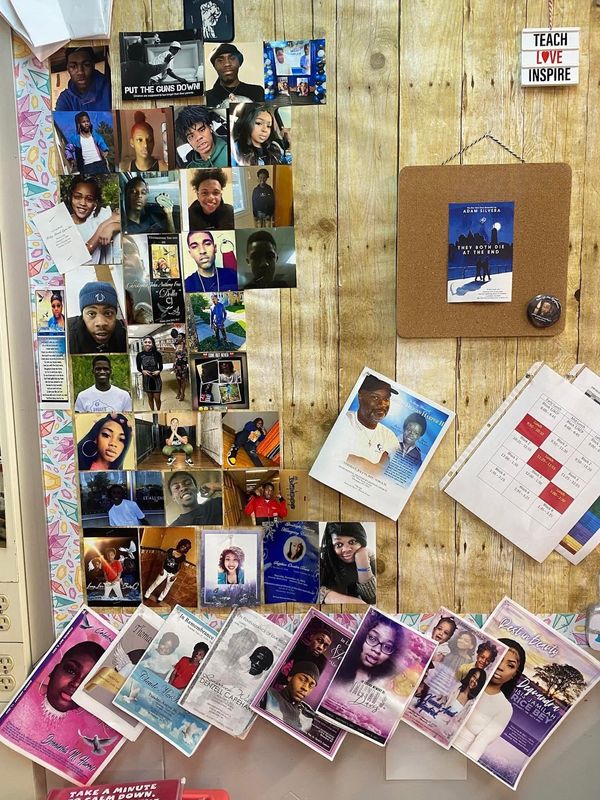
She eventually created a memorial wall in her classroom, where students could add names and pictures of their loved ones who died.
During her nearly 17 years of teaching, Koss has tracked 57 of her former students who died.
Of those, 40 were killed by gunshots, she said.
Koss said she began recording their names in a document after realizing there were too many to list from memory. She gathered their pictures, and hung them on her classroom wall.
Though she’s no longer working as a teacher, Koss still visits students’ graves regularly. She keeps a kit in her car to clean debris off their headstones. She’s helped plan funerals for countless students, and wears the ashes of one she was close to on a necklace.
“They say you’re never truly dead until somebody stops speaking your name,” she said. “And I will always try to keep their names, their memories, who they were alive.”
A mom tries to get help for a son in trouble
After a shooting, elected officials and anonymous commenters on social media often point blame at the child’s parent or guardian.
Still, comments like those don’t reflect situations when parents did try to help — and the complicated realities they confronted in doing so.
Two years ago, when Catherine Mazaba found guns in her 14-year-old son’s bedroom, she wondered what to do. She didn’t know if she could trust the police, call the city or a family friend.
“I freaked out,” said Mazaba, 45.
She tried to convince her son Ben, whom she called Benji, that he was on the wrong path. But finding the guns strained their relationship, she said. Ben denied the guns were his.
She tried connecting with a social worker and getting her son to join programs with mentors, but he wasn’t interested. She quit work to be with him more. She mulled kicking him out, but worried too much about what might happen if she did.
Eventually, she sent him to live with his grandmother.
Four months later, a friend brought him back to Milwaukee, and he returned to familiar patterns.
Mazaba noticed her son was buying things she could not afford, like flashy jeans that cost hundreds of dollars and expensive gifts for his girlfriend. She suspected he was making money illegally.
In March 2024, Ben was arrested after fleeing from the police with a gun in the car. When officers searched his home, they found bullets and marijuana.
Ben spent about a month in juvenile detention. His parents wanted him to return to school and urged a judge to let him out early. Their request was granted, on the condition that Ben live with his father and wear an ankle bracelet for two months.
For a while, things seemed promising: Ben got his driver’s permit, found a passion for tattoo art and envisioned a life without “any street stuff,” as his girlfriend put it.
His parents kept close watch over him, too. Though he lived with his dad, his mom saw him every morning before he left for Audubon High School.
But on July 27, 2024, Ben was shot and killed on South 52nd Street. No one has been charged in his homicide.
His mom, who recently moved out of state, said it’s hard not to blame herself after her son’s death.
“It really is like, what do you do?” she said.
Teaching kids how to resolve conflict to lower the risk of gun violence
Trouble is so easy to get into, but so hard to get out of.
That’s what Romell Greer’s grandmother used to tell him, growing up on the north side of Milwaukee. Now he tells it to kids he works with in Camp Rise, a city-run summer program for MPS students ages 10 to 13 .
Even at that age, many of the kids know someone who has been shot or killed, and they end up looking for ways to protect themselves, Greer said.
“A lot of these young people, sometimes when they get angry, they just see red,” he said. “They see, ‘Oh, I’ve gotta say something, or do something, that is going to make you leave me alone.'”
That’s why, if access to guns is a key factor in youth homicides, so is conflict resolution. Arguments and fights have consistently been the primary factor in most homicides since the city began tracking data in 2005.
Nearly everyone the Journal Sentinel spoke with said social media has made conflicts worse. It allows people to post recorded fights online, prolonging the anger and provoking the drive to retaliate.
“It’s become just a bad, bad place, and a place where beefs, or arguments, accelerate in real time, quickly,” Mayor Cavalier Johnson said in an interview.
Greer is among many in the city working to fight that pattern. While Camp Rise exposes younger kids to careers and mentors, other programs try to directly intervene before violence occurs.
Chaz Fortune works with people ages 12 to 22 who are involved with the criminal justice system, or at risk. He oversees Credible Messengers, a county program that connects young people with mentors from six local organizations.
Fortune and his team try to get a complete picture of a young person’s life: if there’s fighting at home, who they hang out with, what grades they’re getting. They watch for conflicts brewing on social media and in the neighborhood.
When situations escalate, staff intervene, hoping to prevent violence before it starts.
“A lot of these kids, they’re traumatized by this,” Fortune said. “They have mental issues when it comes to focusing, when someone disrespects them or says something they don’t like or looks at them wrong.”
“They feel like violence is the way to settle things, which it’s not,” he said.
A recent review found 76% of Credible Messengers’ 199 participants in 2024 had no referrals to the youth justice system.
A national effort focused on retaliatory gun violence, Advanced Peace, has been operating in Milwaukee since October. The program’s fellows are paid a stipend, check in with a mentor three times a day, participate in internships and receive travel opportunities.
Of its 27 participants, half no longer carry a gun.
“What works is support,” Fortune said.
In Milwaukee, there’s a pattern when children are shot. Everyone wants it to end.
When a child dies from gunfire in Milwaukee, a pattern unfolds.
Family members and classmates pack funeral parlors. Many use social media to call for an end to the violence, then erect memorials at the site of the shooting. Teachers read statements to their classes, saying a student has been killed.
Public officials decry the death of another young person.
Inside MPS, monthly school board meetings begin by listing the names of students and staff who recently died.
Cassellius, the superintendent, said that’s where she first noticed how prevalent gun violence was in the district, which has about 65,600 students.
“This is tremendously traumatic to the school community,” she said.
Parents, teachers, youth mentors, public officials and others all say that string of events should not feel so predictable.
“Kids have to understand, and as adults, we need to teach them, ‘This is not how it’s supposed to be,’” said Edward Nwagbaraocha, a former teacher and current MPS staff member. “And that should come from our governor, that should come from our mayor, that should come from our leaders.”
The pattern can drive a shared sense of apathy and cynicism.
Guns remain prevalent and accessible, even to those legally barred from having them. Social media amplifies and escalates conflicts. Programs that show promise are dwarfed by the number of kids who need them.
Those who spoke with the Journal Sentinel offered overlapping suggestions to stop violence before it starts.
Invest in arts, athletics and other extracurriculars. Give kids reasons to join programs that do exist. Invest in their neighborhoods. Recruit more adult mentors. Hold people accountable, from parents to politicians.
Care — and be outraged — when a young person dies a preventable death.
“If our young people are dying before they reach the age of promise, that is a failure on all of us,” said Reggie Moore, director of violence prevention policy and engagement with the Medical College of Wisconsin.
More than anyone else in recent months, Cassellius has used her position as superintendent to call attention to the crisis of gun violence in the city. The shooting deaths of students in her district deserve the same urgent response as the effort to fix lead hazards in school buildings, she has said.
Her words reopened a wound that’s always been there, like bruises after a football game that appear a day later, said Nwagbaraocha, the district staff member.
“The bruises start to show, but the healing can start now, if we do what’s right,” he said.
David Clarey is a public safety reporter at the Milwaukee Journal Sentinel. He can be reached at dclarey@gannett.com.
Cleo Krejci covers K-12 education and workforce development as a Report For America corps member based at the Milwaukee Journal Sentinel. Contact her at CKrejci@gannett.com or follow her on Twitter @_CleoKrejci. For more information about Report for America, visit jsonline.com/rfa.
This article originally appeared on Milwaukee Journal Sentinel: MPS lost enough students to gunfire last year to fill a classroom. How can we stop the violence?
Reporting by David Clarey and Cleo Krejci, Milwaukee Journal Sentinel / Milwaukee Journal Sentinel
USA TODAY Network via Reuters Connect