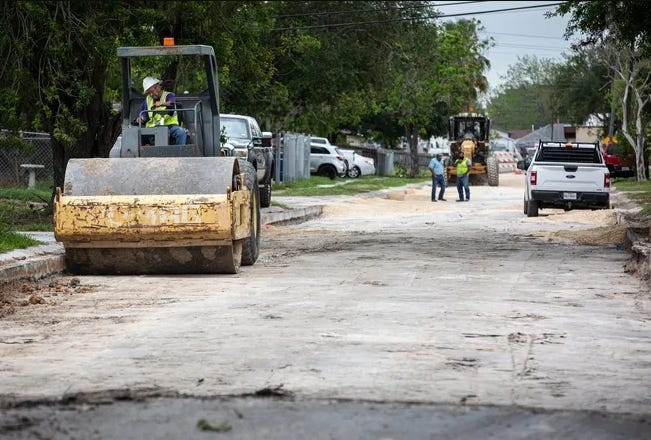
Tacking a street fee back on to Corpus Christi residents’ utilities bills is expected to soon be decided by the City Council, as members consider also the possibility of rate hikes for basic municipal services — water and wastewater — in its Sept. 9 meeting.
Whether a renewed street fee will pass, however, will likely be determined in a split vote as council members weigh potential revenues for the year.

Under the staff’s proposal, the former street fee would be reinstated, and at a higher cost to account for inflation — for most residents, amounting to about $6.60 per month.
Up until its expiration in December 2023, the fee’s revenue was designated solely for investment in repairing and maintaining the city’s residential streets.
Most residents paid about $5.30 per month as part of the program.
It had been in place for about a decade before the previous City Council voted in 2023 to allow the fee ordinance to sunset.
Some of the members who were on the council then have said they were not aware of the practical ramifications of cutting off that revenue, which officials have said totaled about $12 million per year.
Elimination of the fee — combined with inflation — will leave a projected shortfall of about $15 million for residential street work starting in fiscal year 2027, staff told the council in August.
Reimplementing the program would help cover that anticipated deficit, according to presentations.
While some council members have suggested the fee would be a solution to filling a funding gap, others have said they either would not support it or would take it into consideration not as a stand-alone proposition, but as one piece of a larger picture.
City Councilwoman Sylvia Campos said she is supportive of reinstituting the fee because the city doesn’t “have a clear path” right now on how to source funding for the program, while also keeping pace with the need.
“We have to be able to make up for it somewhere,” she said.
Whether to endorse a street fee is “a hard question to answer,” said City Councilman Everett Roy, especially within the scope of the total impacts to utilities bills.
He understands the interest in reimplementing the fee, he said, “but at the same time, we have to be very cautious in terms of what that’s going to do for the average ratepayer.”
“At the end of the day, a fee is just kind of another form of taxation,” Roy said. “And so what I’m looking at is that we modify some of those fees — but I want to make sure that overall, that we haven’t done anything to hurt our citizens, our people.”
City Councilwoman Carolyn Vaughn said she would not support reestablishing a street fee.
Instead of the council making the decision, the street fee should go to voters, she said.
Vaughn suggested its removal had been politically driven, adding that “when you stop something, it’s really hard to put it back.”
“I wish they had not done that because it gave us a sum of money that we knew would be used on residential streets,” she said.
Water and wastewater rates
The council will also be considering rates for water and wastewater services, with several new options on the table.
An initial vote that would have increased charges to residents’ water bills failed Sept. 2, as the council worked through a long list of fee and rate increases that would be among the building blocks of its new budget for the 2026 fiscal year.
At the time, the council had been considering a water rate that would increase the average resident’s bill by $4.78, bringing the cost from about $37.29 to $42.07 per month.
City officials have said the proposed increases in water and wastewater rates are partially driven by debt payments, along with inflation and decreased water consumption.
Among current projects expected to push rates are those for diversifying water supply, including improvements for the Mary Rhodes Pipeline.
Refusing any kind of an increase would translate to forcing $20 million in service cuts, staff told council members Sept. 2.
At the time, reduction recommendations shown in a PowerPoint presentation included terminating 86 positions, to include those that specialize in line maintenance, water resources, and engineering and planning.
Some council members suggested that going through a line-item budget could be the solution to finding savings that wouldn’t have as great of an impact as those listed in the presentation — including avoiding a reduction in force — while mitigating a potential rate increase.
New proposed rates
Options with different proposals for water and wastewater rates, and their correlating service impacts, are expected to be up for discussion in the Sept. 9 meeting.
Documents show the council could choose a water rate that would increase bills for an average residential customer by about $4.08, a number that would call for about $600,000 in cuts.
That could be found through a reduction in funding for a new generator at the O.N. Stevens Water Treatment Plant, according to a presentation.
A second option, it shows, would raise average residential bills by about $3.28 — a move that would result in $1.2 million in cuts, potentially from the same generator fund.
The third alternative would bump up average residential bills by $3.08 — a charge that would be tied to a $4.3 million budget reduction, city documents state.
Among potential cuts would be the elimination of the generator replacement funding entirely, along with a leak detection program, and the use of fluoride as part of the water treatment process, according to the presentation.
Wastewater had not been discussed Sept. 2 after the water rate discussion culminated with the council kicking the water rates back to staff for alternative options.
The initial proposal had been to raise rates that would increase the average resident’s wastewater bill by about $4.20 for wastewater, bringing monthly bills from about $59.32 to $63.52.
Other options could be wastewater rates that would result in about a $3.96 or $3.26 increase on the average resident’s bill, according to a presentation.
Going with a $3.96 increase would mean about $400,000 in cuts, potentially by decreasing maintenance and repairs at all of the city’s wastewater treatment plants, documents show; a rate that would increase average residential bills by $3.26 would mean a $1.7 million reduction in the department’s budget.
That reduction could be met by eliminating nine positions in a major maintenance program at a cost of $2.3 million, the presentation states.
A rate for water, wastewater and stormwater services must be approved prior to Oct. 1, marking the beginning of the 2026 fiscal year.
This article originally appeared on Corpus Christi Caller Times: Here’s what to know about the street fee and new proposals for wastewater, water rates
Reporting by Kirsten Crow, Corpus Christi Caller Times / Corpus Christi Caller Times
USA TODAY Network via Reuters Connect