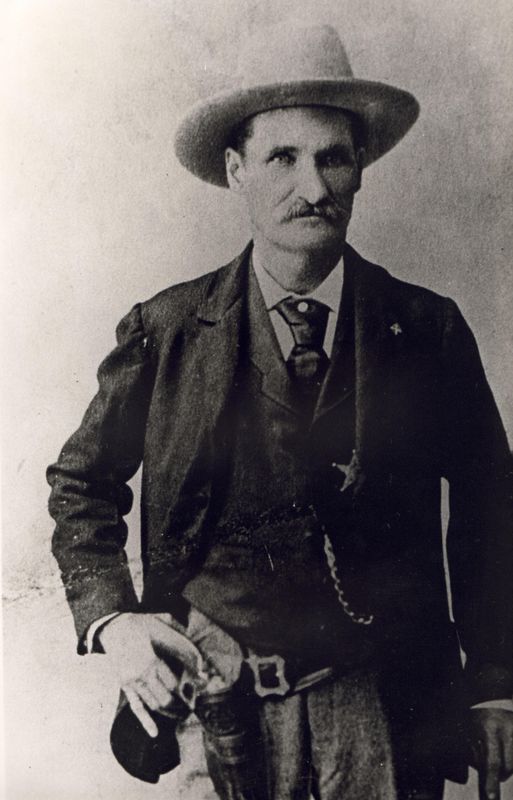
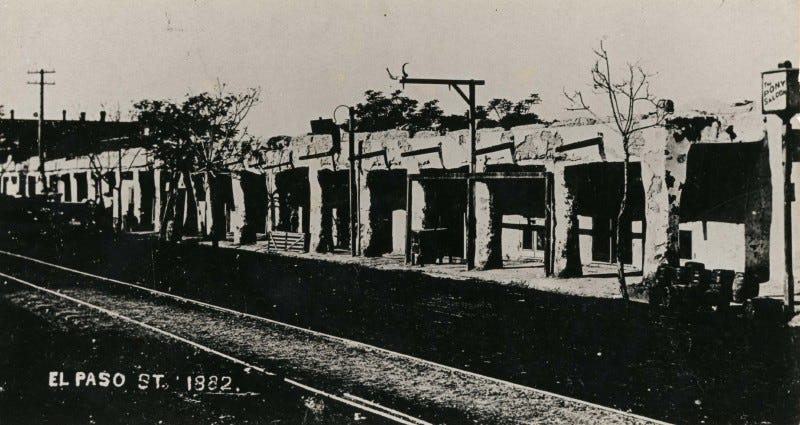
The people of El Paso breathed a sigh of relief Aug. 19, 1895, at the news of the death of John Wesley Hardin at the Acme Saloon. One hundred and fifty years after his death, Hardin, rumored to have killed between 35 and 40 men, is remembered as one of the meanest men of the Old West
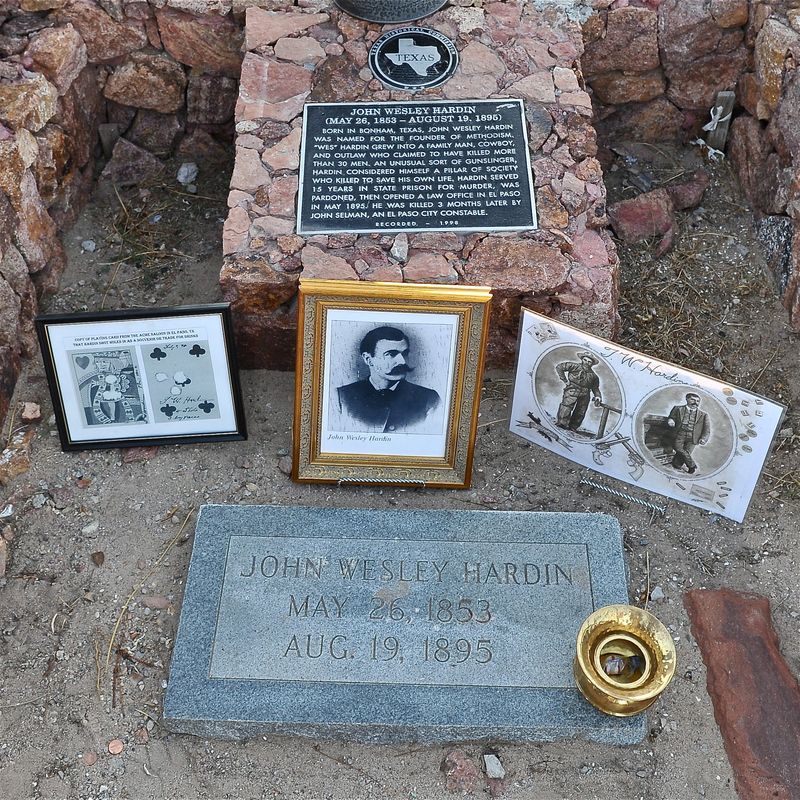
Hardin made a big impact on El Paso in his short time here and is buried in Concordia Cemetery.

This El Paso Times article from Aug. 21, 1895, gives testimony about the shooting of Hardin by John Selman at the Acme Saloon.
He Was Bad: A Brief Sketch of J.W. Hardin’s Eventful Career.
“YOU BEAT FOUR SIXES.”
And Captain Selman Did It – Last Words of John Wesley – A Conflict of Authority. Out on a Ten Thousand Dollar Bond, Henry Brown’s Testimony
Further Investigation this Morning.
The people of El Paso breathed a sigh of relief yesterday morning when they read in the TIMES the story of the killing of John Wesley Hardin at the Acme Monday night by John Selman. Some said it looked like murder, but all agreed that it was what they had been expecting. Three out of every four persons met said Captain Selman had done the proper thing in killing Hardin and taking no chances, while the fourth would admit that Hardin’s death was a good thing for El Paso, but they thought he should have been given “a showing for his white ally.”
The taking of testimony was resumed by Justice Howe yesterday afternoon and the following additional testimony was taken:
Henry S. Brown testified: “I am in the grocery business in El Paso with Lambert. I dropped in the Acme last night a little before 11 o’clock and met Hardin and several other parties. Hardin offered to shake me the dice I agreed and shook first. He shook back and said he’d bet me a quarter on the result he could beat me. We both had our quarters up and we were shaking dice. I heard a shot fired, saw a flash and Hardin fell at my feet at my left side. I heard three or four shots fired. I then left, went out the back door and don’t know what occurred afterward.
When the first shot was fired, Hardin was against he bar facing it as near as I can say, his back was toward the direction the shot came from I did not see him make any effort to get his six shooter. The last words he spoke before the first shot was fired were: “Four sixes to beat,” and were addressed to me. For a moment or two he had not spoken to any one but me. I had had no idea any one was quarreling there from anything I heard. – H.S. BROWN.
We the undersigned practicing physicians hereby certify that we have examined the gunshot wound on the person of John Wesley Hardin, deceased, and it is our opinion that the wound causing his death was caused by a bullet wound, that the bullet entered near the base of the skull posteriorly and came out at the corner of the left eye. –S.G. SHERARD, W.N. VILIS, ALWARD WHITE.
While Mr. Brown was being examined by the county attorney Mr. O.B. Patterson entered the court room and announced that he was there as attorney for Mr. Selman and he objected to the county attorney asking the witness leading questions instead of allowing him to make his plan statement.
Mr. Patterson also stated that he had issued a warrant for the arrest of Selman, who would have a preliminary hearing in the recorder’s court.
At this point the prisoner left the court room and was arrested on the street by Officer Chaudoin and taken to the city hall where Recorder Patterson gave him a hearing and accepting the testimony published in the TIMES yesterday morning fixed Mr. Selman’s bail at $10,000, which was promptly given with Messrs. W.J. Fewel and A.A. Howard as sureties. When Justice Howe learned that Mr. Selman was out on bond, he declared that the bond was void; that bail could not be allowed in murder cases while the preliminary hearing was pending and he said he would notify the sheriff to arrest Mr. Selman. The sheriff was notified and he consulted his attorney Judge Edwards, who said he would not, under the circumstances, advise the sheriff to arrest Selman a second time, though he thought the sheriff had a perfect right to do so, but as everybody knew that Mr. Selman would never think of leaving the city, there was no occasion to put him in jail.
And thus the matter stands. At 9 o’clock this morning Recorder Patterson will resume his investigation into the case as will also Justice Howe.
“FOUR SIXES TO BEAT.”
According to Mr. Brown, who was throwing dice with Hardin when he was killed, Hardin had just made his throw and shoved the box toward Brown with the remark “You have four sixes to beat,” when there was a deafening report and Hardin fell at Brown’s feet. Constable John Selman had beat the four sixes and John Wesley Hardin was no more. It is understood, however, that Shorty Anderson was in the saloon at the time, and that he will testify that when Constable Selman entered the door Hardin saw him in the glass back of the bar and attempted to pull his pistol but failed as the gun seemed to be caught in his breeches in some way.
Mr. Stevens, the proprietor of the saloon, who is very much mortified over such an occurrence taking place in his house, was setting back in the little ante room a adjoining the bar, talking to Shorty Anderson when the shooting occurred, but his position did not command a view of the bar, so he could not see what movement Hardin might have made. One man stated that he saw Selman and Hardin chatting together in the saloon card room at 8 o’clock and that he heard them make an engagement to go out on a lark together. But several parties who were sitting out in front of the saloon say that Mr. Selman came out of the saloon angry and said that Hardin had threatened to chase him around the block if he (Selman) was there when Hardin came out of the saloon. And as John Selman is not one of the running kind he notified his son to keep out of the trouble and he sat calmly down to await its coming. It is strange if Hardin did not see any signs of his impending doom – the doom which he has been courting so assiduously since he came to this city last October.
HARDIN’S HISTORY
John Wesley Hardin was born in Comanche county in 1851. “I met him,” said Deputy Sheriff J.O. Jones yesterday, “In 1874 at Comanche, Texas. His father was a Baptist minister, a good man who was held in high esteem by the people of Comanche. The wild, lawless acts of his son broke the good old gentleman’s heart and hurried him to his grave. John Wesley came to Comanche with a gang of about seventeen alleged cowboys with a herd of cattle that afterward proved to have been stolen in another county.
Hardin and his crowd had the town of Comanche corralled during the year. They would come in and “shoot up” the town nearly every night.
They would enter stores, take what they wanted and offer to pay the merchant in bullets. Young Hardin was recognized as the most reckless young dare devil in that section. He was as quick as lightning with his gun and a dead shot. He took sides with the Taylor boys. The factions were scattered over the counties of Dewitt, Gonzales and Comanche and Hardin was the leader of the Comanche county Taylor faction. Every time any of the two factions came together there was a killing and Hardin devoted himself to hunting down the Sutton people with the ardor of an enthusiastic sportsman chasing down the fox, and there is no telling how many men he killed. The feud resulted in the killing of between 35 and 40 men. About the middle of February, 1874, Deputy Sheriff Webb of Brown county rode into the town of Comanche armed with a warrant for the arrest of one of Hardin’s men. The officer left his horse at a stable and entering the back door of the principal saloon of the place, he saw Hardin and his gang in the saloon and started to pass on through but Hardin walked up to him and asked: “Have you a warrant for anybody here?” Webb replied that he did have such a warrant, and then Hardin asked what he intended to do with it. “I intend to execute it,” responded the plucky officer. With the remark, “I guess you won’t,” Hardin drew his gun and commenced shooting and Webb also had his gun out at work. Webb was killed but I think one of Hardin’s men did the killing. This act made Hardin an outlaw and a fugitive from justice.
Still he defied capture and succeeded in making several more killings before he was caught in 1876. He was then tried, convicted and sent to the penitentiary for twenty-five years, and was pardoned by governor Hogg in February, 1894. John Wesley’s doings since then you are acquainted with. But he had a brother Joe who was lynched by the people of Comanche soon after the killing of Webb in 1874 because he was John Wesley’s brother. Joe Hardin was a lawyer and land agent, and it is stated he had in his possession seals of thirteen counties which he used in making out bills of sale for stolen cattle, etc.”
Mr. Jones speaks in highest terms of praise of the father and later of John Wesley Hardin. The widow of Joe Hardin, a most estimable lady, married Wood Pierce, a well known horseman of Austin. Hardin was a second cousin of Mrs. J.L. Whitmore and Mrs. Frank Powers of the city. His son, who is about 18 years old and lives on a ranch somewhere near San Antonio, is a fine young man; sober and industrious, inheriting all the virtues of his mother and none of the vices of his father. The wife of Hardin died while he was in the penitentiary. Alderman Whitmore says that when not under the influence of drink Hardin was a fine fellow; that he knew his faults and honestly intended to mend his ways and become a good citizen. Mr. Whitmore thought a great deal of him and often lectured him with wholesome advice and endeavored to persuade him to leave El Paso. Hardin was engaged in writing the history of his life and about 350 sheets of his manuscript was found in his room. He told a friend the other day that he would complete his history today.
The funeral of his deceased was conducted from the Star Stable undertaking parlors yesterday afternoon, Rev O.J. Oxley officiating. The remains were laid to rest in Concordia Cemetery.
AFTER THE SMOKE
When Undertakers Powell and Ross undressed Hardin they found his body covered with the scars of old wounds as follows: Two old gun shot wounds close together on right side just above hip bone; gun shot wound on inside of left thigh midway between the knee and groin and a similar wound on inside of right thigh; gun shot wound on back of right elbow; large knife cut wound just below rib on left side besides numerous small scars. Hardin’s death is just what was expected. When drinking he was overbearing and abusive and believed rightly that the people feared him. Officer Chipman voiced the sentiments of all the peace officers when he said yesterday:
“When I read in the TIMES this morning that Hardin was dead I drew a long, deep breath of relief. Every day I feared I would be called into some saloon to arrest Hardin and run the risk of being killed. I never felt better when I saw him dead and I do not think Hardin ever looked better.”
The reporter heard but on single expression of regret yesterday at the death of Hardin. Nearly every body agreed that it would have been foolish for Captain Selman to have taken any chances.
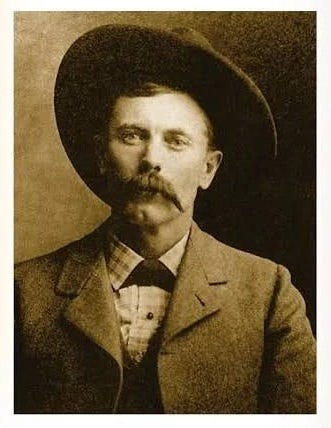
Selman shot by Marshal George Scarborough
While out on bond, Selman ran into U.S. Deputy Marshal George Scarborough, who had been friends with another man Selman killed. Their talk led to a dispute and Scarborough shot Selman four times. Selman died on April 6, 1896, and Scarborough was acquitted of murder.
Trish Long may be reached at tlong@elpasotimes.com.
This article originally appeared on El Paso Times: ‘He was bad’: A brief sketch of J.W. Hardin’s eventful career
Reporting by Trish Long, El Paso Times / El Paso Times
USA TODAY Network via Reuters Connect