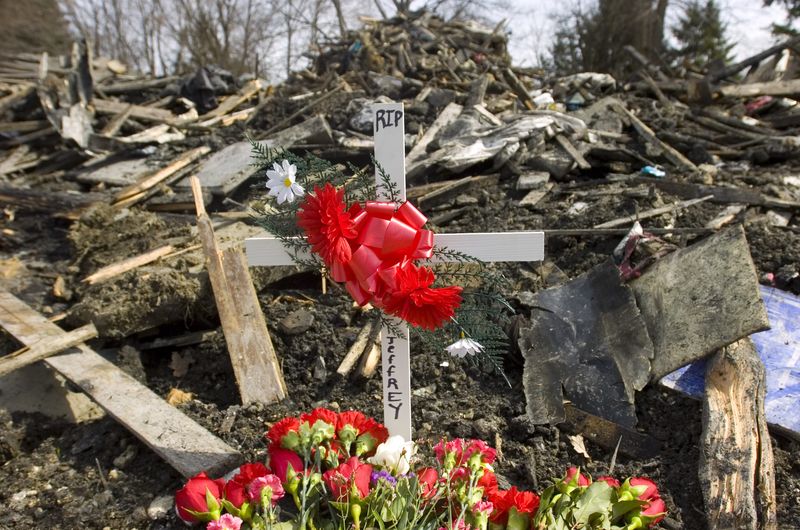
Nearly 100 Broome County residents lined the rows of a courtroom in Binghamton on Aug. 11 for jury selection ahead of a retrial for the man in the 2011 death of Jeffrey Aissa.
Jeremiah Raub, who is charged with second-degree murder and arson in connection with the fatal fire on March 17, 2011, at 20 Milford St., appeared in Broome County Court with his attorney Kurt Schrader, Broome County Assistant District Attorney Lucas Finley and Broome County Court Judge Carol A. Cocchiola.

The case against Raub first went to trial on Jan. 27 and ended in a mistrial after the jury reported they were “hopelessly deadlocked” following nearly 20 hours of deliberating.
The second trial is expected to begin Aug. 12, nearly seven months later.
During jury selection, Cocchiola, Schrader and Finley were given the opportunity to ask a given set of potential jurors questions in order to determine whether they would be capable of making a decision in a case that left the first jury deadlocked.
On March 18, shortly after the first trial, Finley said the main goal during jury selection is to ensure that the chosen jurors come into the process without any bias and to determine if they are capable of remaining “fair and impartial” while paying attention to all of the facts of the case.
Jury selection: What potential jurors were asked
Cocchiola began proceedings Aug. 11 by asking the panel basic questions about their highest level of education, marital status, occupation and hobbies. She also looked for some more information related to the trial, including whether each person had any positive or negative experiences with law enforcement and whether it would impede their ability to fairly judge the witness testimony of multiple investigators and police officers.
When Finley started asking questions, he began by focusing on the importance of circumstantial evidence in the case against Raub. He told the potential jurors they must be able to accept that circumstantial evidence does not have “any less weight” than physical evidence.
In the first trial, the majority of evidence used against Raub was circumstantial, with a five-hour taped confession taking up the bulk of the presentation. Finley said for an incident like this one, a house fire that happened nearly 15 years ago, jurors have to make determinations with what he is able to present to them in court.
“We have one of those situations that does not lend itself to providing physical evidence for me to show all of you in court,” Finley said to the panel.
Finley also discussed the significance of the charges, specifically second-degree murder and how Raub can be found guilty without premeditation behind the crime. He asked the group whether they would have “a difficult time” convicting someone of murder in a case where there was no intention to cause harm, and none of the potential jurors objected.
In his final remarks, Finley asked that the jurors only participate if they will be able to consider that a witness testifying on the stand during trial may be nervous and might not be able to “perfectly recollect” the events on March 17, 2011, and the days that followed.
Schrader said he was looking to determine whether potential jurors would feel the need to find Raub guilty in order to bring closure to an unsolved case. He started his questioning by emphasizing the importance of considering all of the given facts presented during the trial and not coming to a conclusion for the sake of “solving the puzzle.”
“If the puzzle is unsolved, you can’t just force a solution,” Schrader said.
He continued by asking jurors if they had any previous experiences with house fires or traumatic deaths that could lead to their emotions clouding their ability to remain impartial.
In the first trial, the prosecution presented photographs of Aissa’s body as he was found when the blaze at 20 Milford St. was put out. Schrader said he wanted to ensure that jurors would also not be overcome by emotion when viewing these images, a possibility that could lead to bias in deliberations.
Opening statements and testimonies are expected to begin at 9 a.m. on Aug. 12 in Broome County Court.
This article originally appeared on Binghamton Press & Sun-Bulletin: What potential jurors were asked in retrial of 2011 Binghamton arson, murder
Reporting by Jillian McCarthy, Binghamton Press & Sun Bulletin / Binghamton Press & Sun-Bulletin
USA TODAY Network via Reuters Connect