New Albany resident Philip Derrow is a retired business owner.
This column has been updated to include new information.

One billion here, eight billion there, and pretty soon we’re talking real money.
Those billions are just some of the local, state and federal taxpayer dollars luring Intel to build state-of-the-art computer chip manufacturing facilities in central Ohio. Or not.
In a recent earnings call, Intel CEO Lip-Bu Tan said the company is taking a “systematic approach” to its own investment of tens of billions of dollars to build out the Ohio plant.
The first phase of facility operation was initially expected to occur this year.
It was subsequently pushed back to 2028, and in February, it was delayed again until 2030-2031.
The recent earnings call simply reiterated the schedule announced in February.
Readers would be justified to believe it might never happen at all.
Will Intel’s Ohio plants ever open?
Some no doubt wonder if the billions of taxpayer dollars already spent have been squandered.
I’ve wondered that myself.
Fortunately, the evidence suggests that the project is likely to be completed. However, I’m less confident in the timeline since there are still too many missing pieces of the puzzle — particularly related to technological advancements and market forces — that will determine the final outcome.
The Licking County plant site is only a few miles from my home, so I’m more than just a casual observer of the project.
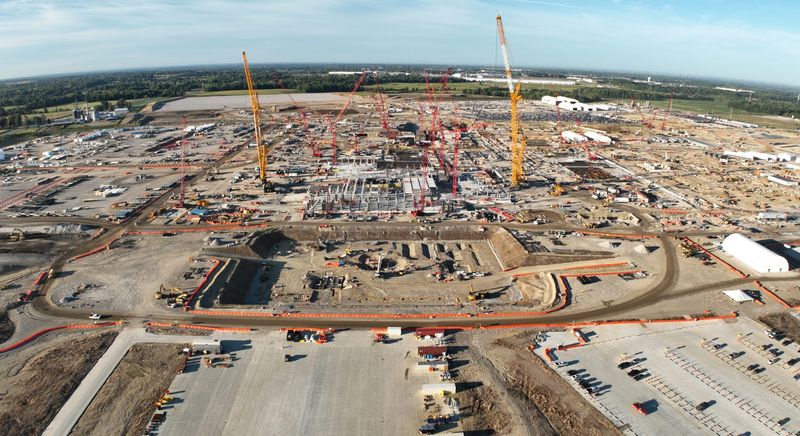
At nearly 1,000 acres, the scale of it is impressive enough from the ground. I also often see it when flying into John Glenn Columbus International Airport. The usual flight path for planes arriving from the west provides an even better view off the left side of the aircraft of just how big the site is.
The aerial view also provides a sense of other projects underway in the area, many of which are a direct result of the Intel venture.
An important caveat for any prediction on this issue involves sunk costs.
Billions of public and private dollars have already been spent, most of which has literally been sunk into the ground (which is not where the term originated).
New and expanded roads, water and sewer pipelines, and power and data cabling are in place or in process.
The sunk costs are real
Intel itself has already spent $7 billion of its investors’ money. Much of the site work and foundations for the first of four phases of the manufacturing facilities and offices themselves are completed.
The scale of that work is also difficult to truly appreciate.
Parts of the facilities themselves, known in the industry as foundries or “fabs,” rest on massive 60-foot-deep concrete inertia pads to dampen vibration.
Many of us got to see the “super load” tractor-trailer rigs that crawled their way from the Ohio River to the job site carrying various components of the plant’s environmental management system.
They’re purpose-built to ensure nearly perfectly contaminant-free conditions to manufacture computer chips with circuitry measured at a scale barely bigger than individual atoms.
There’s no Amazon Prime free return policy for that equipment.
Which means the factory will be built even if Intel isn’t the company to finish building it.
While those sunk costs are real, the trap is getting so attached to them that we keep pouring good money after bad. That’s known as the sunk cost fallacy.
Politicians often do it with taxpayer money like they’re playing Monopoly.
Public companies like Intel are less likely to do so. Corporate leaders have multiple layers of accountability for unwise investments, including bankruptcy, litigation by angry investors, or hostile takeover by a competitor.
Local officials and private developers are also much more accountable to local voters and investors, respectively.
I’m not a fan of public funding of private enterprise, but I’m even less fond of entrusting our nation’s future to foreign powers.
The massive supply chain disruptions caused by government responses to the COVID-19 pandemic laid bare our over-dependence on foreign sources for the silicon-based microchip brains that power virtually everything in the modern world.
Our national and economic security depend on bringing significant chip manufacturing capability back to the continental U.S.
The delays for this massive project are understandably concerning. But they aren’t really surprising, all things considered.
While there are still some missing pieces of the puzzle, the concrete is poured, the costs are sunk — and I’m optimistic the chips will eventually fall our way.
New Albany resident Philip Derrow is a retired business owner. He was a two-term member of the New Albany-Plain Local Board of Education. He is a regular Columbus Dispatch contributor. Reach him at philderrowdispatch@gmail.com.
This article originally appeared on The Columbus Dispatch: Is Intel’s Ohio investment a bust? Billions already buried | Opinion
Reporting by Philip Derrow / The Columbus Dispatch
USA TODAY Network via Reuters Connect