In mid-July of 1911, the Evening Press featured a curious article about a Muncie Police Department evidence cabinet. According to the newspaper, it was a “big red cupboard … fitted against a rear wall in the central police station.”
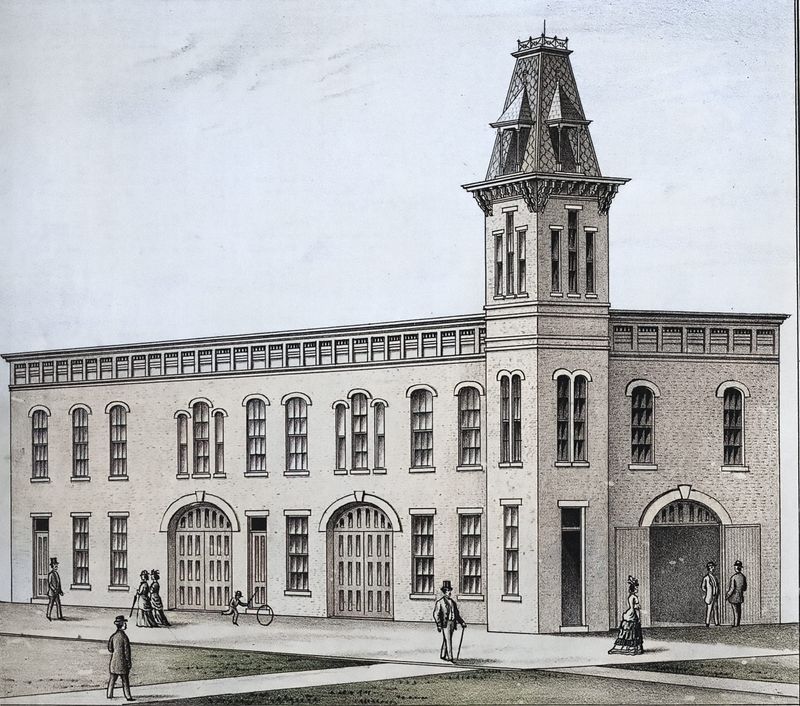
MPD’s headquarters at the time was in the 1874 city hall building at the northwest corner of Jackson and Mulberry streets.

Veteran cops said the cabinet had stood there “as long as the oldest member of the force had any recollection.” Though the law required it to be purged every two years, the evidence reviewed by the Evening Press in 1911 dated back more than three years.
The newspaper noted that, along with many liquor bottles “taken from drunken prisoners,” the cabinet held “revolvers of all makes and kinds, rifles, women’s slippers, brass knucks, clothing, keys, knives, combs large and small, watches, charms, chains, bottles of medicine, pictures and hundreds of other articles, including pocketbooks in which small amounts of money are found.”
The cabinet also held evidence from recent sensational crimes, like the bloody monkey wrench Ben Smith used to bludgeon his father to death in November 1910.
The crime had shocked Munsonians. At that time, 21-year-old Ben Smith lived on his parents’ farm in Andersonville. Today, most maps put Andersonville — an informal place name — at the intersection of Bethel Pike and McGalliard Road. But in 1910, it was an actual hamlet, centered roughly two-thirds of a mile southeast at the intersection of Bethel and Tillotson.
On the evening of Nov. 17, 1910, an argument between Ben and his father, Charles, turned violent when he hit his old man upside the head with a brick. Seeing his dad still alive, Ben brained him with an oversized monkey wrench.
He then rode out to the old Petty farm and dumped the body down an abandoned water well near what is now Alden Road. Ben was arrested, confessed his guilt and was sentenced to prison, where he died of suicide. Cops found the wrench in a ditch off Wheeling Pike.
Next to the wrench in the cabinet was a soft velvet hat with a bullet hole through it. The hat once belonged to a local businessman named Norman Black.
One evening in late September 1910, stablemen discovered a nearly dead Black slumped over in his carriage at a livery barn on Mulberry Street. He had been shot twice with a .32-caliber gun, once in the head. He died within hours. Witnesses later told police that a screaming woman dressed in white ran from Black’s phaéton not long before he was found. The murder was never solved.
On another shelf, reporters found poker chips seized by police during a raid on Bob Crabbs’ cigar store. Bob was the son of O.W. Crabbs, master Muncie gardener, seed dealer and local politician. In fall of 1910, Crabbs the younger opened the New Cigar Store at 117 S. Mulberry, ostensibly to sell fine-rolled tobacco. But at night, he ran an illegal gambling operation in the back.
Crabbs’ joint was raided three times in late 1910. He argued at each subsequent arraignment that every other cigar store owner downtown was running cards. So why was he the only one being raided and prosecuted?
Crabbs was defended in court by George Cromer — former mayor, U.S. congressman and attorney. A judge dropped the first case, but Crabbs was found guilty on the other two and fined $20, about $700 today.
Later that winter, Bob Crabbs got revenge.
In early 1911, an anonymous tipster informed Delaware County Sheriff Albert O’Hara that Muncie police Chief Otto Williamson, his wife, Lida, and some dude named Jimmy Jones were running cards out of the Imperial Cigar Store in the Wysor Building. Williamson was arrested, tried, found guilty and fined $10.
A different shelf in the evidence cabinet held counterfeiting gear seized during a February 1908 raid on William Courtney’s home in Avondale. The MPD searched the house looking for goods recently snatched from Lake Erie and Western Railroad boxcars.
Squirreled away in the attic, cops discovered $1,000 ($34K today) worth of stolen merchandise. As a bonus, they found ingots and dies for minting counterfeit silver half-dollars, hidden outside in a chicken coop.
Courtney and his young accomplice, Charles Nickerson, were arrested at the scene. The feds sent secret serviceman T.E. Hails to conduct the counterfeiting investigation. Nickerson turned state’s evidence and ratted out Courtney, who was found guilty in federal court and sentenced to a term at Leavenworth.
Reporters also noted stacks of candles in the MPD’s evidence cabinet. Police secretary Jesse White explained they were used during raids on speakeasies, known then as “blind tigers” or “blind pigs.” Muncie newspapers reported dozens of such raids between 1908 and 1911, including a large crackdown on Dec. 4, 1909, when police hit 14 establishments.
The next day, the Muncie Star gushed that “from Westside to Boycetown and Whitely to Congerville, people were agog over what was perhaps the greatest blind tiger raid ever pulled off in the state of Indiana.” At one supposed soft drink bar, police seized seven kegs, nine bottles and four jugs of whiskey; 62 barrels and 13 cases of beer; and four bottles of wine.
Finally of note, the cabinet was holding a knife and spoon taken as evidence from a hobo named William “Sorghum” McCoy. He was better known in Hoosier newspapers as “King of the Boxcar Thieves.”
In the evening of April 5, 1911, King Sorghum held up passengers on the New York Central Express Train No. 27, between Winchester and Muncie. The ordeal ended in a gun battle as the train pulled into Union Station downtown. The bandit absconded with about $300.
Sorghum was found two days later in Bellefontaine, Ohio. He was later tried, found guilty and sentenced to five years in the state penitentiary at Michigan City.
The Evening Press concluded that the big red MPD evidence cabinet of crime had “enough merchandise to start a fair-sized curiosity shop. Every article has a bit of history.” MPD secretary White was quoted encouraging someone to “write a book about all that stuff.”
No one did, but at least now there’s a ByGone Muncie article about it. I do wonder, whatever happened to all the evidence?
Chris Flook is a Delaware County Historical Society historian and senior lecturer of Media at Ball State University.
This article originally appeared on Muncie Star Press: ByGone Muncie: Muncie Police Department’s big red cabinet of crime
Reporting by Chris Flook / Muncie Star Press
USA TODAY Network via Reuters Connect