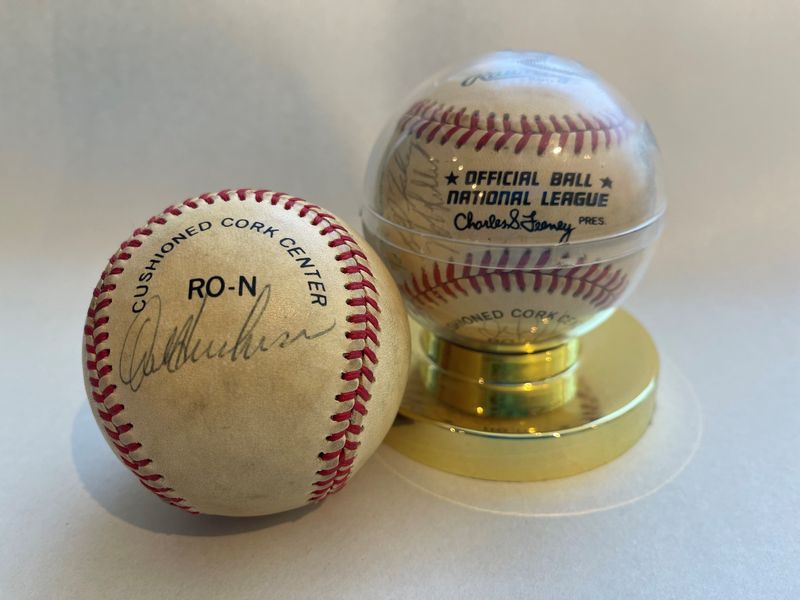
‘Tis the season of baseball and apple pie. Insofar as I know nothing about apple pie except how to eat it, let’s talk about baseball.
Since the first official baseball game was played in 1846, America’s pastime has spawned millions of collectibles, from hats to uniforms, gloves to scorecards, bats to balls. Today let’s cover the latter: signed baseballs. For a ball that costs around $7 to manufacture, adding the right signature can run the value up a thousand times. For that reason along with a few others, we need to explore a few innings of history.

It seems that American baseball grew out of a British game called rounders. Hits and runs, balls and strikes were more or less the same, but that game was played in smaller settings with a softer ball. The first American baseball team was the New York Knickerbocker Base Ball Club, organized by an enthusiast named Alexander Cartwright. Early on, the game morphed into two variants, one with a hard ball and another with a softer one, but things more or less unified during the mid-19th century.
Not long after the end of the Civil War in 1865, a baseball convention was called to codify the rules, and representatives of more than 90 teams showed up.
Baseball remained an amateur’s pursuit until the Cincinnati Red Stockings was formed in 1869. They were a formidable club, winning 56 games on a coast-to-coast barnstorming tour against local teams. After that, other cities spawned their own paid clubs and within two years the game’s top tier was in the hands of professionals. The National League of Professional Baseball Clubs appeared in 1876, followed five years later by the American Association. Most of the early teams were from northeastern and midwestern cities, the south and west not yet cottoning to organized ball. There were some mergers as some teams thrived and others sank, but by 1900 the National League had stabilized with eight core clubs, a lineup that would remain for the next 53 years.
OK, back to the balls themselves. While many baseballs today are made in China, Major League Baseball makes all of its game balls in Costa Rica, and the manufacturing process is not that simple. A small cork core is wrapped in two layers of thin rubber, followed by nearly 400 yards of various yarns. After that, the now-recognizable ball is coated in rubber cement and then sewn inside two pieces of white cowhide. So precise are the manufacturing specifications that all balls are hand-stitched with exactly 88 inches of cotton thread making up 216 raised stitches. When finished, each baseball must weigh between five and 5 1/4 ounces and be at least nine but not more than 9 1/4 inches in circumference. A final test for “liveliness” is almost too crazy to explain.
So that’s the ball. Incredibly, each MLB team goes through almost one million balls a year, thus making the official ball business quite a good one for its manufacturer (currently Rawlings). Today signed baseballs are one of the most coveted souvenirs of the game. Some players, notably Mickey Mantle and Babe Ruth, signed balls carefully and legibly, while many others have employed a completely illegible scrawl. A signed Mickey ball can be worth upwards of $1,000 while those with Babe Ruth’s imprimatur can range well into six figures. Authenticity is the key, however, and credible facsimiles far outnumber originally signed balls. Certificates of authenticity can provide some protection, but they are generally nothing more than rendered opinions. The best way to get a real one is to watch the player sign it yourself.
Mike Rivkin and his wife, Linda, are long-time residents of Rancho Mirage. For many years, he was an award-winning catalogue publisher and has authored seven books, along with countless articles. Now, he’s the owner of Antique Galleries of Palm Springs. His antiques column appears Sundays in The Desert Sun. Want to send Mike a question about antiques? Drop him a line at info@silverfishpress.com.
This article originally appeared on Palm Springs Desert Sun: Antiques: Signed baseballs are souvenirs of summer
Reporting by Mike Rivkin / Palm Springs Desert Sun
USA TODAY Network via Reuters Connect