During the catastrophic flash flooding in Texas, many residents were asleep just after 4 a.m. when the National Weather Service in Austin sent out a flash flood emergency bulletin.
“This is a FLASH FLOOD EMERGENCY for South-central Kerr County, including Hunt,” the alert read. “This is a PARTICULARLY DANGEROUS SITUATION. SEEK HIGHER GROUND NOW!”

While Ohio does not have a “flash flood alley” like the region of Texas devastated by the July 4 downpour, it has seen its share of severe weather requiring emergency alerts in recent years. In 2024, Ohio saw a record number of tornadoes, 74, touch down, breaking a previous record of 62 set in 1992.
Just a few months into 2025, the Ohio River surged over its banks and flooded communities in southwestern Ohio like Cincinnati and New Richmond. As recently as June, Circleville experienced severe flooding.
How do Ohioans get severe weather alerts?
Ohio Emergency Management Agency spokeswoman Sandy Mackey encourages Ohioans to have multiple means of receiving emergency communications.
“There’s not one fit for everybody,” she said.
One of the primary methods government agencies use to warn the public of a weather or other emergency is the Integrated Public Alert & Warning System (IPAWS), a national system that sends emergency alerts to cell phones, weather radios, and television stations.
In the event of an emergency, such as a tornado, the National Weather Service or another government agency uses the IPAWS system to send a wireless emergency alert to the phones of individuals in the affected area. You do not have to opt in for these alerts.
They do not arrive as text messages, but instead resemble Amber Alert notifications, according to Mackey.
The alert is also broadcast on television stations (that banner on the screen accompanied by a rhythmic droning sound) and on NOAA weather radios.
Weather radios are one of Mackey’s favorite methods of emergency communications, she said.
“You can have a battery-operated radio, you can have a hand crank radio, so if your power is out, you can still receive messages,” she said. “And the National Weather Service broadcasts 24/7 real-time information on there.”
How to sign up for Franklin County’s weather alerts
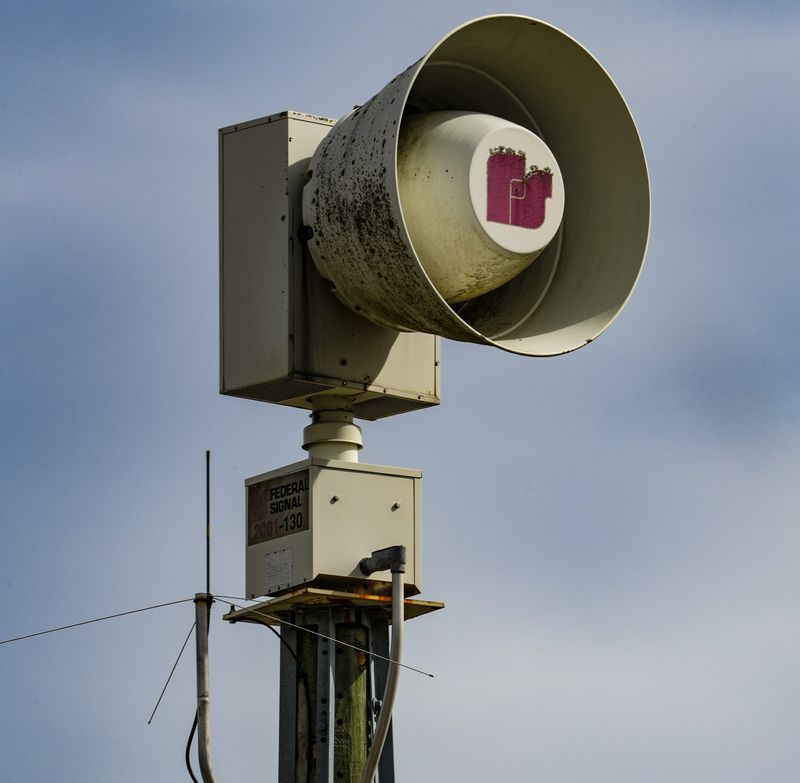
You can also get severe weather alerts from outdoor sirens, the National Weather Service’s website, weather apps, local news outlets, social media, emails and from your friends and family, according to the NWS. Digital billboards in Dayton and Columbus also warn residents of severe weather.
Most Ohio counties, like Franklin, offer residents opt-in mass notification systems that will also text residents about emergencies or public safety announcements like boil orders. Whatever method you choose, the most important thing to do when an alert comes in is to heed it, according to Mackey.
“You have to take action and take responsibility when you hear these to get to shelter. It’s so important,” she said.
Who pays for tornado sirens in Ohio?
Local jurisdictions are responsible for adopting and maintaining tornado sirens, Franklin County Emergency Management & Homeland Security Director Jeffrey Young said. That means they’re funded by local governments, but state and federal grants have previously been used to offset the cost.
“I want to say 15 years ago, there may have been some natural hazard mitigation grants that were available for sirens,” said Young, whose agency maintains Franklin County’s sirens. “But they ended that program, and currently there are (no grants) available that I’m aware of.”
It’s also up to local government to decide whether or not they have tornado sirens at all. Some local areas had tornado sirens in the past but are phasing them out in favor of modern communication methods like wireless messaging, according to Young.
While Franklin County has an array of modern communication methods at its disposal, it has opted to continue operating its around 200 sirens around the region. It provides the service to most of the county, with the exception of Dublin, which manages its own.
“Sirens (are) a very cost-effective way to alert a large volume of people instantaneously,” Young said.
Sirens are meant to notify people outdoors of a weather emergency, not people indoors. That is another reason why it is important to have multiple emergency communications methods at your disposal, Mackey said.
Breaking and trending news reporter Nathan Hart can be reached at NHart@dispatch.com, at @NathanRHart on X and at nathanhart.dispatch.com on Bluesky.
This article originally appeared on The Columbus Dispatch: How does Ohio’s emergency alert system work? What to know when severe weather approaches
Reporting by Nathan Hart, Columbus Dispatch / The Columbus Dispatch
USA TODAY Network via Reuters Connect