Southwest Florida didn’t escape the governor’s veto pen this year.
During the signing ceremony for the 2025-26 budget, Gov. Ron DeSantis announced nearly $567 million in line-item vetoes, nixing funding for dozens of projects across the state.

After the sweeping cuts, however, the budget still included more than $86.8 million in funding for projects and programs in the region.
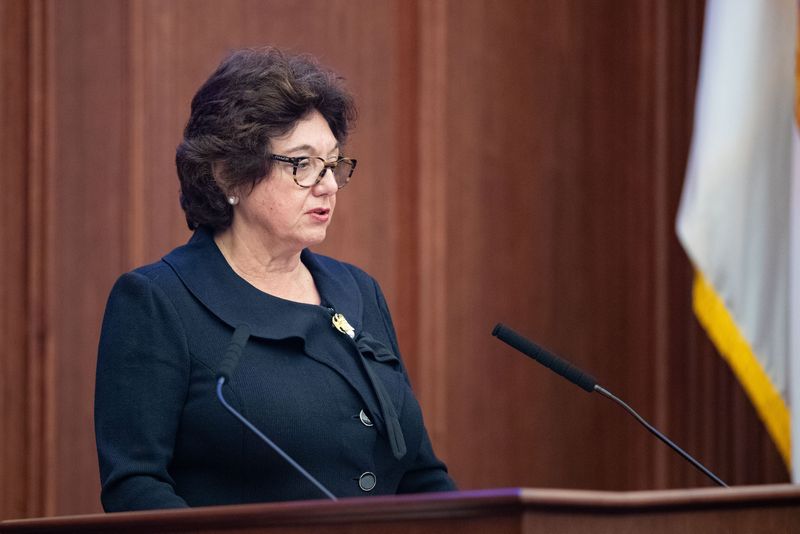
“I’m grateful to my colleagues in the Legislature and Governor DeSantis for supporting meaningful investments in Southwest Florida. Through this year’s state budget, we secured funding to strengthen our local infrastructure, support our law enforcement and continue services for local seniors and veterans,” said Sen. Kathleen Passidomo, R-Naples.
Her district includes Collier, Hendry and parts of Lee County.
While some of the projects Passidomo and other local delegates championed didn’t get funded, many did.
Despite the cuts, she said, the local environment will benefit in a big way from this year’s budget.
“Working with the Governor, we’re also continuing to expand Florida’s Wildlife Corridor, a living legacy that safeguards natural landscapes, where water is stored, food is grown and wildlife roams,” she said. “This corridor will stand as one of Florida’s defining features, treasured for its beauty and economic value for generations to come.”
The governor restored money for the corridor, with $200 million allocated for acquiring and protecting critical lands. The corridor encompasses nearly 18 million acres, including lands in Southwest Florida.
An analysis by Passidomo shows more than $12.3 million allocated to government and nonprofit projects and programs in Collier County.
That money includes:
In a statement, John Mullins, a county spokesman said:
“Like all Florida local governments, the Board of County Commissioners annually submits project funding requests to our State legislative delegation, who work diligently to get our projects included in the General Appropriations Act. Through their efforts, in this session, they were able to secure a total of nearly $4 million in matching funds for three Collier County public health and safety projects, including emergency power generation for the entire Courthouse Annex Building, funding to harden five sanitary sewer lift stations against stormwater inundation, and funding to improve the technology at the Emergency Operations Center that hosts numerous participating agencies during event activations. We value their partnership and appreciate their support as these facilities serve their constituents.”
All of Collier County’s funding requests that made it into the final General Appropriations Act “survived gubernatorial veto,” Mullins said.
Two requests, he said, never made it into appropriations act, including $500,000 to help fund the replacement of an emergency mobile command vehicle, which remains in operation.
“We will continue to plan for an eventual replacement, as funding is made available,” Mullins said.
The other request that didn’t make it: $25 million to help fund water and wastewater improvements in Golden Gate, but the county has a financial plan to “ensure project completion,” he said.
The city of Naples received a total of $4.8 million for four public projects, with the city of Marco Island getting $1,125,000 for two projects.
In Naples, here’s what was funded:
In a statement, city manager Gary Young thanked the governor for his support, and Passidomo and state Rep. Yvette Benarroch, R-Naples, for “championing our efforts to strengthen resiliency and enhance the safety of our residents,” along with the city’s lobbyist.
“In light of the storms and events that have impacted our community over the past three years, these state-funded projects will play a critical role in supporting our resiliency initiatives, improving public safety, and hardening our infrastructure,” he said.
He added: “The Venetian Bay seawall project, which was originally damaged by Hurricane Irma, and the Basin IV stormwater improvements — identified as one of the City’s oldest areas most in need of critical stormwater upgrades— are among our top priorities.”
In Marco, the appropriations included:
Across Collier County, a handful of nonprofits received funding including the Baker Senior Center, the Holocaust Museum, and the David Lawrence Centers. The largest appropriations include: $450,000 for the Healthcare Network to help cover renovation costs at its clinic in Immokalee, and $375,000 for a Pathways to Healing program, run by the David Lawrence Centers, focused on improving wellness and mental health.
In neighboring Lee County, the veto pen was felt harder. Still, critical county water and road projects received funding.
“Despite a few vetoes, Lee County will benefit from nearly $8.5 million of legislative appropriations our delegation obtained for water quality, flood control, critical facilities expansion and Alico Road construction,” said Glen Salyer, the county’s assistant county manager and legislative liaison, in a statement.
Here’s a closer look at critical county projects that received funding:
In her district, Passidomo shared that $36.1 million was appropriated to government agencies, universities and nonprofit organizations in Lee County (not including county projects). The biggest award: More than $21.7 million for a learning, research and outreach center for Florida Gulf Coast University at Babcock Ranch, an 18,000-acre master-planned community that sits in Lee and Charlotte counties. The university has partnered with Babcock Property Holdings on the project, focused on sustainability and resilience.
Meanwhile, Florida SouthWestern State College secured more than $4.6 million for projects and programs in Lee and Charlotte counties, including $1.75 million for an Innovation Lab. The lab on the Lee campus will allow for the introduction of new academic programs in entrepreneurship, and the addition of micro-credentials and digital badges in essential areas, such as prototyping, manufacturing, pitch development and project management.
FSW’s other appropriations: $2.5 million for ongoing renovations of a health building on the Charlotte campus, and nearly $500,000 for nursing simulation equipment there. All of the funding will help FSW further its mission to provide “innovative, workforce-aligned education across Southwest Florida,” said Jennifer Young-Fidler, the university’s director of marketing and strategic communications.
“Florida SouthWestern State College is grateful for the continued support of our local legislators and state leaders,” she said.
Funding awarded to nonprofits in Lee County include $95,000 for the Florida Lions Eye Clinic. The clinic, based in Bonita Springs, provides free eye care to needy residents without medical insurance, including glasses. It’s the only one of its kind in the state.
In Hendry County, the largest appropriation was for LaBelle High School — topping $30.2 million.
Unlike last year, arts grants were largely funded statewide. In Lee and Collier counties, six organizations made the cut this year, including The Naples Players and the Center for the Arts of Bonita Springs, each receiving $150,000.
This article originally appeared on Marco Eagle: State budget includes millions in funding for SWFLA projects – including Marco Island
Reporting by Laura Layden, Naples Daily News / Marco Eagle
USA TODAY Network via Reuters Connect