The aroma of fresh spring rolls, nutty chicken satay and fried crab rangoons lingered in the air at the Hmong American Peace Academy’s first floor café , drawing visitors inside the school.
Dozens filed into the café, which was decorated with string lights and sage green tablecloths, and up through the second floor classrooms filled with galleries that featured students’ art, photos, artifacts and visual interviews.

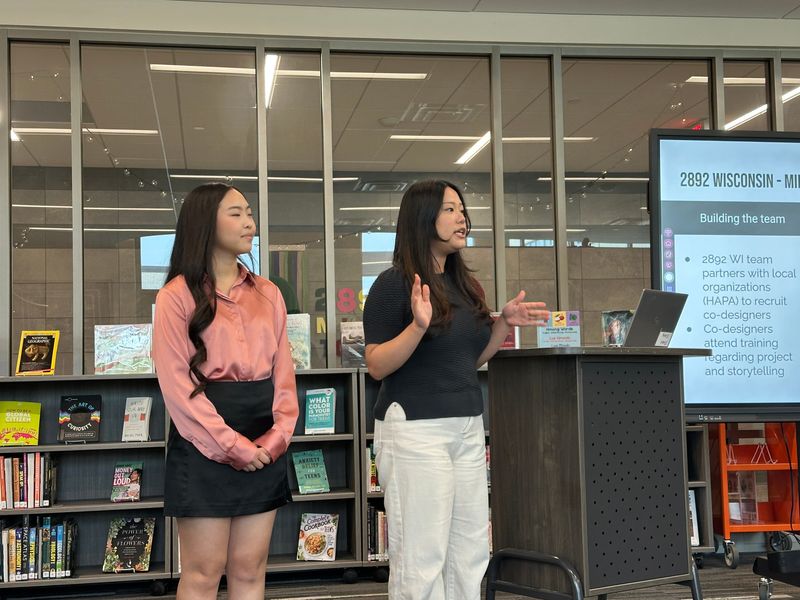
Peace Academy students and staff partnered with a program supported by the National Geographic Society for the June 12 exhibit, “Rooted Voices: Hmong Stories from the Heart of Milwaukee,” designed to celebrate Milwaukee’s Hmong culture.
“Without heritage, we are nothing,” said Chris Her-Xiong, founder and chief executive director at HAPA.
Students conducted interviews and designed, decorated exhibits
Six Peace Academy seniors conducted interviews — including a survey of Milwaukee Hmong youth with over 400 responses — and assembled multimedia projects to capture voices of Hmong youth, businesses, artists and community leaders. The students also designed and decorated the exhibits on the school’s second floor.
Lydia Thao, one of the seniors, said the students began meeting in January after previously working together on a similar project. Meetings took place about once a week and the group settled on three topics to display: Hmong culture and arts, business and youth.
Thao focused on the culture and arts topic for her project, connecting with her uncle Kou Thao, a Hmong movie producer. She interviewed him about his experience as a Hmong filmmaker and worked with National Geographic to edit footage and translate the Hmong language.
“As the Hmong community, our history is not really shared outright in the public, and so we wanted to take this opportunity to just show everyone that we’re here, we exist and we have stories to tell our experiences,” Thao said.
Thao said the “Rooted Voices” project helped the youth connect with older generations and share experiences. She said it makes her feel hopeful to see other youth working to preserve their heritage despite being part of a Hmong generation that is losing their culture and language. According to UNESCO’s Atlas of the World’s Languages in Danger, the Hmong language is “endangered” and continually declining.
Thao added that she hopes what the school is doing spreads to other schools so more students can feel inspired by their culture.
Yulia Lee, another senior, created a display in the business category featuring local restaurant An Ox Cafe, as well as a culture and arts display featuring Elvis Thao, an actor who appeared in “Gran Torino.”
Lee said when she reached out to Thao for her project, he told her he’d been waiting on an opportunity like this one.
“That was such a relief to hear because it’s like, ‘oh my god, he’s actually passionate,'” Lee said. “That’s so cool.”
Hmong culture, identity in Milwaukee
Diane Xiong said it is important that students are working on education projects like “Rooted Voices” because they are the next generation of leaders. She said that as an older Hmong woman she enjoys seeing kids — especially girls — take on leadership roles in a community where they aren’t always encouraged to act as leaders.
“I’m proud because they are young kids who are doing things despite people saying that they can’t,” Xiong said.
Xiong added that Wisconsin, and Milwaukee in particular, needs more education about Hmong culture because of the community’s impact on economy, diversity and culture, and it’s important for the city to recognize the success that has historically come from immigrants.
Pachai Vang said the exhibit was a fun way to teach others about Hmong culture and experiences.
“I think diversity is something that we all should really value, and Hmong people, we’re a big ethnicity group that goes unrecognized,” Vang said. “We thought it would be important to highlight some of our achievements because we are a big part of Milwaukee, because there’s so many of us here, and it’s just really important just to talk about our accomplishments and how great we are.”
2892 Miles To Go
2892 Miles To Go, named after the distance from the East Coast to West Coast, is an education program supported by the National Geographic Society that facilitates collaboration between local youth, educators and leaders to create solutions to address environmental, social and cultural issues.
E Her Vang, a Milwaukee native, said after the 2024 passage of Wisconsin Act 266, which mandated the inclusion of Hmong American and Asian American history in K-12 curriculum for all Wisconsin public schools, 2892 Miles To Go Wisconsin built a team with the Asian American Pacific Islander Coalition of Wisconsin to bring the “Rooted Voices” event to life.
“When we were these students’ age, we were not given the same opportunities to talk about our culture and heritage,” Vang said. “I want students to feel proud about who they are, but also educate the public and the community more about the Hmong culture.”
The Milwaukee 2892 Miles To Go team was co-led by E Her Vang and Kathy Xiong, as well as Hmong history and culture teacher Diane Xiong and six HAPA seniors: Yulia Lee, Ava Lor, Tyson Pha, Lydia Thao, Ashley Vang and Pachai Vang.
Correction, June 20, 2025: A previous version of this article included a student’s incomplete name. Yulia Lee is a recently graduated student at the Hmong American Peace Academy who worked on “Rooted Voices.”
Contact Mia Thurow at mthurow@gannett.com.
This article originally appeared on Milwaukee Journal Sentinel: ‘We exist and we have stories’: Hmong youths share culture in storytelling exhibit
Reporting by Mia Thurow, Milwaukee Journal Sentinel / Milwaukee Journal Sentinel
USA TODAY Network via Reuters Connect