As Milwaukee authorities continue to explore using facial recognition, efforts to stop its use are growing.
Milwaukee politicians and residents gave a strong rebuke of local law enforcement’s interest in the technology at separate city and county meetings in June. Citing concerns over racial bias and unjust surveillance of residents, many argued the technology poses too much risk or needs guardrails.

“We are seeing already how surveillance tech is being weaponized in real time,” said Amanda Merkwae, ACLU of Wisconsin’s advocacy director, referring to the use of data gathered from facial recognition, automated license plate readers, artificial intelligence and other surveillance tools.
While police say the technology would help them investigate violent crimes, that hasn’t convinced opponents in the two months since interest in acquiring it was revealed.
Those concerns led a county committee June 17 to recommend staff create a policy on its use, with protecting civil rights the main focus.
Nationwide, facial recognition has proven controversial, particularly for its inaccuracy with people of color, and prompted fears of use against activists, immigrants, LGBT people and other communities. It has also resulted in legal action.
In Detroit, the police department settled a federal lawsuit for $300,000 over its use that led to the wrongful arrest of a man in 2020. As a result, the department overhauled its policy about using it.
Some cities, including Madison, have banned city agencies using facial recognition.
“Data collected in Milwaukee County does not always stay in Milwaukee County,” Merkwae said. “Once it enters a federal pipeline, it can be accessed, shared and used in ways that we cannot predict or stop.”
Milwaukee law enforcement considering swapping mugshots for access to technology
The Milwaukee Police Department first announced its interest in April in trading 2.5 million mugshots for two licenses giving it access to the company Biometrica’s technology that allows authorities to compare photos to a large database of photos for matches.
The MPD and the Milwaukee County Sheriff’s Office don’t have a contract with any facial recognition technology. The police department has used it through neighboring agencies in the past and is interested in pursuing an agreement with a company.
Both departments have said if they were to acquire it, they wouldn’t make an arrest solely based on an identification made through facial recognition.
The proposal by Milwaukee police has been met with resistance. Roughly two-thirds of Milwaukee Common Council members signed a letter opposing its use by police and the public has spoken out against it at a previous meeting.
Some are advocating the city to use a public body called community control over police surveillance, or CCOPS for short. That body would require police surveillance technology to be reviewed by the public and the Common Council before it can be implemented.
Milwaukee police get chilly reception, criticism for approach
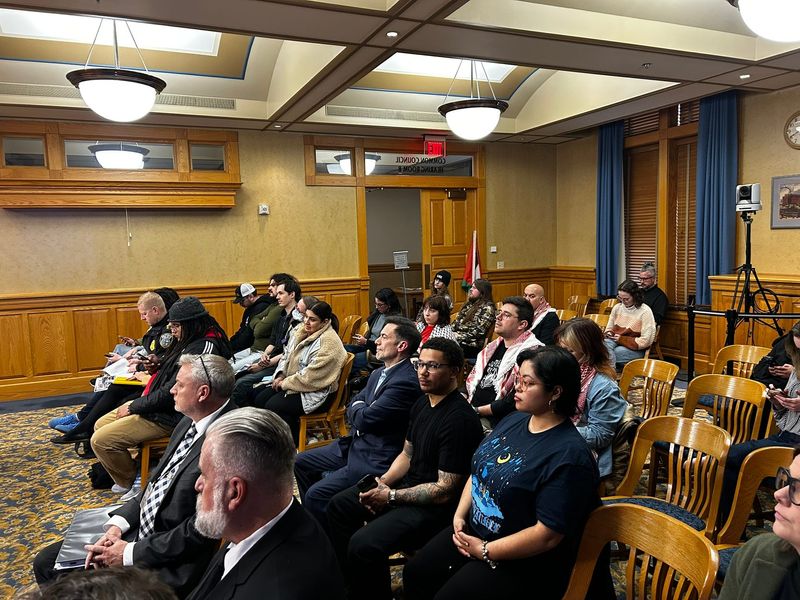
Roughly 40 residents and activists filled a city committee meeting June 18, holding signs that said, “Say no to FRT in Milwaukee” and “Your face, their fortune.”
“This is not free. The cost is 2.5 million mugshots of anyone who has been through the system,” said Ron Jansen, a resident who spoke during the public comment period.
During a police presentation, MPD chief of staff Heather Hough said the department’s hope to use facial recognition technology would be mirroring moves by other groups, like federal agencies and Wisconsin sports teams.
Police officials gave two examples of its use in the past — by accessing the technology from neighboring agencies — drawing some criticism from speakers. Hough framed facial recognition as a neutral technology.
“It is only a tool. The disparity comes from the misuse of the technology,” Hough said.
At the June 18 Equal Rights Commission meeting and an April Fire and Police Commission meeting, Hough said the department doesn’t have to conduct these meetings but is doing so to gather community input. That statement drew criticism from attendees and commission members, prompting an apology from Hough at one point.
“Something to remember maybe is that there isn’t no police oversight,” said Alexandria Staubach, an Equal Rights Commission member. “The community does have a level of control over what MPD does.”
The Equal Rights Commission intends to hold more community meetings on the technology, said Tony Snell Rodriguez, its chair.
Biometrica refutes activists’ assertions, wants chance to speak
Biometrica pushed back against many of the criticisms from residents and activists and was critical of “incorrect stories” in Milwaukee media.
Ka Wade, the company’s chief privacy officer, told the Journal Sentinel that Biometrica doesn’t consider itself a facial recognition company, but instead a big data company. That’s because the company partners with third parties that run photos against their database through facial recognition.
The company’s product works through its database of images made up of law enforcement images or missing persons, Wade said. When authorities want to run an image against that system, it gets put into a “black box,” where it isn’t accessible to any parties, including the company, and isn’t retained by its or other parties’ systems, she said. The facial recognition technology then runs the photo, and it returns a confidence score and possible matches in the company’s database, she said.
The company doesn’t work with federal immigration authorities and is focused on protecting privacy and proper use, Wade said. The company offers recommended law enforcement use policies and anti-bias training.
Wade, whose company is based in Arizona, watched the Equal Rights Commission hearing June 18 through a live stream. She acknowledged her assurances were unlikely to sway those who are against the technology.
“We are trying our best to do it the right way, as hard as it may seem to people,” she said.
Wade said the company hasn’t been asked to participate in any of the public meetings and was disappointed by that. Biometrica would welcome the chance to speak at any meeting or with those who have concerns, she said.
“To not listen to people is arrogance,” Wade said.
Milwaukee County pushes for guardrails to protect residents
On June 17, a Milwaukee County committee unanimously voted to recommend the development of a policy framework for the use of facial recognition technology that doesn’t “suppress First Amendment related activities, violate privacy, or otherwise adversely impact individuals’ civil rights and liberties.”
The committee’s recommendation also asks for a pause on acquiring new facial recognition technology until regulatory policies are in place to monitor any existing and new surveillance technology.
The resolution was in part sparked by efforts at the city level as well as concerns that the Milwaukee County’s Sheriff Office might have been considering the use of the technology without county officials’ knowledge.
Biometrica approached the sheriff’s department about a possible agreement and that prompted a legal review of the department’s data sharing policies, Sheriff Denita Ball said.
“These reviews ensure our procedures are within the scope of the law regarding the constitutional rights of everyone and significantly reduces potential legal exposure to Milwaukee County,” Ball told supervisors at the county’s judiciary, law enforcement and general services committee meeting June 17.
“Prior to utilizing any technology, we would have the policy written, reviewed and then instigated,” Chief Deputy Brian Barkow said.
Ball confirmed that there’s no request for proposal yet to contract with any company using facial recognition.
Barkow later added: “Our intent is to not install it on existing cameras, where when you’re walking through the courthouse and you see a camera, that it is scanning your face to identify you.”
He said any data captured would be used to cross-reference with existing databases, which include booking photos, to identify individuals connected to violent crime incidents, shootings, homicides, sexual assaults and robberies.
The recommended resolution asks the county’s Corporation Counsel, its Information Management Services Division, the Sheriff’s Office and relevant stakeholders and advocates to develop a framework. The aim is to implement strict regulations on facial recognition technology to ensure informed consent, limit data collection and retention, restrict third-party sharing, and mandate transparent annual reporting.
Supervisors Justin Bielinski and Juan Miguel Martinez raised concerns after the city’s Fire and Police Commission meeting that had said the Sheriff’s Office had already been working with Biometrica. This was later confirmed to be an error. The agency had only met with the company for a software demo.
“The thing is that facial recognition technology disproportionately affects communities of color and increased surveillance in our neighborhoods,” Martinez told the committee.
Despite voting in favor of a policy framework, Supervisor Patti Logsdon differed from her fellow supervisors, arguing the technology is needed.
“I think you need that tool in your toolbox,” she told Sheriff’s Office representatives.
Residents and advocates alike attended the committee meeting to voice support for a policy framework.
Heba Mohammad spoke strongly in favor of the policy, sharing her personal experience having been exposed to such technology while living in Palestine and her concerns that it could be used on Milwaukee’s Arab and Muslim communities.
“It’s a slippery slope to reestablish protections of our rights once the tools to violate them have already been sanctioned and purchased,” she said. “And we’re giving away all these rights, potentially for technology that doesn’t even effectively do what it promises to do in terms of solving crime.”
Emilio De Torre, Milwaukee Turners executive director, applauded the county’s “proactive step” toward protecting residents in light of the country’s growing use of facial recognition technology.
“The technology generally is dangerous because of its application,” he said, later adding that its use could rapidly expand to incorporating license plate data and social media. “It’s certainly a short hop, skip and a jump.”
The County Board is set to vote on the resolution June 26. If approved, Milwaukee County Executive David Crowley will have to sign off on the policy framework.
David Clarey is a public safety reporter at the Milwaukee Journal Sentinel. He can be reached at dclarey@gannett.com.
Vanessa Swales covers local government and incarceration for the Milwaukee Journal Sentinel. She can be reached at vswales@gannett.com
This article originally appeared on Milwaukee Journal Sentinel: Milwaukee residents continue push against police interest in facial recognition
Reporting by Vanessa Swales and David Clarey, Milwaukee Journal Sentinel / Milwaukee Journal Sentinel
USA TODAY Network via Reuters Connect