(This story was updated to add new information.)
Taxpayers in Peoria are likely to be on the hook for about $200 million in additional costs needed for the city to meet its federally mandated combined sewer overflow projects.

Members of the Peoria City Council were generally dismayed and, in some cases, incensed to learn that additional costs of $200 million would be required after a misevaluation of the project’s needs during the original planning.
Tim Riggenbach, the City Council’s longest-tenured member, called the new proposal from city staff, which laid out the additional costs and needs on Tuesday night, “an embarrassment to the city” and said he felt like he had been “hoodwinked” and “sold a bill of goods.”
“I’m just flabbergasted,” Riggenbach said. “I’m just flabbergasted. We were so proud of ourselves that we were going to the be the first city in the whole country to get a green deal with the EPA and we miscalculate the soil …”
The problem at hand for the city on Tuesday night had multiple prongs, each of which adds a wrinkle to the CSO overhaul plan the city began implementing in 2021.
Chief among those issues was a misevaluation at the beginning of the projects as to what kind of soil would be prevalent throughout project sites. Original testing found that areas below the bluffs in Peoria were likely to have sandy soil, which meant that water infiltration would be high.
As the project got underway, engineers realized that there was more variance in the soil than they had originally assumed and the soil throughout the project area was not as permeable as expected, meaning water would have to be diverted to more permeable areas. This required quick changes to the engineering plan and a transition away from green infrastructure.
Another misstep in the original calculations came in 2018 when city staff and a hired consulting firm projected about $109 million in costs for the projects. That figure did not factor in inflation. In 2025 figures, that cost is about $136 million. High inflation and supply-chain disruptions have also driven costs higher for the projects. Additionally, CSO projects for years three and four only had one bidder, which drove up costs.
However, the new plan proposed on Tuesday night, which would transition the city’s CSO project from the originally proposed green infrastructure to more traditional gray infrastructure, which constitutes things such as pavement, carried a price tag of more than $300 million — a $200 million difference in cost.
What that means for Peorians, as City Finance Director Kyle Cratty simply put it Tuesday night, is rate increases on their sewer bills, which are mostly based on water consumption.
“While it is not necessarily the happiest way to look at it, the only way to pay for it because this is dedicated revenue is rate increases,” Cratty said. “… The short answer is, the best way mitigate is to raise the rates that are in place. I say all that understanding, yes, this is going to impact households. That is the reality as we look closer.”
Rate increases are expected to be implemented in May 2027, Cratty told the council. All Peorians pay into the CSO through the city’s stormwater utility tax. In order to pay for the increases to the CSO projects, city staff recommends increasing sewer rates in both the city sewer system and the Greater Peoria Sanitary District.
What this could mean for homeowners’ bills depends on if the city funds the projects using a loan from the Illinois Environmental Protection Agency or if it issues bonds.
The quarterly range for CSO fees on sewer bills could rise from $3.97 per quarter to $20.12 per quarter or $31.29 on the high end if bonds are issued. The total average sewer bill in Peoria could rise from roughly $69.45 per quarter to $86.88 a quarter if the city uses a state loan or $98.05 per quarter if it issues bonds.
City Manager Patrick Urich told the council that switching to gray infrastructure projects during the second wave of projects will be more expensive up front for the city but will ultimately save money over the lifetime of the projects, which Peoria pays for by borrowing money from the state.
Instead of moving forward with the originally proposed green infrastructure proposals, the city will instead build five tanks along the Peoria riverfront to hold stormwater overflow.
The first tank that would be built is a 6.4 million gallon tank off the Cedar Street Bridge on the riverfront. It will cost $60 million to construct. Construction of the tank would likely begin in 2027. Urich said moving ahead with green infrastructure instead of the tank would cost more than $100 million. Peoria will finish its year four CSO green projects in 2025 and will then pivot to the new plan.
The tanks could be built either above ground or below ground. Evaluations are still being made as to which option would be cheaper. The size of the tanks will vary from site to site, depending on what is needed.
City Engineer Andrea Klopfenstein emphasized in an interview with the Journal Star on Wednesday that the green infrastructure that has been put in place is working, but the costs associated with installing the green infrastructure unexpectedly rose. She said maintenance costs for green infrastructure, inflation, soil condition and the green initiatives not being as effective as expected all drove costs up.
Riggenbach remained skeptical of all the figures city staff presented to the council, given the already large increase in costs presented.
“I’ve lost confidence in your estimates, I’m afraid to say,” Riggenbach said.
Klopfenstein said evaluations and adjustments on the projects have been happening since year one of CSO projects. She said that city staff “raised the red flag as soon as we could and when we knew that we had to.”
“We’ve done it as quickly as we can, but the way the consent decree is modeled it’s project after project, so it takes a while for you to realize that the numbers aren’t coming in as good as we thought they were going to,” Klopfenstein said.
‘We’re stuck’
Peoria has little options about how to tackle the CSO issues. A mandate issued by the Environmental Protection Agency in 2009 dictated that the city was legally required to fix its issues. An EPA estimate figured Peoria could spend up to $500 million on the project.
When the city began moving along with planning, it came to a cost projection of about $109 million for the projects in 2018 by utilizing green infrastructure throughout the project zones, which encompass most of South Peoria, Downtown Peoria, the North Valley and the East Bluff. At the time, the $109 million price tag was considered a victory when compared to the $500 million projection the EPA gave.
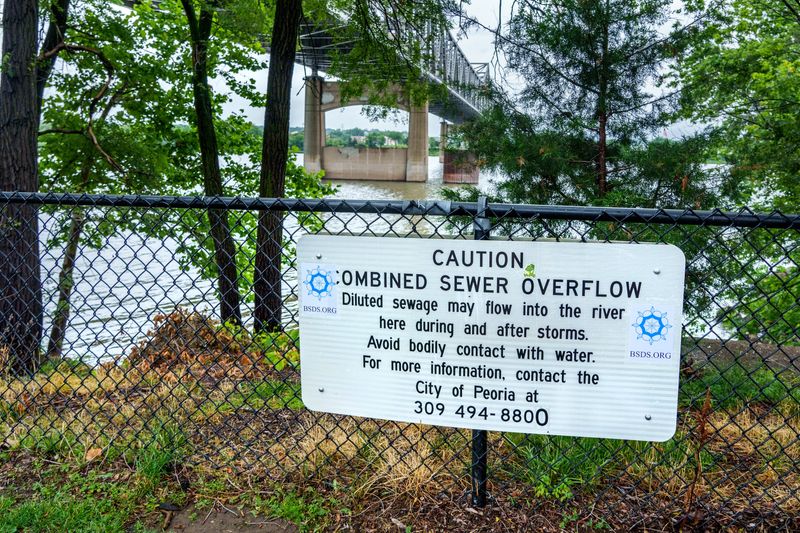
A CSO is a sewer system where stormwater and sanitary wastewater mix together during heavy rain incidents, overwhelming the old infrastructure, causing the water and waste to flow together into the Illinois River. In 2006 the EPA found Peoria to be in violation of the Clean Water Act because of the flow of wastewater into the river.
As the council now knows, however, that $109 million projection — which spanned the 18 years of projects — did not factor in inflation and also was made utilizing the misevaluation of soil throughout the project zones.
Now, in order for the city to meet EPA mandates, a price tag of more than $330 million is projected on a slew of projects the city is legally required to complete.
“We’ve got to do it, we agreed to do it, so I mean, unfortunately, we’re stuck, our kids are stuck,” Riggenbach said Tuesday night. “I think it’s really just an embarrassment to the city to go back now and say, ‘OK, forget all that green talk we did five years ago, we’re going gray after all. I’m just really disappointed.”
Denis Cyr, the city’s 5th District city councilmember, said he was “scared” for what the added costs would mean for future generations of Peorians who would have to foot the bill for the projects.
How the City Council decides to fund the projects will determine what the total final price tag of the projects comes out to, after interest and all other costs are paid on the bonds and loans the city will take out.
The estimated total for the projects, with inflation, is $338 million. If the city takes out a 30-year loan with the Illinois Environmental Protection Agency, the total repayment amount will be roughly $408.9 million. If the city moves forward with 30-year bonding, the repayment amount for the projects would be $666.9 million.
At-large city councilmember John Kelly said at the end of Tuesday night’s meeting that there was no reason to play the “blame game” as to who is at fault for the miscalculations. Kelly said Peorians were now in this problem together and all the city could do now was move forward and solve the issue.
Ali said, in defense of city staff, that they were now working to present the council with the most cost-effective plan possible in light of the revelations that the projects would cost more money. Ali said, “even scientists make some judgments that don’t work out,” in reference to the soil miscalculation, adding that she didn’t know if the city had much a choice in the matter moving forward.
Riggenbach said Tuesday that some blame lies on himself and others who served on the City Council in 2018 for not scrutinizing the original proposal more closely, specifically the fact that the original projection did not factor in inflation.
This article originally appeared on Journal Star: ‘Embarrassment’: Additional $200M needed to fix Peoria sewer overflow issue. Here’s why
Reporting by JJ Bullock, Peoria Journal Star / Journal Star
USA TODAY Network via Reuters Connect