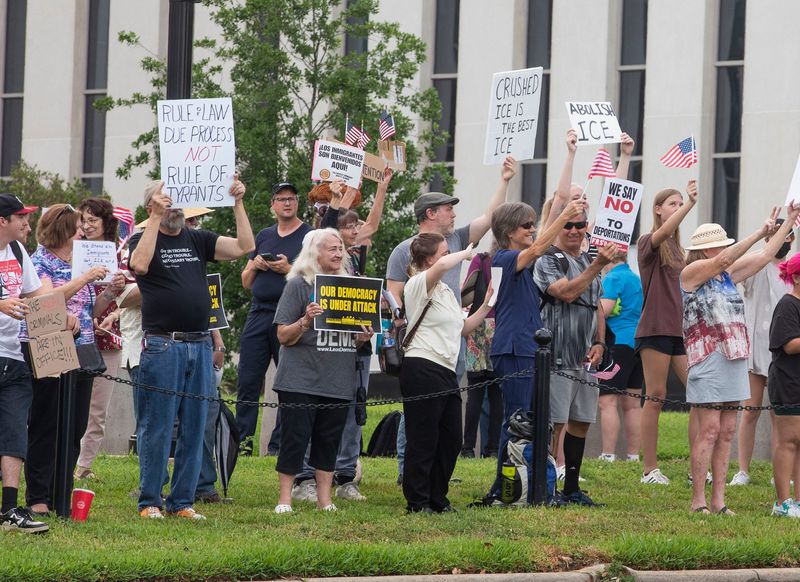
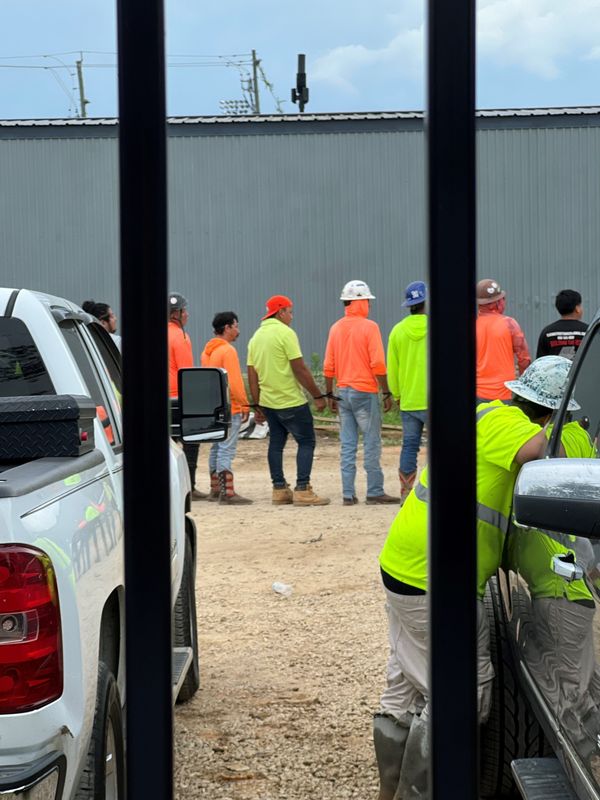
On May 29th, U.S. Immigration and Customs Enforcement (I.C.E.) detained more than 100 undocumented migrants from construction sites in College Town along West Gaines Street. As detention vans transported workers from the raid, crews halted construction, leaving many sites vacant. The aftermath leaves developers anticipating a shortage of construction workers throughout Tallahassee.
While ICE has publicly stated this operation was a success, the city’s rental market will undoubtedly suffer because of the operation.

Housing affordability has been a major concern in Tallahassee. The recent deportation operation threatens to escalate an already struggling housing market. To avoid further escalating the housing crisis, policymakers must adopt sanctuary policies that protect undocumented workers.
Sanctuary policies are systemic protections for undocumented immigrants. The most impactful form of sanctuary policy is abstaining from 287(g) agreements. This provision of the Immigration and Nationality Act requires local cooperation with the Department of Homeland Security to enforce immigration violations. By abstaining, workers who pose no threat to public safety are not transferred to an ICE detention center by local law enforcement.
Housing affordability is already approaching an all-time low. According to the Florida Housing Data Clearinghouse, home median rent prices have increased by 46% since 2019. Further data from the Tallahassee-Leon County Office of Economic Vitality (OEV) reported student housing costs, measured as rent per bed, rose by 36%. Additionally, construction is already starting to decline. Single-family construction permits declined by around 7.7% since 2024, according to the OEV.
As permits decline and housing costs rise, any additional pressure against developers would exacerbate the housing crisis. With the operation targeting residential construction sites, the threat of deportation disincentivizes undocumented migrants from going to work.
This is common sense. Indeed, economists Troup Howard, Mengqi Wang, and Dayin Zhang found that as the deportation of undocumented unskilled laborers increased, domestic unskilled laborers did not fill the resulting vacancies, and skilled domestic labor also decreased. As a result, the general labor shortage reduced homebuilding and drove prices up for new and existing housing.
Employers in California, Georgia, and Arizona have reported that undocumented workers are fearful of showing up to work sites. If the raid produces the same pattern, then the effect of deportation would be similar.
Approximately 34% of the construction workers in Florida are foreign-born, with around half being undocumented, according to the Urban Institute.
While only 100 migrants were detained in College Town, the threat of ICE within the area actively deters at-risk workers from showing up to the 43 ongoing residential construction projects. With a fearful and gutted construction workforce, we can expect many developers to delay housing projects and reduce applications for new construction.
While sanctuary cities still experience federal raids, undocumented workers would have more day-to-day security from local law enforcement. Many construction workers would still be fearful of showing up to worksites; however, abstaining from DHS cooperation ensures housing does not grow costlier.
The city of Tallahassee must prioritize its interests. With housing insecurity growing, assisting ICE would harm the housing market. Protections through sanctuary policies can ensure the housing crisis does not continue to grow.
Nicholas Montano is an economics major at Florida State University and a research intern at the DeVoe L. Moore Center in the College of Social Sciences and Public Policy. The views represented in this column are those of the author, and they do not necessarily represent the views of the College, the DeVoe L. Moore Center, or Florida State University.
JOIN THE CONVERSATION
Send letters to the editor (up to 200 words) or Your Turn columns (about 500 words) to letters@tallahassee.com. Please include your address for verification purposes only, and if you send a Your Turn, also include a photo and 1-2 line bio of yourself. You can also submit anonymous Zing!s at Tallahassee.com/Zing. Submissions are published on a space-available basis. All submissions may be edited for content, clarity and length, and may also be published by any part of the USA TODAY NETWORK.
This article originally appeared on Tallahassee Democrat: ICE raids threaten housing affordability in Tallahassee | Opinion
Reporting by Nicholas Montano / Tallahassee Democrat
USA TODAY Network via Reuters Connect