

By Coralie Lamarque
July 28 (Reuters) – France is grappling with an unprecedented fire season that has led to the evacuation of hundreds of thousands of people and dealt a blow to the economy during the peak tourist season.

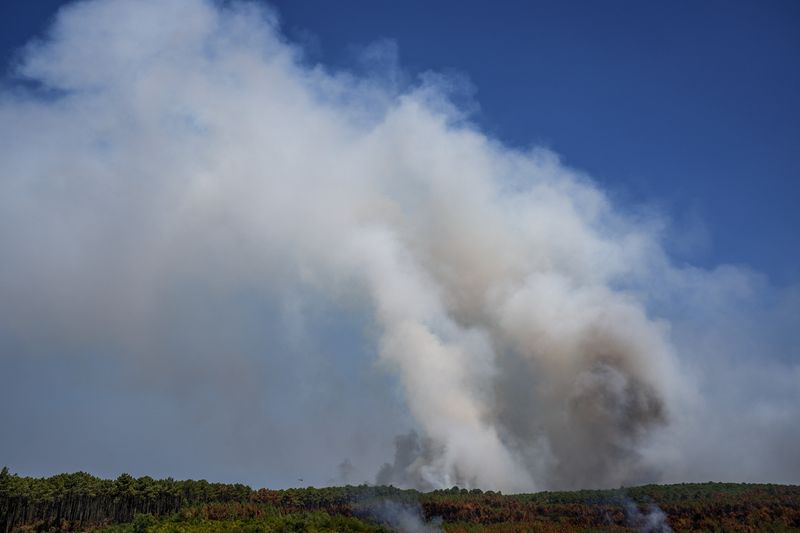
But it’s not just the scale of the fires that is breaking new ground. They are also behaving in ways not seen before in France, including the formation of the country’s first-ever reported pyrocumulonimbus, or “fire-cloud”.
Below is a look at this rare phenomenon:
WHAT IS A ‘FIRE-CLOUD’?
A pyrocumulonimbus is a cloud that forms above a large wildfire when intense heat drives smoke, ash and water vapour high into the atmosphere.
“You can think of it as like a chimney, which is a fire at the bottom and the smoke going straight up a chimney into the stratosphere,” David Bowman, professor of pyrogeography and fire science at the University of Tasmania, told Reuters.
While meteorologists can identify conditions that favour their formation, they cannot predict with precision when or where a fire-cloud will develop, said Jean-Christophe Vincendon, wildfire coordinator for the French national meteorological service.
HOW DO THEY WORSEN WILDFIRES?
Fire-clouds can make wildfires more dangerous and less predictable by generating powerful winds that alter a fire’s direction or producing lightning that ignites new blazes.
When they run out of energy, they can also trigger what’s known as a “plume collapse”.
“When the plume collapses, it’s a showering of debris, burning debris,” said Bowman.
WHAT DOES THIS MEAN FOR EUROPE?
French authorities said on Saturday that a pyrocumulonimbus had been observed near Bordeaux, the first recorded in France.
The phenomenon presents an added challenge for emergency services because the erratic nature of fire outbreaks can force authorities to widen evacuation zones as a precaution, said Marc Vermeulen, head of the Gironde fire and rescue service.
Bowman said Western Europe could now expect to see more of this phenomenon, which tends to occur in more extensive wilderness areas, such as in Canada or Australia.
“This is a very gravely serious milestone,” Bowman said. “It is fascinating, but it is also absolutely disastrous and terrible, and we just don’t want more of these things.”
(Reporting by Coralie Lamarque, Editing by Gabriel Stargardter and Ros Russell)
By Coralie Lamarque | Reuters | © Copyright Thomson Reuters 2026.
