

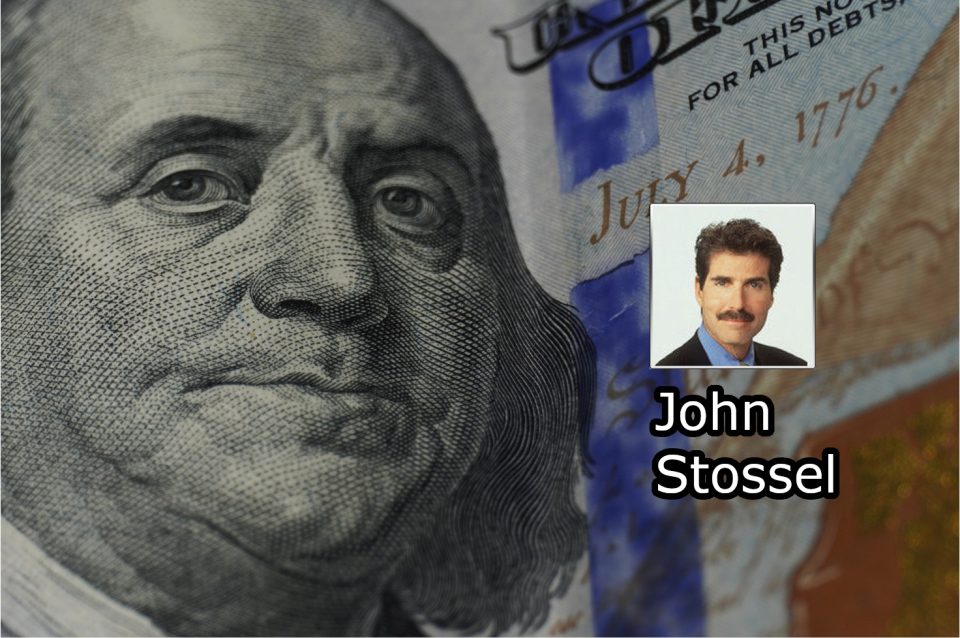
By John Stossel

This summer, the United States celebrates its 250th birthday.
In 1776, few people believed this new version of self-government would last.

After the Constitutional Convention, Benjamin Franklin was asked what kind of government the Founding Fathers had created.
“A republic,” he replied, “if you can keep it.”
If …
It’s rare that a new form of government lasts dozens of years, let alone 250.
How did America do it?
In my new video, people give reasons:
“In the U.S. Constitution, you see a lot of phrases like ‘Congress shall not …’ or ‘No law shall be passed …,'” Rob Henderson, the author of “Troubled” who coined the term “luxury beliefs,” points out. “It’s not about what government will do for you. It’s focused on (how) Congress and the government are not going to interfere in your lives.”
That made America different, says economist Donald Boudreaux: “Compared to most other governments throughout history, ours has been the freest and the most liberal in the sense of tolerating differences in people and accepting economic change.”
Daniel Di Martino, who escaped Venezuela to come here, says: “We’re all immigrants fleeing from something — dictatorships, tyranny, socialism. The descendants of those people were willing to take more risks, and also willing to defend their liberties.”
That made Americans different from Europeans.
“By necessity, Americans were very independent,” says Linnea Lueken of the Heartland Institute. “We went out into untamed wilderness and established towns that didn’t have to lean on a central government to function properly.”
Without nobility controlling property, ordinary people could own land, start a business and keep the profits.
“America is more devoted to property rights than any other country, and that is why America is more free,” argues Ryan McMaken of the Mises Institute.
Property rights and limits on government allowed Americans to try the new things that made America prosperous.
The Founders didn’t want a government that took care of people. They wanted a government that mostly left us alone.
They created “three branches of government designed specifically to check each other,” says author Wilfred Reilly. “Because so many mistakes are made by leaders.”
“Leaders” do make mistakes, constantly.
Yet today, we keep increasing their power. There is that instinct to say, “Problem? Government should fix that. There ought to be a law!”
But the more laws governments pass, the more power politicians have and the less autonomy individuals have. The Washington swamp keeps growing, under both Democrats and Republicans, most of whom ignore the limits our smart Founders put into our Constitution.
It’s good that there are free market think tanks that push back.
I like the Cato Institute’s mission: “Keep the principles, ideas, and moral case for liberty alive.”
Cato President Peter Goettler recently wrote, “The forces of liberalism unleashed in the Founding era ultimately brought the curtain down on slavery and have persistently extended rights, liberty, and the American dream.”
But he also points out today’s threats to that dream: “Towering debt we continue to accrue … masked government agents disappearing people without due process; targeting of political enemies … tariffs fluctuating at the president’s whim … enmeshing of government with private enterprise … foreign adventurism absent congressional involvement or national debate …”
Sigh. All true.
The Constitution says only Congress can declare war, but presidents from both parties now grab power that the Founders never intended for them to have.
Harry Truman intervened in Korea without a formal declaration of war. Likewise, John F. Kennedy expanded U.S. military involvement in Vietnam. Richard Nixon expanded the war into Cambodia. George H.W. Bush ordered the invasion of Panama. Bill Clinton engaged in military operations in Bosnia and Yugoslavia. President Donald Trump launched military actions in Iran. All without congressional approval.
“That’s not what America was about,” says McMaken. “America was focused on rights and protecting them.”
“The first nation in history founded on the inalienable rights of the individual,” adds the Atlas Society’s Jennifer Grossman. “It recognized that man is not a sacrificial animal for the collective, the king or the majority.”
“That alone makes us rich,” agrees Boudreaux. “That alone makes us more likely to survive another 250 years.”
For 10 generations, the American republic has prospered.
Benjamin Franklin’s question is still relevant: Can we keep it?
Every Tuesday at JohnStossel.com, Stossel posts a new video about the battle between government and freedom. He is the author of “Government Gone Wild: Exposing the Truth Behind the Headlines.”
COPYRIGHT 2026 BY JFS PRODUCTIONS INC.
