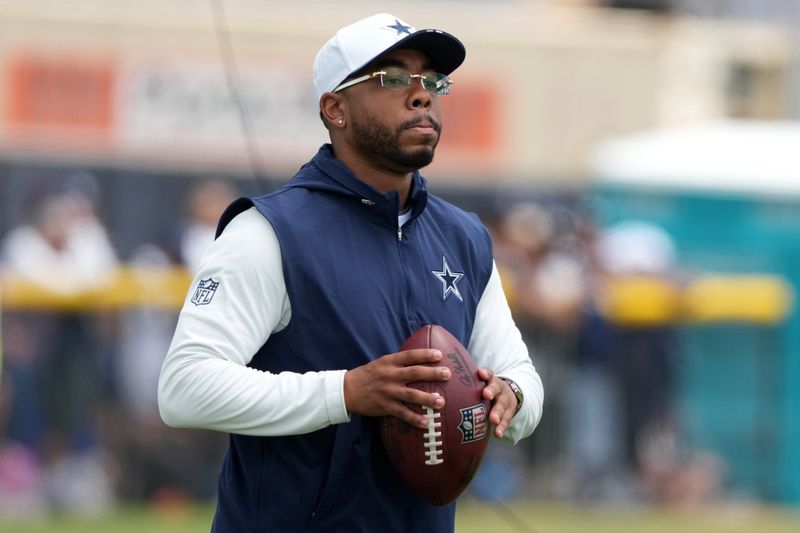
Christian Parker’s fingerprints have been on the Cowboys’ defensive rebuild from the start. Dallas has not positioned its first-year defensive coordinator as the club’s final authority on personnel (this is still the Cowboys after all), but it has clearly made room for his input in shaping the unit.
Will McClay said Parker “has a vision for the guys that we have,” and the coordinator reportedly spent draft week sending McClay photos of Caleb Downs and Malachi Lawrence. Dallas came away with both players in the first round. Cute little coincidence? Please.

That context matters in the ongoing conversation around Von Miller’s arrival.
Parker has consistently presented himself as a detail-driven coordinator who wants to build around the players at his disposal, rather than shove everyone into a rigid, prepackaged system and hope it works out.
Earlier in training camp, Parker said Dallas wanted to be “detailed” in its fundamentals, technique and scheme mastery. He has also described an instructional environment built on repeated communication, situational adjustments and mental reps.
So when considering who Parker is — meticulous, systematic and precise — it is reasonable to see Miller’s arrival as more than a blind swing at a famous name. The available evidence suggests Dallas trusts Parker’s personnel vision. Parker’s own comments suggest he values intentional, role-specific deployment.
That does not guarantee Miller will look like peak-Denver Von Miller. Nobody needs to pretend it does. But it does make a lot more sense than treating this signing like a jersey-sales stunt.
Disguise, matchups and scheme diversity
Parker shared several elements of his vision for the 2026 Cowboys defense at his introductory press conference in February. His hiring naturally led to assumptions that Dallas would lean hard into a 3-4 structure because of his Vic Fangio background. Parker clarified that the actual plan would be more flexible than a single label.
“The first thing is… we’re gonna be multiple,” Parker said, “I think that whenever you form a defensive structure, it’s about the players that you have. So our core principles, we’ll be a 3-4 by nature, but 4-3 spacing will be appropriate, 4-2-5 in nickel, different front structures, coverages behind it. But I will say being multiple is probably the most important thing about it.”
A few minutes later, he added more detail: “You want to build a package that has diversity in scheme…” he explained, “You want to have guys that no matter what scheme they’re in, they can be significant contributors and then you want to just highlight it around their strengths.”
Miller remains the NFL’s active leader in career sacks, but he has done far more than rush the passer across his 15 NFL seasons. Still, his 2025 deployment with Washington suggests Dallas is most likely to use him as a targeted pass-rush weapon rather than ask him to take on the heaviest workload of his prime. That does not mean he can only line up outside and go hunt quarterbacks.
Miller recorded nine sacks in 17 games while playing roughly 37 percent of Washington’s defensive snaps. The most realistic expectation is a specialized role that takes advantage of what he still does best: threaten the edge, stress protection and punish isolated blockers.
Parker’s flexibility is where this becomes interesting.
The simple fact that Miller’s name, résumé and film command respect gives Parker another way to manipulate an offense’s attention. Miller may draw double-teams that create a numbers advantage elsewhere. He may be aligned as the obvious threat while Dallas brings pressure from another location. He may simply force a protection call that gives another rusher a cleaner path to the quarterback.
Miller also has experience working from either side of the formation, which gives Dallas another opportunity to hunt matchups rather than allowing offenses to hide a vulnerable tackle from him.
Then there is the opportunity for split-second pre-snap confusion. Even if Miller is primarily rushing from the edge, placing four or five credible pass-rush threats on the field together can complicate a quarterback’s protection process. The offense has to determine where its slide is going, who might need help from a back or tight end and whether the look is showing the actual rush.
That uncertainty is exactly where Parker’s philosophy comes into play. As he said, “Sometimes affecting the quarterback comes through pressure. Sometimes it comes through disguise. Sometimes it comes through… talent.” Miller can contribute to all three.
Situational roles and changing the math
“How we can change the math and get our best players on the field will always be a part of what we do.”
Another Parker quote from his introductory press conference that now feels a little bit like foreshadowing.
By now, Cowboys fans interested enough to read this far have probably heard the consensus: Miller is unlikely to carry a majority of the snaps. He is 37 years old and has managed a major knee injury in recent seasons, while Dallas also has a deeper edge group to rotate. That is not an indictment. It is common sense. And it may be exactly what makes the signing work.
Miller’s value does not depend on taking snaps from any particular player. The value is in Parker creating fronts with too many credible problems for an offense to comfortably account for.
Put Miller alongside interior disruptors such as Kenny Clark and Quinnen Williams, and offenses cannot simply slide protection outward and live with the consequences inside. In the right matchup, that can leave an offensive tackle isolated against a future Hall of Famer. And if Parker widens Miller’s alignment, it could give him more room to build speed toward the tackle without traffic clogging the rush lane.
The reverse can also work. If an offense uses a tight end or running back to chip Miller, that player is delayed or removed from the route concept, helping the coverage behind the rush. If protection slides toward Miller, a player such as Rashan Gary may get a cleaner one-on-one opportunity.
Dallas can also use movement along the front to create favorable lanes. Stunts and games can force linemen to have to communicate and exchange rushers in a hurry. Miller does not need to be the player crashing inside on every design for that to help him; interior movement can still create an edge lane, an isolated tackle or a late rush path for him to attack.
That is the “change the math” piece. It is not necessarily about asking Miller to be the guy he was a decade ago. It is about creating a situation where the offense cannot comfortably account for everybody.
Attitude, physicality and detail
The most obvious way Miller fits Parker’s defense may be playing style. Earlier this month, Parker described the identity he wants for the unit:
“The first thing is we want to be detailed in our work and our fundamentals and technique and obviously the mastery of the scheme, but there’s an element of of violence and physicality that we want to play with, that we will play with.”
Physicality and technique? Miller has brought those traits to the field throughout his career. Age and accumulated wear do not automatically erase a player’s understanding of leverage, his hand usage, or his ability to recognize how a blocker is setting him.
Miller may no longer win every matchup with the same explosive frequency he had in his prime. That is fine. He does not need to. His value can come through timing, awareness, hand fighting, rush counters and the little changes in leverage, direction and body positioning that veteran pass rushers use to make a blocker uncomfortable.
Think of him as a player who has evolved in how he displays physicality, not one who no longer possesses it.
Parker continued, “It’s tying all those things together in terms of knowing your job, knowing what the man next to you is doing… and then doing that with an attitude and the physicality required to play this game.”
That is a useful framework for evaluating Miller in Dallas. His fit is not just about sacks. It is about whether he can execute a defined assignment, help stress protection, provide reliable technique within the structure and bring the urgency Parker wants from his defense.
The limitations are real. Miller’s age, recent injury history and reduced snap share mean Dallas should not build its entire pass rush around him. But that is not what this signing appears designed to do. The question is whether Parker can get high-value snaps from Miller while the rest of the front handles the larger workload.
The Cowboys did not sign 2015 Von Miller. That’s not who they need him to be. If Parker can consistently put Miller in advantageous situations, Dallas may have added a player who still knows how to turn a small edge into a very big problem.
This article originally appeared on Cowboys Wire: Christian Parker, Von Miller may be match made in limited snap heaven
Reporting by Jazz Monet, Cowboys Wire / Cowboys Wire
USA TODAY Network via Reuters Connect
By Jazz Monet, Cowboys Wire | USA TODAY Network