It is easy in our polarized times for moderate voters to feel a bit homeless politically.
In swing-state Wisconsin, moderates are vastly outnumbered within the Republican Party by voters to their right and vastly outnumbered within the Democratic Party by voters to their left.

In other words, their voice inside the two major parties is limited.
The flip side is that the “independent vote” increasingly consists of self-described political moderates, according to years of Wisconsin polling by the Marquette Law School. In a purple battleground that is often decided by tiny margins, the parties ignore these voters at their peril come November.
Which brings us to the 2026 open-seat race for governor in Wisconsin to succeed Democrat Tony Evers, who is generally viewed in the world of politics as a moderate-leaning liberal or a liberal-leaning moderate.
There’s a very good chance that the next Wisconsin governor will be further from the political “center” than Evers. In fact, this could turn out to be the starkest ideological choice for governor that this state has faced in decades (more on that later).
But no matter how conservative the Republican candidate is or how liberal the Democratic candidate is, the winner will need support from moderate and independent voters. That’s just election math.
This is a look at what the polling tells us about the role of moderate voters in the state’s biggest election this year.Self-described moderates make up about a third of the state’s registered voters, a figure that hasn’t changed much in the 15 years that Marquette has polled in Wisconsin.
Their clout is smaller within the two parties, of course, because that’s where the most ideological voters can be found.
Moderates make up 18% of Republican voters in the state and 26% of Democratic voters, based on the last two years of polling by Marquette. The “moderate” share of Republicans has been stable in the Trump era, while the “moderate” share of Democrats has been dropping.
But quite the opposite is the case with the independent vote, where moderates loom much larger.
Marquette’s polling gives us two windows into the makeup of independent voters in Wisconsin.
One is to look at independents broadly defined, a group that includes people who identify as independents but acknowledge that they lean toward one party or the other. This group is roughly a third of registered voters in the state. Moderates have made up a rising share of these voters in recent years – more than 50%.
The other is to look at independents narrowly defined. These are the “pure indies” who don’t lean toward either party. They make up only 13% of registered voters in the state. It’s a much smaller group but a better cross-section of true swing voters.
This is the segment of the electorate where moderate voters are the most prevalent.Back in 2012, the first year of the Marquette poll, moderate voters made up about 45% of these “pure” independents.
That rose to around 50% by 2020.
And it has climbed to just under 70% in the past three years.
It makes perfect sense that the least partisan voters also identify as the most moderate and least ideological voters.
But the polling doesn’t really tell us why “pure indies” are much more moderate in their makeup than they used to be in Wisconsin.
It could be that some moderates have shifted from identifying as Democrats to identifying as independents. It also could be that some conservatives have migrated from “independent” to “Republican.”
This sort of ideological sorting by party would certainly increase the moderate share of the independent vote. It also might help explain why the edge in party ID in Wisconsin has shifted a little from Democrats to Republicans over the past decade or so, according to the polling.
Moderates face voting dilemma in states like Wisconsin
Whatever the explanation, one result is that moderate voters can face a dilemma in competitive states such as Wisconsin. They are potential kingmakers in November, but their choices are dictated by two parties over which their influence is modest or declining.
And when I say potential kingmakers, there’s a caveat. We are not talking about a big slice of the November electorate. Those “pure” independents who skew so moderate politically are less engaged in politics and less likely to vote than more partisan voters.
“They punch below their weight when it comes to turnout. That means their influence in practice is less than what their influence in principle would be,” says Marquette pollster Charles Franklin. “They’re still the important vote that is as up for grabs as anything in the state. But it’s much more a game of inches than a game of yards.”
And when you look at people who check both boxes for being “swingy” – meaning they are “pure” indies who also identify as moderates – then you’re down to an even thinner slice of the Wisconsin electorate: 8% of registered voters in Marquette’s polling.
It’s too early to know which party’s nominee for governor will have more appeal this November to this small segment of mostly moderate swing voters. We don’t even know who the Democratic nominee will be. And these voters aren’t easy to generalize about, because they’re not monolithic, they’re less “political,” and they’re hard to poll on because of their relatively small numbers.
One thing you can say – and it’s no shock – is that moderate independents are very negative toward both parties.In polling since last fall, only 27% of these voters have a positive view of the Democratic Party. Only 25% have a positive view of the Republican Party.
Given the political climate in this midterm, Republicans probably face a bigger challenge with these voters than Democrats. Only 19% of moderate independents have a positive view of the MAGA movement, based on Marquette’s last three surveys combined. Only 26% approve of the job President Donald Trump is doing. That number has been declining. By contrast, a little over 50% approve of Evers, the Democratic governor.
But in the governor’s race, a lot may depend on the candidates themselves and their ability to appeal to unaligned voters.
Tom Tiffany rates as most conservative Wisconsin House member
We already know the GOP nominee: U.S. Rep. Tom Tiffany, who represents most of the state’s northern half in the U.S. House of Representatives.
According to a rating system widely used by political scientists, Tiffany is the most conservative of the state’s eight U.S. House members.
In fact, by this same system, he is the one of the most conservative House members in Wisconsin’s modern history (surpassed only by Republican Mark Neumann, who served from 1995 to 1999).
Can Tiffany compete for these voters as a candidate of the right in a year when his party is facing big headwinds?
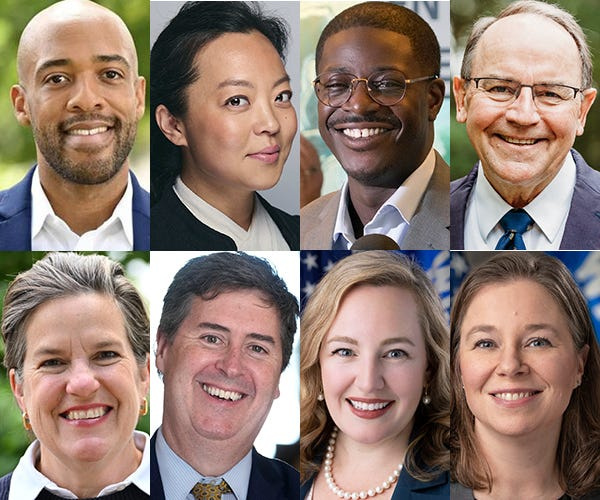
On the Democratic side, the nominee won’t be decided until August, and we don’t know what kind of Democrat will emerge from the state’s open primary.
The field includes some candidates from the party’s more moderate wing, but the two leaders in the public polling have been liberal former Lt. Gov. Mandela Barnes and state lawmaker Francesca Hong, a democratic socialist. It’s fair to say both are to the left of Evers, the outgoing governor.
A Tiffany-Barnes or Tiffany-Hong matchup would arguably be the starkest political contrast in a Wisconsin governor’s race in many decades (even when you consider how polarized the elections of 2012, 2014 and 2018 were over Republican Gov. Scott Walker).
Which side can capture a small slice of true independents won’t be the only factor that decides the governor’s race this fall. The other keys include which party’s voters are more unified behind their candidate and which party’s voters turn out in greater numbers.
But the unaligned vote matters more in Wisconsin than it does in most other states. That’s because the parties are so evenly matched, and because this state has had such an unusual run of close races. The last three contests for president, the last two contests for U.S. Senate, and one of the last two contests for governor have all been decided by one point or less.
One thing about a state as competitive as Wisconsin is that no matter how small the swing vote is these days, it can still decide elections.
This article originally appeared on Milwaukee Journal Sentinel: Will moderate voters find a home in Wisconsin’s governor’s race?
Reporting by Craig Gilbert, Special to the Journal Sentinel / Milwaukee Journal Sentinel
USA TODAY Network via Reuters Connect
By Craig Gilbert, Special to the Journal Sentinel | USA TODAY Network