Priyatha Premnath is handing out mouse bones to high school students.
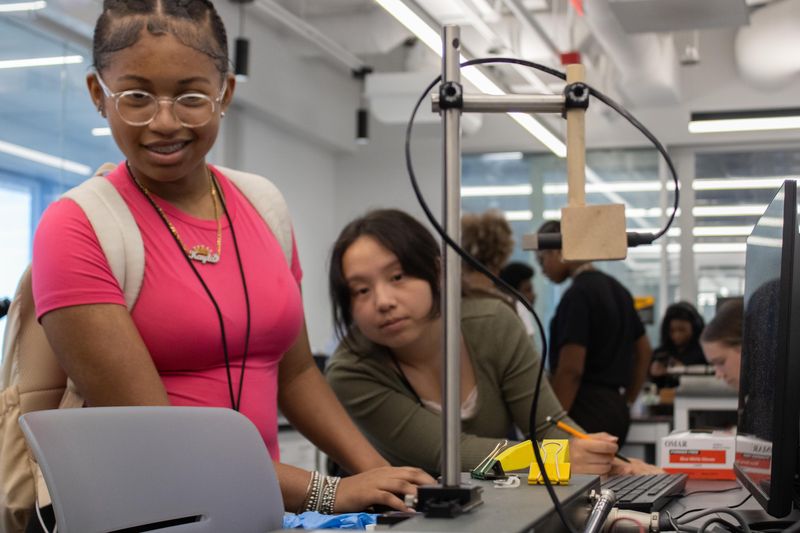
Excited chatter fills the lab as students pull on bright blue gloves and hold out one hand.

The students and Premnath, associate professor of biomedical engineering at University of Wisconsin-Milwaukee, have taken over a space on the ninth floor of UWM’s Engineering and Mathematical Sciences building.
30 minutes after bone distribution, groups of students debate whether the bones will break under tension as they place them in a tensile testing machine.
This type of hands-on experience is typical of EnQuest, a weeklong engineering camp held every summer at UWM. It’s primarily aimed at inspiring high school girls to pursue STEM careers, although it’s open to all.
EnQuest has two camps – a day camp for eighth through 11th graders and an overnight camp for ninth through 12th graders. Both prioritize exposing campers to a variety of engineering skills and projects, and connecting them to working professionals.
Chris Beimborn, manager of STEM outreach at UWM ‘s College of Engineering and Applied Science, has coordinated both camps for 15 years. Applications for next summer’s camps likely will open in March.
The idea came from a former doctoral student, Marissa Jablonksi, who was working with mechanical engineering professor John Reisel on a federal grant initiative to increase student recruitment and retention. Jablonski reached out to Beimborn, who was working with local schools on outside enrichment activities to broaden student understanding of STEM. The two ended up developing the program together.
“My primary goal is to impact their perception of engineering and their motivation to give it a chance,” said Beimborn. “A lot of students and a lot of people in our whole society have a very narrow – and not so accurate – view of the work of engineers.”
She wants high school girls to understand that engineering is about applying imagination and creativity to real world problems.
EnQuest prioritizes project-based learning.
Throughout each camp, students work on a group project centered on one engineering field with a tangible purpose that high school kids see as valuable.
The day camp always works on a project for an off-grid community in Guatemala that’s in partnership UWM’s student chapter of Engineers Without Borders. This year they helped customize a solar power station.
The overnight camp project usually has a biomedical engineering focus, led this year by Premnath and Masah Dabagh, also an associate professor of biomedical engineering at UWM. The two professors are office neighbors and collaborators. The campers’ project this year focuses on bone healing, and draws from their joint research projects combining Premnath’s bone expertise with Dabagh’s computational modeling skills.
Dabagh, who has worked with EnQuest since 2022, noted that women’s participation in STEM careers is still not high. She hopes this kind of endeavor can show young girls what they can achieve in biomedical science and the beauty of the field’s multidisciplinary nature.
Overnight campers discover real world impact
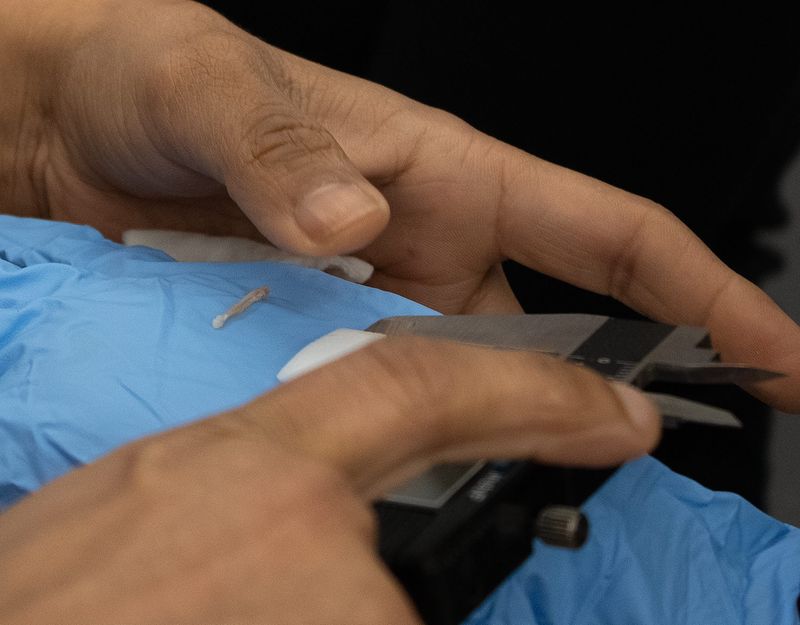
For the bone project, overnight campers first learned the anatomy and function of mice bones. Then, on day three, they received real mouse bones and two small rectangular polymers. Polymers are a type of material often used in biomedical engineering to interact with different parts of the human body.
They measured the dimensions of the materials and used a tensile testing machine to measure how much pulling force, or tension, the bones and polymers could withstand. Then they used their dimensions and tension measurements to calculate how much each material can stretch.
The next day, Dabagh helped the campers use a computer software called 3D Slicer to virtually segment the bone into different parts and turn the 2-D images of mice bones into a 3-D model. In Dabagh’s lab, these models are typically used to run simulations of how different forms of stress and strain impact bone healing.
When a person’s bone fractures, Premnath said, doctors may need polymers, like collagen, for a bone graft or to deliver different drugs to the bone to promote healing. The materials used in these procedures need to have similar properties to the original bone, which can determined by the type of testing and computer modeling done by the campers.
“This is such a great way of showing students even before they join engineering that this is the real world impact that you can have,” said Premnath. “You can improve somebody’s health, you can improve the way somebody ages or the way somebody heals, through biomedical engineering.”
Throughout the week, students also completed smaller projects and activities to expose them to different types of engineering. They used a scanning electron microscope from Discovery World to look at different baking ingredients, for example, and later used the ingredients in a competition to invent new recipes.
On the last day of camp, students presented a recap of the week to their families and camp counselors. They recounted learning how environmental engineers design spaces to prevent floods on a storm weather walking tour, manipulating liquid metal to make keychains at the Foundry, and making codes for security lockboxes.
Separate from engineering, they also praised the food options on UWM’s campus.
Collaboration nature is by design
Jacqueline Barlas, a rising junior studying biomedical engineering and chemistry at UWM, has a longstanding relationship with EnQuest. She was inspired by her sister, an EnQuest alum, to attend the program three years ago as a student, and has returned as a counselor each year since.
“The camp is so important because it teaches collaboration with people that you don’t really know,” said Barlas. “That will be a big part of college and that will be a big part of when you go out into industry.”
The collaborative nature is by design. Beimborn said research studies on motivating students in STEM found working with others is beneficial. As a result, EnQuest fosters relationships between the campers and the program that often last beyond the summer.
Earlier in the summer, Beimborn went to a wedding where the bride and maid of honor had met at EnQuest. She always hopes that the camps give students an encouraging support network.
“An academically motivated kid might have some tough days with their peers in their school,” said Beimborn. “When they form this group of friends that share their interests and attend different schools I feel it takes the edge off those bad days.”
Donnisa Edmonds is a 2026 Mass Media Fellow at the Journal Sentinel through the American Association for the Advancement of Science. She can be contacted at dedmonds@usatodayco.com.
This article originally appeared on Milwaukee Journal Sentinel: UWM camps show high school girls how to use their creativity in STEM
Reporting by Donnisa Edmonds, Milwaukee Journal Sentinel / Milwaukee Journal Sentinel
USA TODAY Network via Reuters Connect
By Donnisa Edmonds, Milwaukee Journal Sentinel | USA TODAY Network